


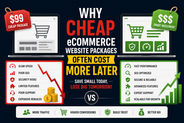
Many businesses looking to launch an online store focus heavily on one thing first—price. At first glance, choosing the cheapest option seems like the smartest decision. A low upfront investment feels safer, especially for startups and small businesses trying to control expenses.
But in eCommerce, cheap solutions often create expensive problems later.
Many low-cost website packages promise quick delivery, attractive designs, and “everything included.” However, what they usually hide are limitations in performance, SEO, scalability, security, and long-term maintenance.
If you’re comparing different eCommerce website packages, understanding the true cost behind cheap pricing can help you avoid costly mistakes.
In this guide, we’ll explain why cheap eCommerce website packages often cost more later—and how to make the right investment from the start.
Cheap eCommerce packages are low-cost solutions designed to help businesses launch quickly with minimal upfront investment.
These often include:
While these packages may look attractive initially, they often prioritize speed and affordability over performance and long-term growth.
That’s where the hidden costs begin.
Website speed directly impacts user experience and conversions.
Cheap packages often use:
According to Google Search Central, page experience and Core Web Vitals play a major role in both rankings and user satisfaction.
If your store loads slowly:
A package that saves money upfront may quietly cost thousands in lost sales later.
Many cheap eCommerce packages include only basic SEO settings.
This creates major limitations such as:
Without strong SEO foundations, your business becomes overly dependent on paid ads.
That means you keep paying for traffic instead of building sustainable organic growth.
Professional packages are built with long-term SEO performance in mind—not just launch speed.
Security is one of the most overlooked risks in low-cost packages.
Cheap providers may compromise on:
According to OWASP, weak security practices remain one of the biggest risks for web applications.
A single security breach can lead to:
Saving a few hundred dollars early can become a major financial problem later.
Many businesses outgrow cheap packages quickly.
What works for 50 products may fail for 5,000.
Common scaling issues include:
When growth happens, businesses often realize the original website must be rebuilt from scratch.
That means paying twice.
A better package should support both present needs and future growth.
Cheap pricing often excludes important services.
You may later pay extra for:
The “cheap package” becomes expensive because the real requirements were never included.
What looked affordable at first becomes a long-term budget drain.
Design is not just about appearance—it affects revenue.
Cheap packages often rely on generic templates with poor UX decisions, like:
According to Nielsen Norman Group, poor usability directly impacts customer trust and purchase decisions.
A beautiful-looking website that converts poorly is still a bad investment.
Many low-cost providers offer limited post-launch support.
This creates problems when:
Without expert support, even small issues can become major business disruptions.
Professional packages include strategic support—not just basic setup.
That support protects revenue.
The goal should never be the cheapest package.
The goal should be the best long-term ROI.
A smart eCommerce investment focuses on:
The right package should help your business grow—not create future repair bills.
Before buying, ask:
If the answers are unclear, the package is probably too cheap for the wrong reasons.
Cheap eCommerce website packages are attractive because they reduce upfront cost.
But the real cost appears later through:
In most cases, businesses don’t save money—they simply delay spending it.
And usually, they end up paying more.
The smartest decision is not buying the cheapest package.
It’s choosing the one that protects growth.
Your eCommerce website is not just a design project—it’s your revenue engine.
Choosing the wrong foundation can create years of unnecessary costs.
If you’re evaluating professional eCommerce website packages, focus on business value, not just pricing.
Because in eCommerce, cheap rarely stays cheap for long.
Not always, but many cheap packages lack advanced SEO features like schema markup, technical optimization, and strong site architecture, which can limit long-term organic growth.
Most cheap packages fail when businesses need better performance, advanced integrations, stronger SEO, or scalability. Instead of upgrading, many companies end up rebuilding the entire site.
Yes, for businesses focused on growth, custom packages often provide better ROI through stronger SEO, better conversions, scalability, and fewer rebuild costs over time.
Common hidden costs include speed optimization, plugin fixes, SEO improvements, security upgrades, mobile optimization, integrations, and ongoing technical support.
If the package lacks clarity around SEO, scalability, support, security, and integrations, it may create expensive problems later—even if the initial price looks attractive.

© 2025 Crivva - Hosted by Airy Hosting Managed Website Hosting.