


You built the store. You set up the products. You hit publish and then realize that running an online store is a full-time job without a manual.
Sound familiar? You’re not alone. Most entrepreneurs start in ecommerce thinking the hardest part is getting the store live. Then reality hits: inventory runs out, orders pile up, product listings grow stale, customer emails go unanswered, and analytics dashboards collect dust. This is where ecommerce management comes in.
This guide explains what ecommerce management really means, what day-to-day tasks it includes, and why doing it well can change a store from just surviving to thriving.
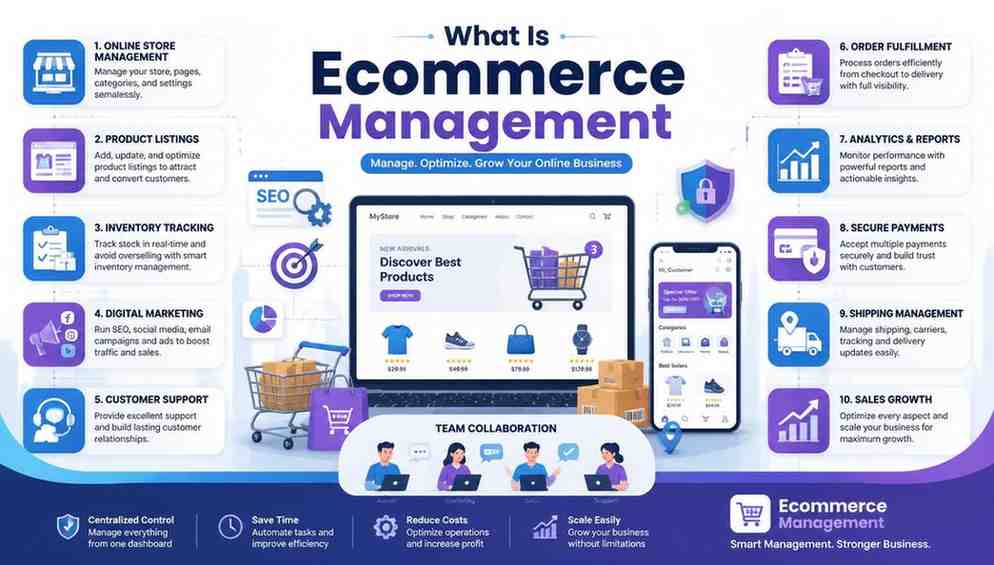
Ecommerce management is the ongoing process of running, improving, and growing an online store. It includes everything from how products are listed and priced to how orders are fulfilled, customers are supported, and performance is tracked.
It’s not a one-time task. It involves the daily and weekly work that keeps your store running well, competitive, and profitable.
Think of it this way: building an ecommerce store is like opening a retail shop. Ecommerce management is everything that happens after you flip the “Open” sign: restocking shelves, training staff, running promotions, reviewing sales, and making sure customers leave satisfied.
Whether you’re using Shopify, Amazon, WooCommerce, or a multi-channel setup, the main challenges are the same: time, consistency, and managing many tasks at once.
Breaking it down, ecommerce management services involve six key areas. Each area affects the others. If you neglect one, the consequences will show up in your revenue, reviews, or both.
Here’s the honest truth: many online stores fail not because the product is poor, but because their operations break down. Bad inventory management leads to stockouts. Slow fulfillment results in negative reviews. Unclear product pages cause abandoned carts. Each of these issues has a direct cost.
Good ecommerce management creates a positive ripple effect. When your listings are optimized, traffic converts better. When orders ship on time, customers return. When you analyze your data, you stop guessing and start making smarter budget decisions.
A few real-world patterns you’ll recognize if you’ve been in the game for a while:
None of these issues is fatal by itself, but they build up. When they all happen at once, especially during scaling, they can halt growth completely.
Store owners often struggle with this question: when should I stop doing everything myself?
The truthful answer is sooner than you think. Ecommerce management services become valuable when the operational workload distracts you from tasks only you can handle, like product development, brand building, and strategic partnerships.
Most businesses hit this turning point between $10K and $50K in monthly revenue, when managing day-to-day operations becomes a full-time job. That’s when hiring specialists, whether a dedicated team, an agency, or a managed service, starts to pay off in saved time and avoided errors.
What do ecommerce management services usually cover? Depending on the provider and your needs, they can manage everything from catalog management and SEO optimization to order processing, handling returns, platform migration, and performance reporting. Some specialize in specific channels, like Amazon or Shopify. Others provide full management across your complete tech stack.
The right fit depends more on where your biggest operational gaps are than on your business size.
This point confuses many people, so let’s clarify. Ecommerce marketing is about bringing people to your store. Ecommerce management ensures the store is ready when they arrive and that the experience keeps them returning.
Marketing without management is like running ads for a broken store. You pay to attract people to a frustrating experience. On the other hand, excellent operations without marketing mean a well-run store no one knows about. You need both; they serve different purposes.
If you’re unsure where to start, consider these questions:
Pricing errors, out-of-stock items still listed as available, and missing product details quietly kill conversion daily.
In a world where Amazon has trained customers to expect two-day delivery, slow shipping is a competitive disadvantage, even if the product is great.
Revenue looks good, but margins are what keep the business afloat. If you can’t quickly calculate profit after costs, shipping, platform fees, and ad spend, that’s a management issue.
A clear and easy return process reduces friction and boosts purchase confidence. Buyers are more likely to click “add to cart” when they know returns are straightforward.
At least once a week, and monthly at a minimum. Growing stores have someone paying attention to what the numbers say.
Ecommerce management isn’t exciting. It lacks the appeal of a viral product launch or a standout ad campaign. But it forms the base for everything else. When your operations are solid, your marketing money stretches further, customers trust you more, and scaling feels much less stressful.
Whether you’re currently managing everything yourself or starting to explore professional ecommerce management services for your business, the first step is the same: identify the gaps. From there, every improvement you make builds over time, which is how sustainable ecommerce businesses grow.
An ecommerce manager oversees the daily operations of an online store, including product catalog upkeep, order fulfillment coordination, customer experience, platform performance, and marketing execution. In smaller businesses, one person may handle all these tasks. In larger operations, it is often a team with specialized roles for each area.
It covers inventory tracking, creating and optimizing product listings, order processing and fulfillment, customer service, returns management, pricing strategy, analytics monitoring, and overseeing marketing campaigns. The scope varies based on the store’s size and sales channels.
Costs widely vary depending on the work scope and the provider. Freelance support may cost $500 to $2,000 per month for part-time help. Full-service agency ecommerce management can range from $2,500 to over $10,000 per month for comprehensive support. Many businesses find it a cost-effective solution when they compare it against the time and revenue lost due to poor operations.
Digital marketing focuses on attracting traffic and customers through channels like paid ads, SEO, social media, and email. Ecommerce management centers on the store operations that turn that traffic into sales and encourage return visits. Both are essential, but they serve different roles in a successful online business.
Absolutely. Small businesses often see the most benefit because operational inefficiencies have a bigger impact on margins. Even part-time support with inventory, listings, and customer service can provide the owner more time to focus on growth. The key is to identify which tasks consume the most time and cause the most mistakes, then seek help there first.

© 2025 Crivva - Hosted by Airy Hosting Managed Website Hosting.