


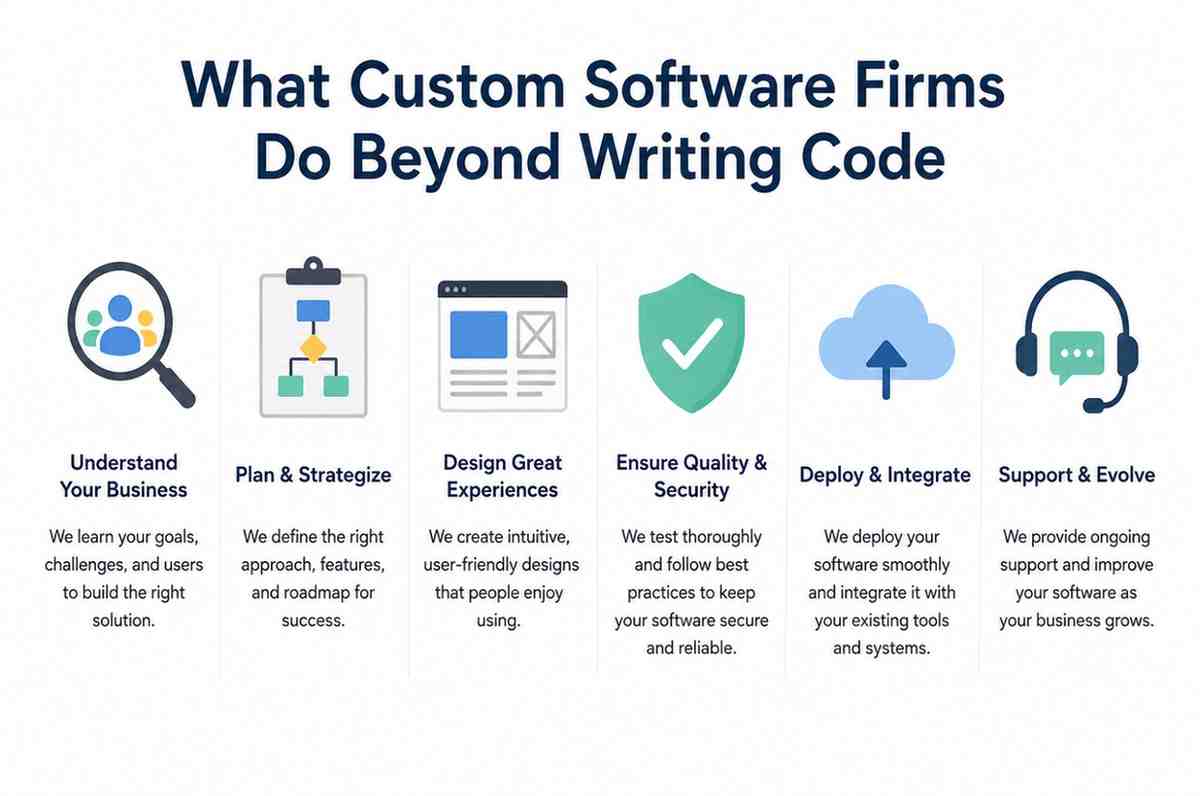
Most businesses assume a custom software application development company simply builds features and hands over a finished product, but that assumption misses the real value of what these companies actually do. The scope covers business analysis, user experience design, systems integration, quality assurance, and ongoing support — each phase directly shaping the outcome. Once you understand what happens beyond the code, choosing the right development partner becomes a far more informed and confident decision.
Many businesses enter the process expecting a team to take a feature list and immediately start building, but the real work begins long before a single line of code is ever written. Development teams invest significant time upfront understanding your business model, existing systems, and the specific problem that brought you to them in the first place.
Every decision the team makes connects back to a measurable business reason, and that discipline is what separates a strategic partner from a simple code vendor.
A custom software application development company delivers a layered set of services that extend well beyond writing and testing code, and understanding this full scope helps businesses set accurate timelines, budgets, and project expectations from day one. These services collectively determine whether the final product performs as a strategic business tool or simply as functional software that solves a narrow technical problem.
Each of these services functions as part of a connected delivery process, and removing any single layer consistently reduces the quality and longevity of the final product.
Before committing to any technology investment, most businesses need a clear side-by-side view of what each option actually delivers, because the right choice depends entirely on how complex and specific your requirements are. The comparison below reflects the most common points where these two approaches diverge in real business environments.
|
Factor |
Custom Software |
Off-the-Shelf Software |
|
Fit to business needs |
Built exactly around your workflows |
Designed for a broad, general audience |
|
Scalability |
Scales in line with your business growth |
Often hits functional ceilings as usage grows |
|
System integration |
Connects natively with your existing stack |
Requires workarounds or costly middleware |
|
Long-term cost |
Higher upfront, lower over time |
Low entry cost, higher customization fees later |
|
IP ownership |
You own the codebase and all its logic |
Vendor controls updates, pricing, and access |
|
Support quality |
A dedicated team knows your system deeply |
Generic support shared across thousands of clients |
Businesses with complex workflows, growing teams, or strict compliance requirements almost always see a stronger return from purpose-built software over a three-to-five-year period.
Building custom software development solutions starts with a clearly defined problem statement rather than a pre-loaded feature list, and that starting point fundamentally changes the quality and relevance of what eventually gets delivered. Development teams spend considerable time investigating the root cause of your operational bottleneck before recommending any technical approach or platform architecture.
A custom software application development company using this approach delivers a product shaped by real feedback rather than assumptions formed in the first week of planning.
The demand for a custom software development company in USA has grown steadily because American businesses face compliance obligations, operational complexity, and user expectations that generic software platforms were never designed to handle at scale. Partnering with a domestic team also eliminates timezone delays, reduces communication gaps, and improves accountability at every stage of the project lifecycle.
When compliance, communication reliability, and industry knowledge all carry equal weight, a domestic development partner reliably produces better outcomes across the project.
Many businesses delay their decision to hire a custom software application development company because the day-to-day process feels unclear, and that uncertainty often pushes them back toward generic tools that never fully address their actual operational needs. In practice, the engagement follows a well-defined structure that keeps every stakeholder aligned from the first conversation through the final delivery and beyond.
Understanding this structure before signing any agreement makes the entire engagement far less uncertain and significantly more productive for everyone involved.
Choosing a custom software application development company is ultimately a decision about how your business will operate, compete, and scale over the next several years and not simply a one-time technology purchase. Businesses that approach this engagement with clearly defined goals, assigned internal ownership, and active participation throughout the project consistently deliver better products and see returns on their investment far sooner. If your current tools are creating friction, forcing manual workarounds, or leaving visible gaps in your daily operations, a purpose-built solution designed around your exact workflows deserves a serious and honest evaluation before you renew another off-the-shelf contract.

© 2025 Crivva - Hosted by Airy Hosting Managed Website Hosting.








