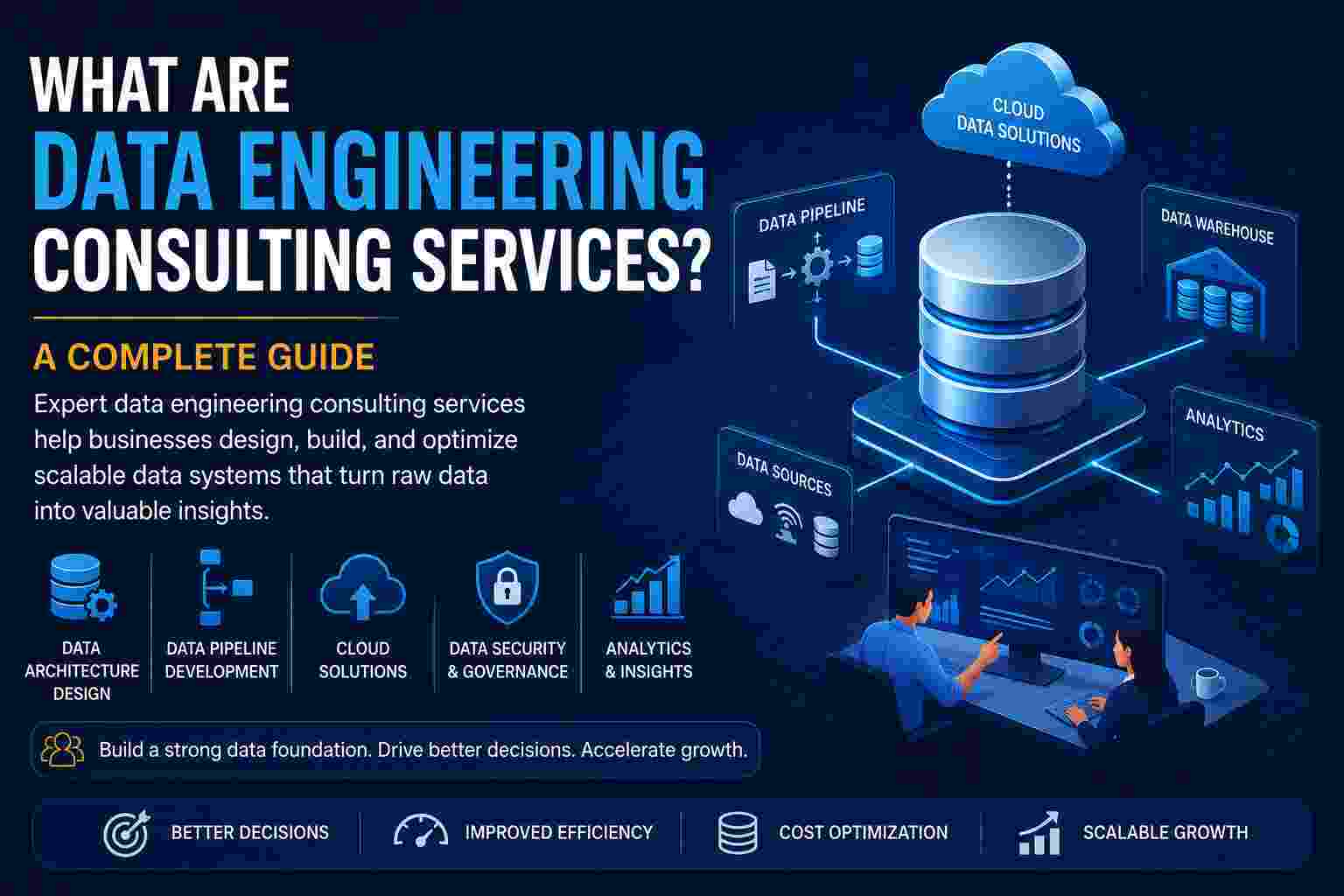
In today’s digital landscape, data has become one of the most valuable assets for businesses. From customer interactions to operational metrics, organizations generate vast amounts of information every day. However, raw data alone is not enough — it must be structured, processed, and analyzed to deliver meaningful insights. This is where data engineering consulting services come into play.
These services help businesses build strong data foundations by designing efficient systems, pipelines, and architectures that transform raw data into usable formats. In this guide, we’ll explore what data engineering consulting services are, why they matter, and how they support modern enterprises.
Data engineering consulting services involve expert guidance and technical implementation to create and manage data infrastructure. Data engineers focus on collecting, organizing, and preparing data so that it can be easily accessed and analyzed by teams such as data analysts and data scientists.
Unlike other data roles, data engineers work on the backend, ensuring that systems are reliable, scalable, and capable of handling large volumes of data. Their goal is to make data accessible, accurate, and ready for decision-making.
Data engineering consultants also help organizations modernize outdated systems and adopt advanced technologies that improve operational efficiency. By creating automated workflows and centralized data environments, businesses can reduce manual effort and increase productivity.
Organizations across industries rely on data engineering services to stay competitive and efficient. Here are some key reasons why these services are essential:
With the rapid increase in digital platforms, businesses handle data from multiple sources such as websites, mobile apps, cloud systems, IoT devices, and social media platforms. Managing this growing data ecosystem can become challenging without proper infrastructure. Data engineering helps businesses organize, store, and process this information efficiently.
Inaccurate or incomplete data can lead to poor business decisions and operational inefficiencies. Data engineers implement processes to clean, validate, and standardize data, ensuring that organizations work with reliable information.
Modern businesses require quick access to data insights for better decision-making. Data engineering services create optimized pipelines that process information in real time or near real time, reducing delays and improving responsiveness.
Protecting sensitive customer and business information is critical in today’s cybersecurity landscape. Data engineering consultants implement encryption, access controls, and compliance frameworks to secure data environments.
Artificial intelligence, machine learning, and predictive analytics depend on well-structured data. Data engineering services provide the clean and organized datasets needed to support advanced analytical applications.
Centralized data systems allow teams from different departments to access consistent information. This improves collaboration between operations, marketing, finance, and management teams, leading to better business outcomes.
Professional data engineering consulting services include several core elements that help organizations build a robust data ecosystem.
Consultants design scalable data architectures such as data warehouses, data lakes, and hybrid systems. These architectures support efficient storage, processing, and retrieval of data.
A well-designed architecture ensures that businesses can handle growing workloads while maintaining performance and reliability.
Data pipelines automate the movement of data from various sources into storage and analytics systems. These pipelines ensure continuous data flow and reduce manual processing efforts.
Automated pipelines also help organizations maintain up-to-date information for reporting and analytics.
Businesses often use multiple applications and platforms, resulting in fragmented data environments. Data integration combines data from different systems into a unified structure, improving consistency and accessibility.
This allows organizations to gain a complete view of their operations and customers.
Extract, Transform, Load (ETL) and Extract, Load, Transform (ELT) processes prepare data for analysis and reporting.
These processes involve:
Efficient ETL and ELT workflows improve data accuracy and reporting capabilities.
Cloud computing has transformed how businesses manage data. Data engineering consultants help organizations migrate to cloud platforms and optimize cloud-based data systems.
Cloud data engineering provides:
Popular cloud platforms include AWS, Microsoft Azure, and Google Cloud.
Maintaining control over business data is essential for security and compliance. Data governance ensures that data is managed responsibly and follows industry regulations.
Consultants establish:
This helps businesses maintain trust and avoid regulatory penalties.
Efficient data systems are critical for smooth business operations. Data engineering experts optimize database performance, query execution, storage usage, and workflows to improve system efficiency.
Performance optimization ensures faster processing and reduced operational costs.
Investing in data engineering consulting services provides businesses with several long-term advantages.
Businesses often face several data-related challenges that professional consultants help solve.
Choosing the right provider for data engineering services is crucial for long-term success.
The field of data engineering continues to evolve with emerging technologies and innovative approaches.
In an era when data drives business success, investing in data engineering consulting services is essential to building a strong, scalable data foundation. These services enable organizations to manage complex data environments, improve data quality, and unlock valuable insights.
By leveraging professional data engineering services, businesses can enhance efficiency, reduce costs, and gain a competitive edge. From cloud migration and pipeline development to advanced analytics and AI readiness, data engineering plays a vital role in modern digital transformation strategies.
Partnering with an experienced provider such as GeoPITS ensures that your data infrastructure is reliable, secure, and future-ready, helping your organization maximize the true potential of its data.

© 2025 Crivva - Hosted by Airy Hosting Managed Website Hosting.