The development of leadership has always been one of the most complicated issues of organizations. Classroom lectures, case studies, role-playing exercises and other traditional training methods have been in use over the decades. They all have in common the fact that they are simulations of reality, with no one ever putting a leader into reality. The difference between knowing and doing has baffled HR professionals, L&D teams, and executives.
VR leadership training is changing that equation. Virtual reality fills the gap between idea and experience, and makes leadership development faster, deeper, and more quantifiably effective.
What Is VR Leadership Training?
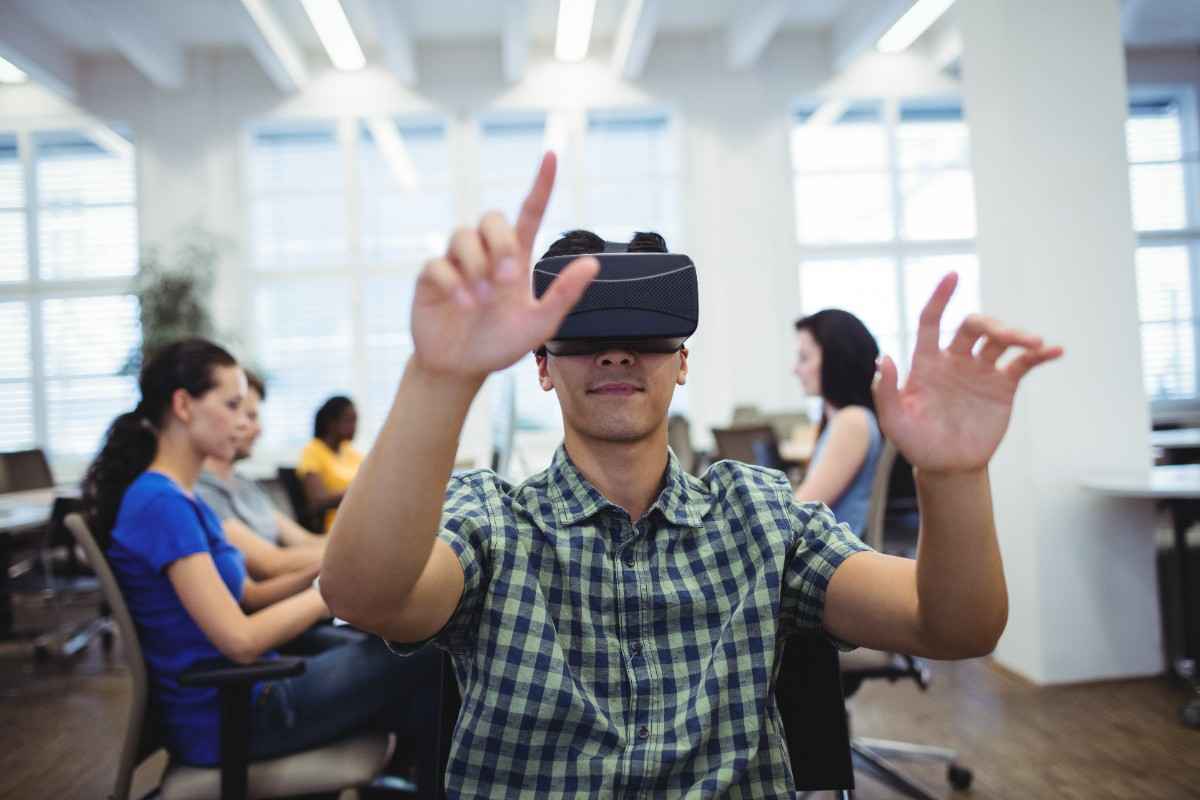
VR leadership training is a type of leadership training that utilises virtual reality technology to simulate real-world leadership scenarios: team conflicts, high-pressure decision-making situations, performance conversations, crisis management, inclusive workplace situations and others. The subjects are put into a 3D environment using a VR headset and are required to respond, react and lead in real-time.
In contrast to a video or a case, VR training is dynamic and embodied. The learner is not a spectator; he is a participant. Their decisions have an impact on the simulation, and they are immediately provided with data-driven information on their performance.
The present shift of passive to experiential learning is the central one to explain why VR is rapidly gaining traction in leadership development programs around the world.
Why Traditional Leadership Training Falls Short
The reason most traditional leadership programs fail is that, according to researchers, they have what is termed the transfer problem, in that leaders learn concepts in a training room but are unable to apply the concepts to real-life high-stakes situations. This is due to many reasons:
- Lack of emotional engagement: Reading about how to approach a challenging feedback conversation is quite different from actually doing it. The learning does not completely take root where there are no emotional stakes.
- No safe practice space: The mistakes of real leadership have the real cost of damaged team morale, loss of trust, and missed business outcomes. Conventional training seldom provides leaders with a really safe box to fail, reflect, and attempt once more.
- Low retention rates: It is always observed that individuals forget up to 70 per cent of new information within a span of 24 hours unless it is reinforced by some form of active learning. Lectures and slide decks do not fare well with regard to the retention of long-term knowledge.
- Inconsistency of delivery: Instructor-led training can have a wide range of differences depending on the person delivering it. Different leaders who work in the same organization might have very different experiences in development.
All four of these gaps are met by VR at the same time.
How VR Leadership Training Works in Practice
A properly developed VR leadership training system will generally have a systematic curve:
- Scenario Design – The training is initiated by a well-developed scenario, which depends on the actual issues that leaders have to deal with. These may involve dealing with a disengaged team member, handling a sensitive HR discussion, leading through an organizational change, facilitating an inclusive meeting, or making strategic calls in an uncertain situation.
- Immersive Experience – The leader wears a headset and gets into the situation. They hear, watch and communicate with virtual characters that react dynamically to the decisions made. The environment is realistic enough to elicit actual emotional and cognitive reactions.
- Decision Points – In the course of the scenario, the learner encounters decision points. Do they cut off a team conflict or leave it to play? Are they providing direct feedback, or are they toning down the message? Every decision shifts the storyline in a new way, reflecting the manner in which true leadership decisions can reverberate through organizations.
- Debriefing and Analytics – Following the scenario, the learner is given a debrief, which could be a mixture of AI-generated feedback, behavioural analytics, and facilitated coaching. They are able to view where they faltered, which signals they missed and how their judgments impacted the results. A variety of platforms enable learners to repeat the scenario by making alternative decisions to compare the outcomes.
- Group and Peer Reflection – When training in a group, teams can share their various ways of looking at the same situation, a potent conversation starter that enriches the shared language of leadership and perspective-taking across the organization.
The Science Behind Why VR Works for Leadership Development
The success of VR leadership training is not anecdotal in nature, but rather based on the well-established learning science.
- Embodied cognition underlines the close relations between brain and body in the learning process. When a learner is physically placed in a scenario using VR, the experience is more like a real memory than an abstract lesson.
- Emotional memory encoding refers to the fact that the experiences which are associated with emotional stakes are encoded into the long-term memory more durably. A VR scenario that induces actual nervousness, empathy, or discomfort leaves stronger memory traces than a discussion on the same topic in a classroom.
- The other important benefit is deliberate scale practice. The performance of the world-class in any field, be it surgery, sport, music, etc., is based on thousands of hours of conscious, systematic practice with feedback. VR enables this sort of practice to become achievable by the leadership on that scale that simply could not be attained previously.
- The factor of psychological safety also contributes. Knowing they are in a simulation makes those leaders more accepting of doing things they would not have done under real conditions. Such a desire to go through with experimenting is also a leadership muscle that must be exercised.
Key Leadership Competencies That VR Trains Effectively
VR does not equally apply to all leadership skills. It works best on competencies which involve subtle interpersonal reactions and real-time decision-making:
- Emotional intelligence and empathy – perspective-taking simulations that enable leaders to experience situations through the lens of the point of view of another person.
- Difficult conversations – feedback, performance management and conflict management situations.
- Inclusive leadership – becoming aware of unconscious bias, managing microaggressions, and establishing psychological safety.
- Crisis decision-making – high-pressure situations, time-bound, and uncertain information.
- Cross-cultural communication – working in varied teams and international stakeholder settings.
- Presence and executive communication – practising orality, narrative, and persuasion in virtual communities.
Measuring the Impact of VR Leadership Training
The ability to measure VR is one of the greatest advantages of VR compared to traditional training. All the interactions within a VR environment can be monitored – where participants are looking, how long they pause before responding, how their responses compare with benchmarks, and how their performance improves over repeated performances.
Through this behavioral information, organizations can:
- Detect leadership competency gaps at scale, across large cohorts.
- Individualise development paths using individual performance data.
- Indicate evident ROI to stakeholders by behavioural change measures instead of by satisfaction measures only.
- Monitor progress with time as leaders review scenarios during their course of development.
Companies that have undertaken systematic VR leadership programs report a quicker time to preparedness of new administrators, enhanced retention of the learning six months following training, and higher confidence among participants in managing real-life leadership issues.
Integrating VR Into a Broader Leadership Development Ecosystem
Being precise is worthwhile: VR leadership training is most effective when it is a part of a broader ecosystem of leadership development and not as a standalone solution. The best programs incorporate VR with human-coaching, peer-learning, on-the-job tasks, and guided reflection.
Consider VR as the practice court. It provides leaders with the reps, the feedback and the psychological preparedness to enter the real playing field with greater ability and confidence. It is in the coaching conversation immediately following a VR session, or in the team discussion immediately following the unpacking of the various perspectives.
Organisations that position VR within a more well-rounded context, based on real-world business challenges, facilitated by skilled facilitators, and reinforced through continuous development touchpoints, see the best results.
Is VR Leadership Training Right for Your Organization?
VR leadership training fits the needs of organizations that:
- Will require leadership pipelines that they must develop at scale.
- Is it steering through the multifaceted organizational change or transformation?
- Desire to create more able, emotionally intelligent leadership cultures.
- Require regular, replicable development experiences among geographies.
- Seeking quantifiable results and data-driven insights of their L&D investments.
It is especially useful to first-time managers who are making the transition between individual contributor and people leader, which is a notoriously difficult transition in which the impact of not prepared leadership is felt within a short time, both by the team and by the organization.
Conclusion
VR leadership training is one of the most significant changes in the development of leadership in a generation. It tackles the core constraints that have long kept traditional training in the same place, over a span of decades.
The organizations that are currently investing in immersive development of leadership are creating a decisive competitive advantage: leaders with more preparedness, increased awareness of themselves and their ability to navigate the complex, human challenges that define leadership in the modern workplace.
Excellence in leadership is not a one-off training process. It is constructed by experience and reflection, and through deliberate practice, which is possible through VR in ways that were simply not possible before.
The future of leadership development is immersive. The question is whether your organization will be at the forefront of that transformation or be a follower.