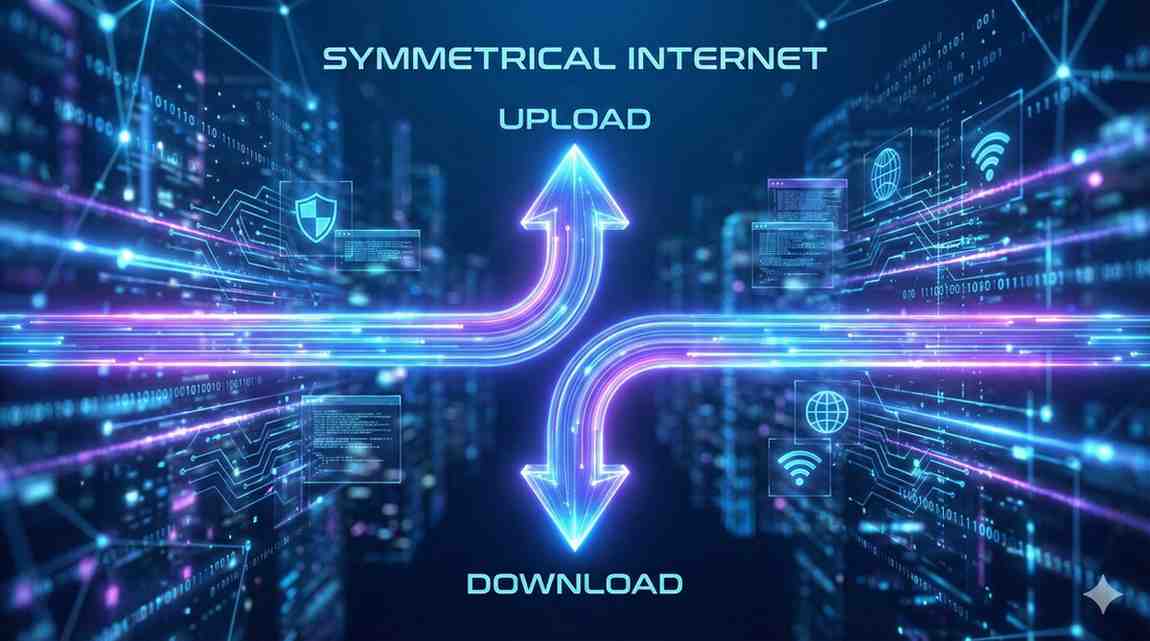
Ever wonder why your video calls freeze even when your internet plan claims to offer high-speed performance? Or why uploading a file takes forever, even though downloading is quick? If so, you’re not alone. Many people don’t realize that the issue is not with the internet but with the difference between upload and download speeds.
And that’s exactly where Symmetrical Internet comes in.
Before you spend extra on a new plan, you might ask yourself: “Do I really need symmetrical internet speeds, or is this just another buzzword?”
Let’s break it down in a clear way.
Most internet plans are asymmetrical, meaning your download speed is much faster than your upload speed. For example, you might get 200 Mbps for downloads but only 10 Mbps for uploads. This setup works fine for general browsing and streaming. However, it falls short for tasks like video calls or cloud backups, which require sending data.
Symmetrical Internet provides equal upload and download speeds. With a plan of 200 Mbps for downloads, you also get 200 Mbps for uploads. Why does this matter? Our online lives involve not just consuming content but also creating, sharing, conferencing, uploading, and syncing.
Let’s break down why symmetrical internet speeds are becoming more important than ever.
Video calls rely heavily on upload speeds.
Even if your download is strong, low upload bandwidth can cause:
With equal upload and download speeds, your video stream reaches the platform smoothly in real time.
Our devices constantly upload data to the cloud, including photos, documents, backups, and security footage. Slow upload speeds mean slow syncing. If you’ve ever waited hours for files to upload, you know how frustrating that can be. Symmetrical internet solves this problem.
If you’re a:
…you probably upload big files regularly.
Symmetrical internet can cut those upload times drastically—saving time and reducing frustration.
Most gamers focus on download speeds, but gaming relies more on upload speed and latency. Your commands, movements, and live interactions need fast, stable upstream bandwidth. Symmetrical internet minimizes lag spikes and improves real-time responsiveness.
Security cameras continuously upload footage to the cloud. The more devices you have, the more your upload speed gets split. With symmetrical internet speeds, your security system runs smoothly without slowing down other devices.
The gap between upload and download speeds exists because traditional internet use has centered around downloads like watching videos or streaming music.
But today, almost everything we do online includes uploading:
While download speed helps you receive information, upload speed determines how effectively you send information out. Nowadays, both speeds matter equally.
Let’s make this practical.
You definitely need symmetrical internet if you:
Upload large videos?
Render files?
Livestream?
Symmetrical speeds are a game changer.
If you share your network with other working or studying members, upload congestion becomes a huge problem.
Most homes now do:
Each pulls upload power even in idle mode.
Slack, Drive, Dropbox, Teams, Zoom, Notion every tool uploads data continuously.
Not everyone needs a symmetrical internet.
You probably don’t need it if you:
If your usage is simple, a standard asymmetrical plan is more than enough.
For most people, that’s not really true. Platforms like Netflix, Hulu, and YouTube depend more on download speed. Upload speed hardly plays a role in simple content consumption. However, if you stream on Twitch, YouTube Live, or Facebook Live, then symmetrical speeds are definitely worth it.
Not all internet technologies support symmetrical speeds.
Most fiber providers offer symmetrical or near-symmetrical speeds by default.
Business internet sometimes includes symmetrical upgrades—but at a higher cost.
Some 5G and fixed wireless providers are starting to offer more balanced speeds, but full symmetry is still rare.
Traditional satellites are almost always asymmetrical.
Even new-generation systems focus more on download than upload.
Here’s the honest, simple answer:
You need it if:
You don’t need it if:
For the modern digital worker, symmetrical internet isn’t a luxury—it’s becoming a necessity.
But for casual users, it’s not essential.
Symmetrical Internet is more than just a buzzword. It’s a solution for today’s digital lifestyle. As our online activities increasingly rely on equal upload and download speeds, the demand for symmetrical internet will continue to rise. Whether you need it, though, depends entirely on how you use the internet.
If you spend your day uploading, sharing, conferencing, cloud syncing, or creating, symmetrical speeds can greatly enhance your online experience. If not, your current asymmetrical plan might work just fine.
Yes, a symmetrical internet is absolutely worth it if you work from home or often upload files. It supports smooth video calls, online gaming, and cloud-based workflows. If your daily tasks involve sending data, equal upload and download speeds make a noticeable difference.
It’s highly recommended because video calls depend on both upload and download speeds. Lag, pixelation, and audio drops usually happen when upload speeds are low. With a symmetrical internet, your video quality stays clear and stable.
Fiber is the most common and reliable source of symmetrical internet speeds. Some modern 5G home internet services and business plans can also offer equal upload and download speeds. Still, fiber remains the gold standard for consistency.
It won’t speed up download-heavy tasks unless your old plan was underpowered. But it significantly improves activities that rely on uploading—like sending files, gaming, or video calls. Essentially, your WiFi feels faster because everything becomes more balanced.
For most households, 100–300 Mbps symmetrical offers great performance for work, streaming, and browsing. Larger families or content creators benefit from 500–1000 Mbps symmetrical speeds. The more devices and uploads you handle, the higher the speed you’ll want.

© 2025 Crivva - Hosted by Airy Hosting Managed Website Hosting.