You had a product deadline three weeks out. Your developers were already stretched thin. Hiring a full-time engineer would take months, and a traditional outsourcing contract felt too rigid, too slow, and honestly, too risky. Sound familiar?
This is the exact situation thousands of tech companies face every single year. The pressure to ship faster, build smarter, and stay lean all at once is real — and the old ways of scaling a team simply do not keep up anymore.
That is where staff augmentation steps in. Not as a buzzword, but as a genuinely smart approach to how modern software development teams grow, adapt, and deliver.
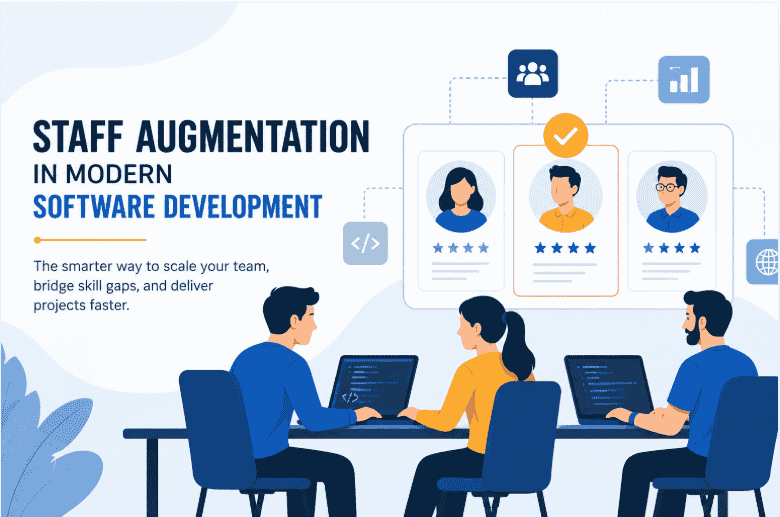
At its core, staff augmentation is a workforce strategy where you bring in external skilled professionals to work alongside your existing in-house team. These are not outsourced contractors who disappear into a black box. They are integrated members who work under your direction, align with your workflows, and contribute directly to your goals.
Think of it less like outsourcing a project and more like temporarily adding horsepower to your engine — without buying a whole new car.
The model is flexible by design. You can bring someone on for a two-month sprint, a product launch, or an extended engagement. And when the need changes, you scale accordingly.
Finding experienced software developers has become one of the most competitive challenges in the tech industry. Skilled engineers in areas like AI, cloud architecture, DevOps, and mobile development are in high demand globally. Building a full-time team with all these specializations in-house is expensive and often unrealistic.
Staff augmentation lets businesses tap into a global talent pool without the overhead of permanent hires. You get the skill when you need it, for as long as you need it.
Product timelines do not wait for lengthy recruitment cycles. When a feature needs to ship, or a bug is blocking users, the last thing you want is a three-month hiring process standing between you and progress.
Augmented staff can typically be onboarded and contributing within days. That kind of agility is a genuine competitive edge.
Hiring full-time senior developers comes with significant costs beyond just salary — benefits, equity, equipment, training, and long-term commitments. For projects that have a defined scope or evolving needs, these costs rarely make sense.
Staff augmentation keeps budgets lean. You pay for the expertise you need, not a permanent seat at the table. And because you are choosing specialists rather than generalists, the output quality tends to be high from day one.
A startup racing toward a product release does not need a permanent team of fifteen engineers. It needs the right people right now. Staff augmentation makes it possible to bring in five extra developers for eight weeks, hit the launch, and then scale back without laying anyone off.
Your existing team might be strong across the board, but the new project requires deep expertise in, say, Kubernetes or React Native — skills that nobody on the current team has at scale. Rather than sending everyone through training, you bring in someone who lives and breathes that technology.
Sometimes the team is not missing skills. They are just overloaded. Adding capacity through augmented staff reduces burnout, keeps delivery on track, and maintains the quality of work that slips when developers are stretched too thin.
This is where working with a reliable IT staff augmentation agency can make a real difference — providing vetted, experienced talent that integrates smoothly rather than adding management overhead.
This distinction matters more than people realize.
With traditional outsourcing, you hand a project over to an external team. You define requirements, they build it, and you review the output. Communication can be slow, context gets lost, and your team stays largely uninvolved with the actual development work.
With staff augmentation, the external professionals join your team. They attend your standups. They work in your tools, follow your processes, and report to your leadership. The control stays with you. The talent comes from outside.
That difference in control and integration is exactly what makes augmentation so appealing for companies who care about code quality, culture, and long-term product ownership.
Business needs shift. An augmented team can grow or shrink with those needs. This kind of flexibility simply does not exist with permanent hires.
You are not limited to the talent pool in your city. Staff augmentation opens up access to experienced developers across the world — specialists who have worked on similar challenges and bring proven knowledge to the table.
Unlike outsourcing, you set the direction. Your product managers, architects, and leads remain in charge. The augmented staff follows the strategy you define.
With more hands on deck and no recruitment delays, projects move faster. Features get built. Bugs get fixed. Releases happen on time.
When experienced external professionals work side by side with your in-house developers, knowledge naturally flows. Your team picks up new techniques, best practices, and perspectives that stay long after the engagement ends.
Not all augmentation arrangements work equally well. Here are a few things that make the difference between a smooth integration and a frustrating one.
Clear communication from the start matters enormously. Whether the augmented professionals are remote or on-site, expectations around communication, deliverables, and availability need to be set upfront.
Cultural alignment is often underestimated. Technical skills are table stakes. How someone works — their approach to feedback, collaboration, and ownership — determines whether they genuinely add to your team dynamic or create friction.
Proper onboarding is not optional. Even for short-term engagements, giving augmented staff the context they need about your codebase, architecture, and team conventions pays off quickly in the quality of their contributions.
There was a time when staff augmentation was seen as a stopgap — something you did when you were in a pinch. That perception has shifted significantly.
Today, leading software companies treat it as a deliberate, ongoing part of their talent strategy. It allows them to stay nimble, bring world-class expertise into critical projects, and respond to market demands without the rigidity of a fixed headcount.
The companies winning in product development right now are not necessarily the ones with the largest teams. They are the ones with the most adaptable teams — and staff augmentation is one of the clearest paths to building that kind of adaptability.
Staff augmentation has earned its place as one of the most practical and effective approaches to building software in today’s environment. It bridges the gap between what your team can do right now and what your project demands right now — without forcing you into long-term commitments that might not make sense six months from now.
Whether you are a fast-growing startup trying to hit your first launch, or an established company managing multiple product lines with shifting resource needs, this model gives you access to skilled professionals, control over your development process, and the kind of flexibility that modern software development genuinely requires. Done right, it is not just a short-term fix. It is a smarter way to build.

© 2025 Crivva - Hosted by Airy Hosting Managed Website Hosting.