

There’s a reason solitaire engagement rings have never gone out of style. Decade after decade, through every trend in jewellery design, the single-diamond solitaire holds its ground. Not because it’s the safe choice — but because it’s the honest one. One diamond. Nothing between you and the stone. And that kind of clarity, in every sense of the word, is hard to argue with.
If you’re beginning your search, this guide will walk you through everything that genuinely matters: what makes a solitaire work, how to read a diamond, what to ask before you buy, and why heritage still counts in a world of fast jewellery.
The solitaire has been the benchmark of engagement ring design since the late 19th century, when Tiffany & Co. introduced the now-iconic six-prong setting in 1886. Before that, diamonds were typically set flush to the band or surrounded by smaller stones. Raising the diamond on prongs changed everything — more light entered the stone from more angles, and the diamond became the unambiguous focal point.
That principle hasn’t changed. What has changed is the variety available to buyers today: different band metals, prong counts, setting heights, diamond shapes, and certification standards. Knowing how these variables interact is what separates a confident purchase from a regrettable one.
Every solitaire diamond engagement ring is defined by its centre stone. There’s no cluster of smaller diamonds to distract the eye, no elaborate metalwork drawing attention away from the gem. This is the solitaire’s greatest strength and its greatest demand — the diamond has to earn its place.
The GIA (Gemological Institute of America) developed the four-C framework that remains the industry standard:
If you’re browsing solitaire engagement ring diamond options and feel overwhelmed by the numbers, focus on this: a beautiful, well-cut stone in an honest setting will always outshine a larger stone with a mediocre cut.
The “solitaire” refers to the number of main stones — one — not to a single setting style. You’ll encounter several distinct approaches:
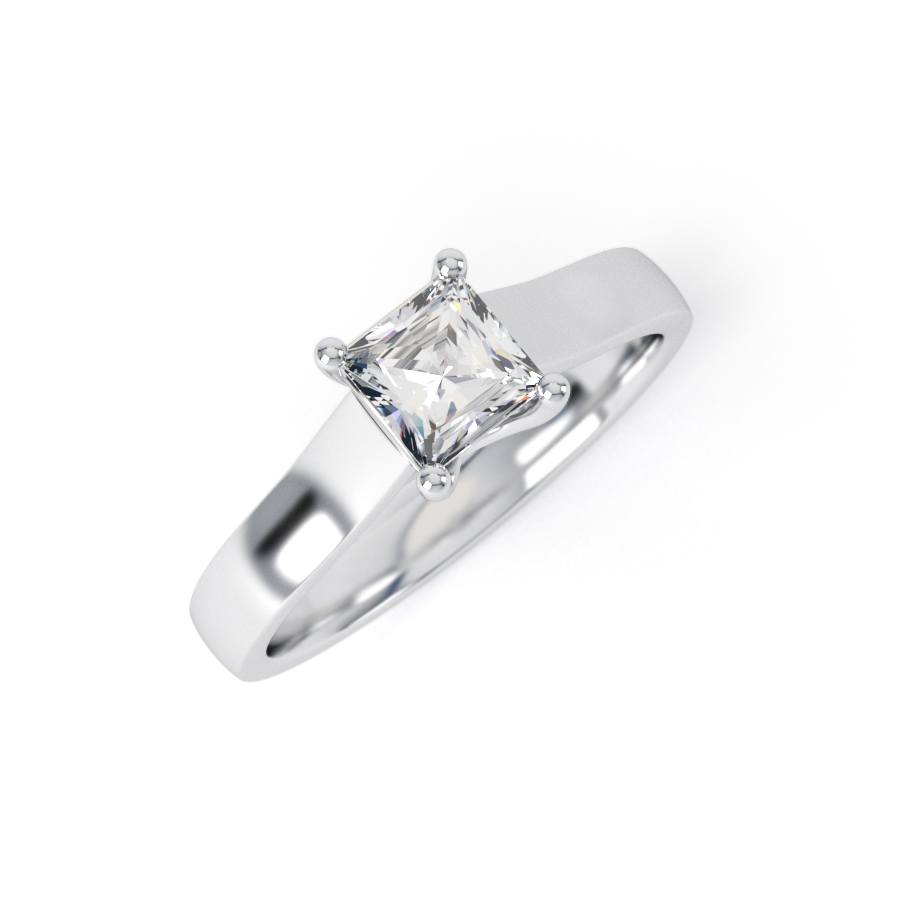
Prong settings are the most common. Four-prong settings expose more of the diamond’s surface, making it appear larger. Six-prong settings, like the classic Tiffany mount, offer additional security and a rounder look to the diamond’s silhouette. Eight-prong designs are less common but suit round brilliants beautifully.
Bezel settings encircle the diamond’s girdle in a thin collar of metal. They’re the most protective setting available — ideal for people with active lifestyles — and give a clean, modern aesthetic that photographs exceptionally well.
Cathedral settings arch the band up to support the diamond, creating a dramatic height. They suit larger stones and elongate the finger.
Tension settings appear to float the diamond between the band’s open ends, held in place by the metal’s pressure. Visually striking, though they require more careful maintenance and sizing.
For most buyers, the four-prong or six-prong round brilliant remains the canonical choice — but the best setting is the one that matches how the wearer actually lives.
The shape is the diamond’s personality. Each has its own character and suits different hands and aesthetics.
Round brilliant — the most popular shape globally, offering maximum fire and brilliance. Flatters virtually every hand shape and finger length.
Princess cut — a square shape with sharp corners. Very brilliant, very modern. Clean and graphic.
Oval — elongates the finger, appears larger than its carat weight, and has returned strongly to fashion over the past decade. An excellent choice.
Cushion cut — soft corners, a vintage quality. Available in square or rectangular proportions. Particularly beautiful in a cathedral or halo setting.
Emerald cut — rectangular with stepped facets. More about clarity and depth than sparkle. Requires a higher clarity grade, as the step facets make inclusions more visible.
Marquise — the most elongating shape. Bold and dramatic. Rarely the safe choice, always the memorable one.
At Marlows Diamonds, you’ll find solitaire settings crafted to complement each of these shapes, with stones certified to international standards — giving you confidence in what you’re actually buying.
Any serious solitaire diamond engagement ring purchase should come with a grading certificate from an independent laboratory. GIA and IGI (International Gemological Institute) are the two most widely trusted bodies.
The certificate confirms what you’re paying for — the cut, colour, clarity and carat weight of the specific stone — and provides documentation for insurance purposes. A retailer who can’t or won’t provide independent certification on a significant stone is a retailer worth walking away from.
Marlows Diamonds, established in 1951, provides certified diamonds across its solitaire range. That kind of accountability doesn’t happen by accident — it comes from seven decades of building a reputation one ring at a time.
The band matters more than people realise. It affects durability, maintenance, and how the diamond reads visually.
Platinum is denser and more durable than gold, develops a soft patina over time (rather than wearing away), and is hypoallergenic. It’s the natural choice for a ring intended to last generations. It also makes white diamonds appear at their most brilliant.
18ct white gold offers a similar aesthetic at a lower price point, but requires rhodium plating every few years to maintain its white appearance.
18ct yellow gold has seen a significant resurgence. It creates a warm, vintage character and suits warmer-toned diamond colours beautifully.
18ct rose gold is romantic in tone and particularly flattering on a wide range of skin tones. It ages gracefully.
Before finalising any solitaire purchase, these questions will save you from regret:
A good jeweller answers all of these without hesitation.
Most proposals involve an element of surprise, which means most buyers don’t know the ring size. A few approaches that work:
Borrow a ring she wears on her right-hand ring finger and have it sized at the shop. Have a trusted friend or family member find out discreetly. Buy a standard size (most women’s rings are between N and P in the UK) and plan to resize immediately after. Virtually every reputable jeweller offers a complimentary first resize.
A solitaire’s prongs are what keep the diamond in place. Check them annually — a bent or worn prong is a small problem; a lost stone is not. Clean the ring regularly with warm water, a drop of washing up liquid, and a soft brush. Avoid ultrasonic cleaners for rings with inclusions, as the vibration can worsen existing fractures.
For diamond engagement rings at any price point, professional cleaning and prong inspection once a year is good practice — most jewellers offer this as a complimentary service for rings purchased from them.
Remove the ring before heavy gym use, gardening, and household cleaning. The chemicals in cleaning products can damage metals and reduce a diamond’s surface brilliance over time.
The internet has made it easy to find a ring at almost any price. It’s also made it easy to buy something that looks right in a photograph and disappoints in person.
There’s a reason people still choose established jewellers with physical presence and long trading histories. You can see the ring. You can feel the weight of the metal, judge the diamond’s performance in natural light, and build a relationship with someone accountable. That matters when you’re buying something intended to last a lifetime.
Marlows Diamonds has been doing exactly this since 1951 — operating from a position of expertise and long-term reputation rather than transactional volume.
A solitaire engagement ring isn’t just a piece of jewellery. It’s a decision that distils everything about the gesture down to its most essential form. One diamond. One person. One moment.
The right ring combines a well-cut certified stone, a setting suited to how she lives, and a jeweller with the expertise and integrity to stand behind what they sell. Start there, and the rest becomes considerably more straightforward.

© 2025 Crivva - Hosted by Airy Hosting Managed Website Hosting.