Artificial intelligence has moved far beyond buzzwords and prototypes, it’s now powering customer support, automating operations, and reshaping how businesses make decisions. At the center of this transformation are AI agents: intelligent systems capable of reasoning, acting, and learning within defined environments. But here’s the catch, building effective AI agents isn’t just about writing code or integrating APIs. It’s about strategic design, domain understanding, and long-term scalability.
That’s why choosing the right partner matters.
With dozens of vendors claiming expertise in AI agent development, businesses often struggle to separate true capability from marketing noise. A poor choice can lead to underperforming systems, wasted budgets, and stalled innovation. On the other hand, the right partner can accelerate your roadmap, unlock measurable ROI, and position your organization ahead of competitors.
In this guide, you’ll learn exactly what to evaluate before selecting an AI agent development company from technical depth and industry experience to scalability, compliance, and collaboration models. Whether you’re building your first intelligent agent or expanding an existing ecosystem, these insights will help you make a confident, future-proof decision.
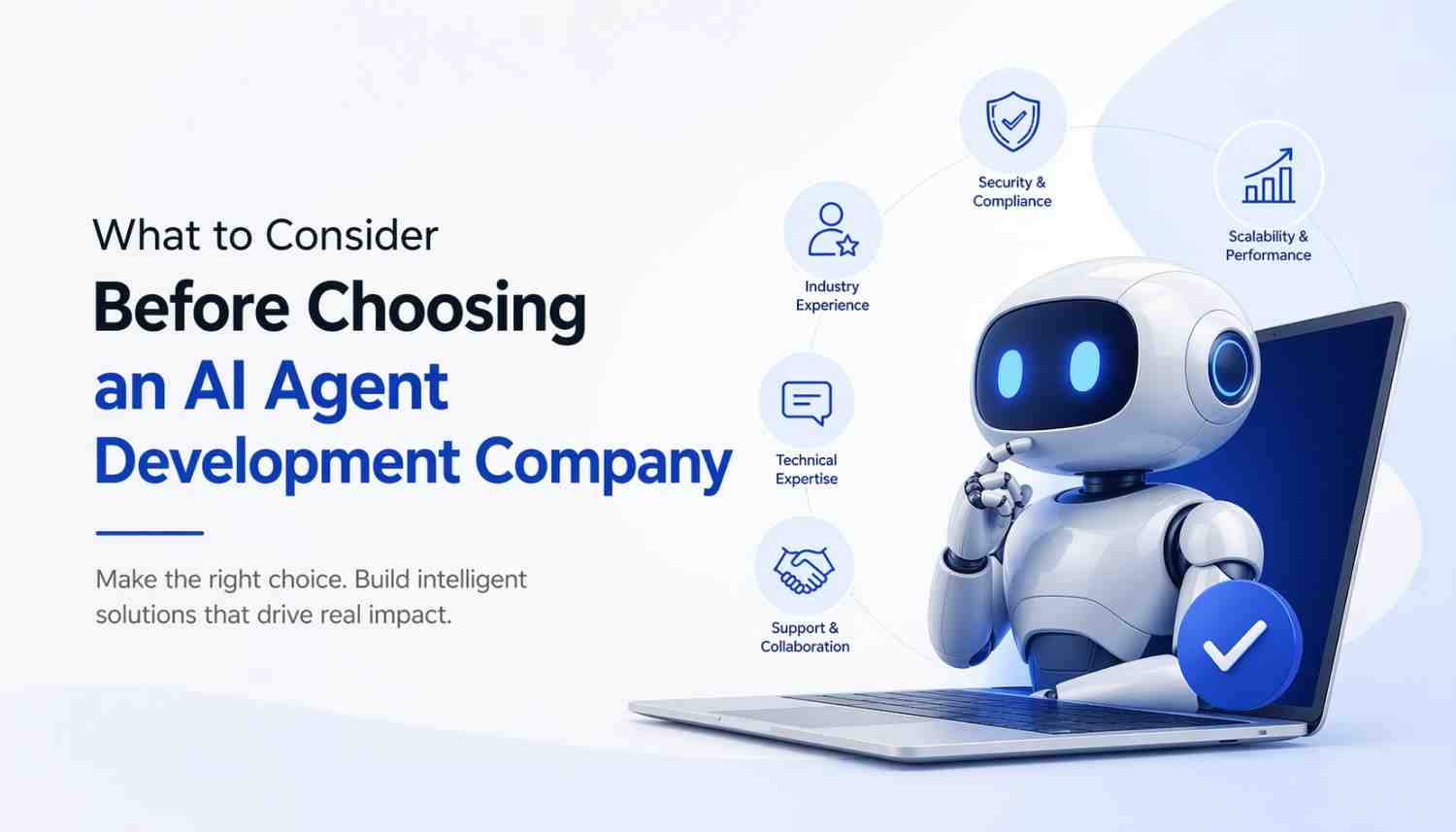
Not all AI vendors are created equal, and technical expertise is often where the biggest gaps appear. Many companies can build chatbots or automate workflows, but AI agents require a deeper level of engineering, combining natural language processing, reasoning frameworks, memory systems, and decision-making logic.
A capable AI partner should demonstrate proficiency across multiple AI domains, including large language models (LLMs), reinforcement learning, and orchestration tools. Beyond that, they should be able to explain how these technologies are applied, not just list them as capabilities. For example, if you’re building a customer support agent, can they design context-aware responses that improve over time? If you need an operations agent, can they integrate with legacy systems and handle edge cases reliably?
Another critical factor is their approach to architecture. Strong vendors design modular, scalable systems rather than rigid, one-off solutions. This ensures your AI agents can evolve as your business grows or as new technologies emerge.
Ultimately, you’re not just hiring developers, you’re choosing a team that will shape how intelligence operates within your business.
Technical skills alone aren’t enough. Context matters just as much.
An AI solution built for healthcare will differ significantly from one designed for e-commerce or finance. Industry-specific regulations, data sensitivity, and user expectations all influence how AI agents should behave. That’s why it’s important to choose an AI development company that understands your domain, not just AI in general.
Look for case studies or examples that closely match your intended use case. Have they built agents that automate workflows similar to yours? Do they understand the challenges unique to your sector? For instance, in financial services, explainability and compliance are critical, while in retail, personalization and speed often take priority.
Beyond past experience, evaluate how well they approach problem discovery. A strong partner will ask thoughtful questions about your business goals, user journeys, and operational constraints before proposing a solution. If a company jumps straight into implementation without fully understanding your needs, that’s a red flag.
The best AI agents don’t just function well, they align seamlessly with the business processes they’re designed to enhance.
AI projects often start small, a prototype, a pilot, or a limited deployment. But the real value emerges when these systems scale across teams, departments, or even entire organizations. Unfortunately, not all solutions are built with growth in mind.
When evaluating a vendor, ask how their systems handle increasing complexity. Can the AI agent manage higher volumes of interactions without degrading performance? Is the infrastructure designed to support real-time decision-making at scale? What happens when new data sources or integrations are introduced?
Equally important is maintainability. AI systems require ongoing updates, whether it’s retraining models, refining prompts, or adapting to changing business rules. A reliable provider of AI agent development services should offer a clear plan for post-deployment support, including monitoring, optimization, and continuous improvement.
Scalability isn’t just a technical requirement, it’s a strategic necessity. Without it, even the most promising AI initiative can hit a ceiling.
As AI agents interact with sensitive data, customer information, financial records, proprietary business insights, security and compliance become non-negotiable. This is especially critical in industries with strict regulatory frameworks, such as healthcare, finance, and legal services.
A trustworthy AI partner should have well-defined protocols for data handling, storage, and access control. This includes encryption, secure APIs, and compliance with standards like GDPR or industry-specific regulations. But security goes beyond infrastructure, it also includes how data is used to train and improve AI models.
Ethical considerations are equally important. AI agents must be designed to avoid bias, ensure fairness, and provide transparent decision-making where necessary. Ask potential vendors how they address these challenges. Do they conduct bias audits? Can they explain how their models arrive at certain decisions?
These questions aren’t just about risk mitigation, they’re about building trust with your users and stakeholders.
Even the most technically capable company can fall short if collaboration isn’t smooth. AI development is inherently iterative, requiring constant feedback, adjustments, and alignment between teams. That’s why communication and workflow transparency are critical.
Start by evaluating how the company manages projects. Do they follow agile methodologies? How often will you receive updates? Will you have direct access to developers and AI specialists, or will communication be filtered through account managers?
Cost structure is another area where clarity is essential. AI projects can vary widely in scope and complexity, so pricing should be transparent and tied to deliverables. Be cautious of vague estimates or unusually low bids, they often lead to hidden costs or compromised quality later on.
A strong partnership feels collaborative, not transactional. The right company will act as an extension of your team, not just a service provider.
Choosing an AI partner is not just a procurement decision, it’s a strategic investment in your organization’s future. The right company will help you move beyond experimentation and into meaningful, scalable impact. The wrong one can delay progress and erode confidence in AI initiatives altogether.
As you evaluate your options, focus on more than just technical capability. Look for alignment between their expertise and your goals, their processes and your workflows, their vision and your long-term strategy. The best AI agent solutions are built through collaboration, iteration, and a deep understanding of both technology and business context.
AI is evolving rapidly, and the decisions you make today will shape how your organization competes tomorrow. Take the time to choose wisely, ask the right questions, and prioritize partners who are as invested in your success as you are.

© 2025 Crivva - Hosted by Airy Hosting Managed Website Hosting.