

As commercial photovoltaic (PV) installations continue to grow in size, rooftop electrical infrastructure is becoming more complex than many project teams initially anticipated.
Modules, inverters, and structural attachments typically receive the majority of design attention. Conduit routing, however, often determines how easy a system will be to inspect, maintain, and modify years after installation.
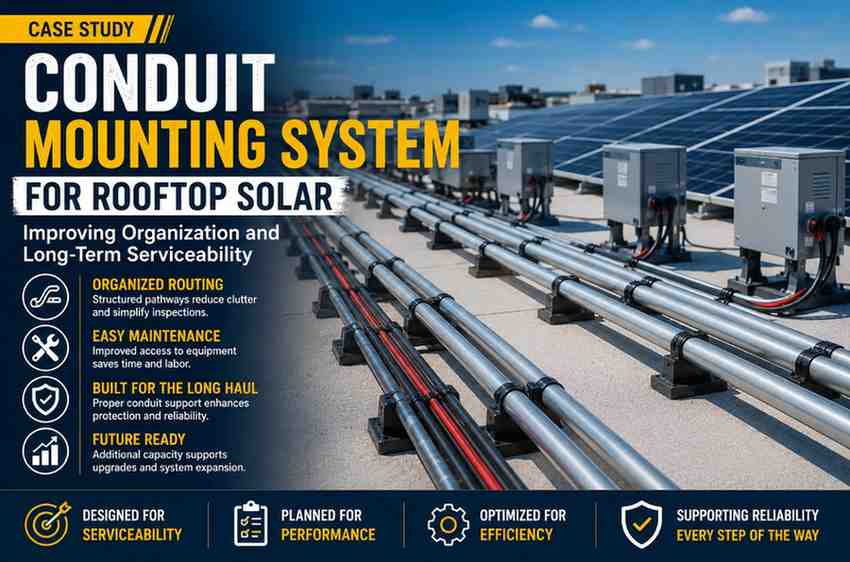
This case study examines how a commercial rooftop solar project approached conduit organization during the design phase and the operational benefits that followed once the system was in service.
The project involved a rooftop solar installation on a large industrial facility with a low-slope membrane roof. The design included multiple inverter locations, communications equipment, monitoring infrastructure, and several long conduit pathways connecting electrical equipment across different sections of the roof.
From an engineering perspective, the photovoltaic array itself presented few unusual challenges. The greater concern was how to manage electrical infrastructure within a rooftop environment already occupied by HVAC equipment, maintenance pathways, roof drains, and future expansion zones.
During the early design review process, the project team identified conduit routing as an area that could significantly influence long-term maintenance efficiency. The objective was not simply to complete the installation but to ensure the rooftop remained organized and serviceable throughout the system’s life.
As the project moved into detailed planning, several routing concerns became apparent. Electrical pathways would need to cross multiple roof sections while preserving access to critical rooftop equipment. At the same time, future maintenance activities and potential system upgrades had to be considered.
|
Design Challenge |
Long-Term Operational Concern |
|
Long conduit pathways |
Increased routing complexity |
|
Multiple equipment zones |
Congestion around service areas |
|
Future expansion requirements |
Additional conduit capacity needed |
|
Roof access corridors |
Potential routing conflicts |
|
Distributed electrical infrastructure |
More difficult inspections and troubleshooting |
The project team recognized that routing decisions made during installation could directly affect serviceability years later. Disorganized conduit pathways may not pose immediate problems, but they often become more noticeable when technicians troubleshoot equipment, perform inspections, or prepare systems for reroofing work.
Rather than treating conduit support as a final installation task, the project team incorporated a rooftop solar conduit mounting system into the overall design strategy.
The first step involved establishing dedicated conduit routing corridors across the roof. Instead of allowing electrical pathways to develop organically during installation, conduit runs were grouped into predictable zones designed to support future accessibility.
Maintaining clear access around inverters, combiner boxes, communications equipment, and maintenance pathways was also prioritized. This reduced the likelihood that future service work would require technicians to navigate around congested electrical infrastructure.
The team also evaluated options for solar wire management as part of the broader conduit support strategy. By coordinating cable organization and conduit routing, the project team created a more structured electrical layout while reducing potential conflicts among rooftop systems.
Future adaptability played an important role as well. Additional routing capacity was incorporated into the design to accommodate monitoring upgrades, equipment replacements, and future electrical modifications without requiring significant changes to existing conduit pathways.
Once the system was operational, the benefits of the design approach became more apparent.
Electrical pathways remained organized and easy to identify during inspections. Maintenance personnel could access equipment without navigating around unnecessary conduit congestion, and circuit tracing activities became more efficient due to the structured routing layout.
As routine maintenance activities were performed, technicians reported improved accessibility compared to similar projects where conduit organization had received less attention during design.
The project team also found that future modifications could be accommodated more easily because routing corridors had been planned with additional capacity in mind. Rather than introducing new congestion points, electrical additions could be integrated into an existing organizational framework.
Perhaps most importantly, the rooftop maintained order that supported long-term serviceability. As equipment aged and operational requirements evolved, the electrical infrastructure remained predictable and manageable.
One of the most valuable takeaways from this project was that conduit support should be evaluated as part of a broader maintenance strategy rather than a standalone installation requirement.
Many serviceability issues found on aging commercial rooftops can be traced back to routing decisions made during construction. Technicians frequently encounter systems where conduit pathways restrict access, complicate troubleshooting, or create unnecessary challenges during reroofing projects.
By contrast, projects that prioritize conduit organization during the design phase often benefit from lower maintenance complexity and improved accessibility throughout the system lifecycle.
Industry research from the National Renewable Energy Laboratory (NREL) continues to emphasize the importance of maintainability, reliability, and long-term operational performance across photovoltaic installations. Organized electrical infrastructure directly supports those objectives by enabling safer, more efficient maintenance activities.
A conduit mounting system for rooftop solar improves rooftop organization by creating structured electrical pathways that simplify maintenance, improve accessibility, support circuit identification, and accommodate future modifications. When integrated into the design process, conduit support helps reduce operational complexity while improving long-term system serviceability.
This project demonstrated that conduit support is far more than a method of holding conduit above the roof surface.
When incorporated into the design process, a conduit mounting system for rooftop solar can improve rooftop organization, enhance maintenance efficiency, and create a more adaptable electrical infrastructure. As commercial solar installations continue to grow larger and more sophisticated, those operational benefits are becoming increasingly valuable throughout the system’s lifecycle.
A conduit mounting system supports and organizes conduit pathways above the roof surface while maintaining accessibility and electrical organization throughout the photovoltaic installation.
Organized conduit routing simplifies maintenance, improves equipment access, supports troubleshooting, and reduces long-term operational complexity.
Properly organized conduit pathways make inspections, repairs, circuit tracing, and future modifications easier to perform.
Early planning helps avoid routing conflicts, preserve maintenance access, and create a more manageable electrical infrastructure layout.
Yes. Well-organized conduit pathways are easier to modify when additional equipment, monitoring systems, or future expansions are introduced.
Accessibility, routing flexibility, roof compatibility, future expansion capacity, and long-term serviceability are among the most important evaluation factors.

© 2025 Crivva - Hosted by Airy Hosting Managed Website Hosting.