

Climate change, rising pollution, an increase in diseases, natural calamities, and other environmental concerns have become a pressing issue for everyone. World environmental leaders have recognized the importance of addressing deforestation and ecological practices that harm the planet, and have acknowledged the role various industries play in contributing to the preservation of nature. With increasing awareness of climate change, the AEC industry has been making significant contributions to reducing waste and adopting sustainable practices.
The construction and architecture industry seamlessly adheres to the “reduce, reuse, recycle” concept, applied to materials, equipment, construction practices, and more. Today, constructing sustainable buildings has become a prominent method in every stage of the construction project. However, one of the crucial stages is the MEP, where maintaining harmony was the primary aspect, but maintaining sustainable practices is an added one.
MEP engineers nowadays ensure that they minimize waste and increase energy conservation through the use of the right equipment, methods, and strategies. Without MEP, a building is merely an infrastructure that is neither functional nor comfortable for occupants to live in. This highlights the true significance of MEP engineering in both simple and complex buildings.
However, the growing emphasis on sustainable practices has highlighted the need for more energy-efficient equipment. Architecture and construction companies must install eco-friendly systems and adopt efficient practices that benefit the environment while also reducing costs.
The industry has witnessed significant transformation, from approaches to work methods to design style. Every aspect of the sector is revamped, thanks to building information modeling. BIM has offered various benefits to AEC professionals, enabling them to enhance the overall construction process with 3D data-rich models. From improving communication to accurate facility management, BIM has become a game-changer tool for architects, engineers, and other professionals.
The ability does not end here, but allows for maintaining harmony and synchronization between MEP components (mechanical, electrical, plumbing & fire safety). BIM MEP services ensure the coordination and strategic planning of design to incorporate sustainable practices and equipment. Let’s briefly understand how BIM helps to achieve green building design with MEP BIM services.
One of the recent changes in the AEC landscape is the incorporation of sustainable and green practices. The agenda is to minimize the overall carbon footprint and contribute to saving the environment in the best way possible. In the modern realm, BIM is a key technology that has altered the working approach from traditional to digital practices. The concept of sustainability is now evident in the AEC sector, and BIM plays a key role. Moreover, any infrastructure project entails crucial components called MEP, which require seamless coordination, the installation of equipment, materials, and more.
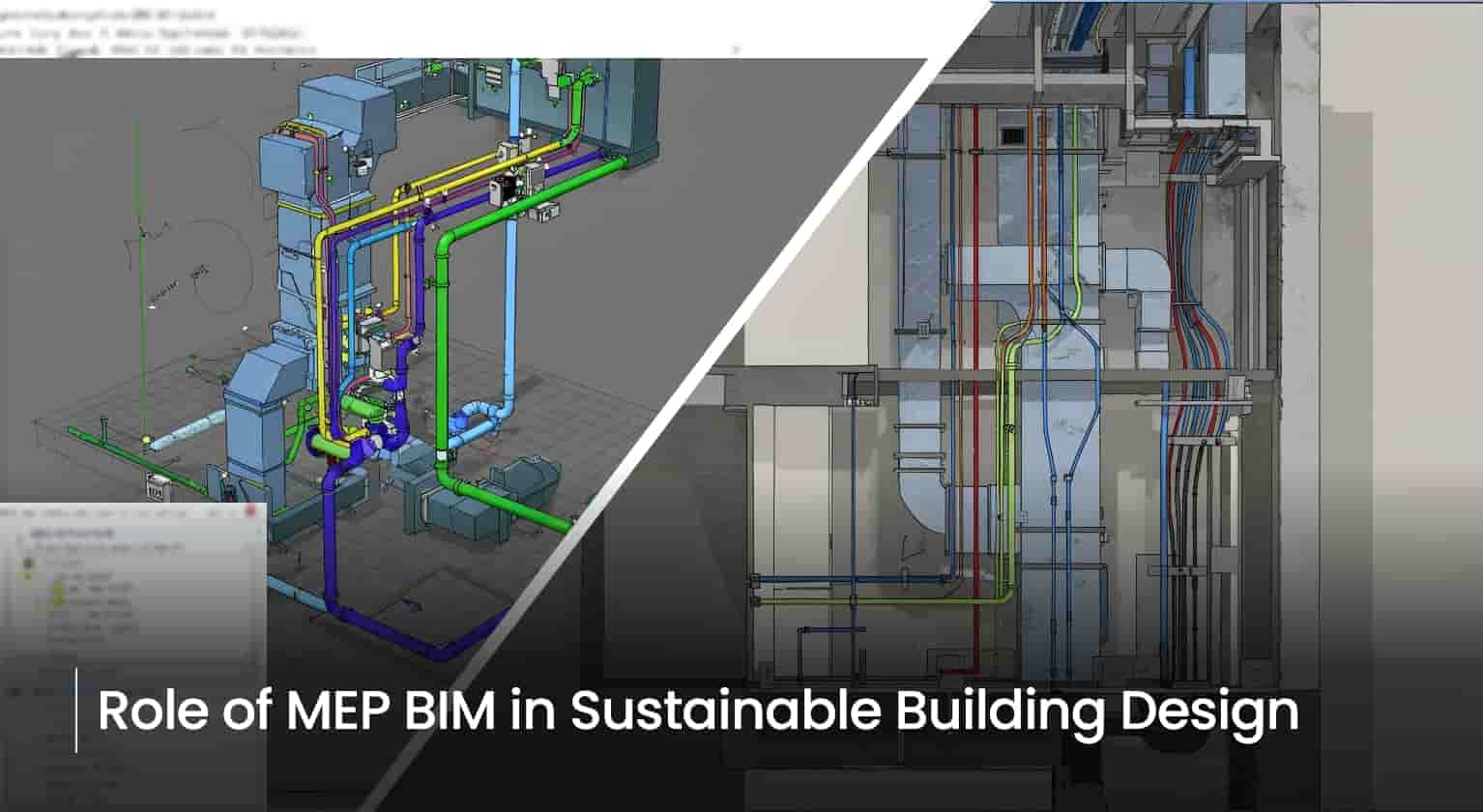
During MEP design, BIM enables enhanced visualization, clash detection, and harmony among all components, among other benefits. Above all, BIM MEP services play a critical role in sustainable design practices for infrastructure projects. Planning the project design along with sustainable design is not easy. MEP BIM for sustainable design is a game-changer for AEC professionals.
The sustainability factor has become a primary aspect of MEP design, encompassing the efficient use of resources and the reduction of waste in industrial factories and construction projects. 3D BIM modeling in the initial design stage enables energy modeling, facilitates quick clash detection, and optimizes project operations. MEP plays a crucial role, comprising a variety of key factors that can be achieved through BIM services. Mechanical, electrical, and plumbing systems require eco-friendly building design through BIM modeling, which enables the optimization of energy performance, reduction of resource consumption, and enhancement of occupant comfort.
For example, HVAC BIM services enable MEP engineers and professionals to achieve seamless and energy-efficient power consumption, as well as well-ventilated spaces with minimized air duct waste and reduced resource consumption.
HVAC BIM for sustainability ensures the optimization of HVAC and lighting aspects, rainwater harvesting, and the analysis of building performance. In fact, this significant step towards sustainability helps achieve green building certification, MEP BIM, and LEED certification, which is evident in project paperwork, approvals, and other documentation. Let’s look into some of the key strategies and benefits of MEP BIM in green construction.
Sustainability is a key factor in the architecture and construction realm, enabling green building design, efficient resource utilization, energy savings, and other benefits. Since the consumption and performance of lighting, heating, and cooling systems can be determined through building designs, it also involves an energy-efficient planning and eco-friendly design approach, resulting in the elimination of the carbon footprint. Many projects in urban cities have mandated sustainable and green building design. Let’s understand some of the key benefits of BIM MEP services for sustainable construction designs.
These are some of the benefits of eco-friendly building design. However, there are novel ways in which MEP designs make sustainable building design. Following ar;
Green building BIM services in MEP design are a key aspect for today’s project success. The selection of the right material, energy-efficient equipment, strategic and sustainable design planning, and more are mere parts, but they create a profound impact on overall building designs. With this, the AEC industry is a key contributor to saving the environment and reducing carbon footprints in the projects.
Moreover, it also depends on the project’s location and type, considering the use of infrastructure as well as the climatic conditions in the region. For example, an extreme cold location must have infrastructure with property heating pumps, a hot water supply, and more. At the same time, extremely hot conditions require plants to have frequent oxygen, HVAC, and more.
The concept of MEP BIM for sustainable design has gained significant traction, enabling designers and engineers to implement green construction and design practices in accordance with sustainability standards and codes.

© 2025 Crivva - Hosted by Airy Hosting Managed Website Hosting.