

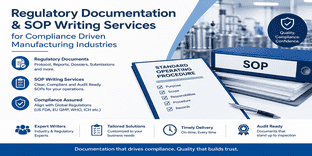
In regulated manufacturing, documentation is the foundation of compliance, quality assurance, and operational control. Whether operating a pharmaceutical plant, food processing facility, medical device unit, or chemical manufacturing site, organizations depend on accurate documentation to maintain licenses, pass audits, and support product quality. As regulatory expectations continue to evolve across FDA, CDSCO, WHO-GMP, ISO, BIS, and FSSAI frameworks, professional regulatory documentation and SOP writing services have become a strategic investment. Well-structured documentation systems help manufacturers reduce compliance risks, improve audit readiness, strengthen quality management systems, and protect long-term business continuity.
The financial impact of poor documentation is becoming increasingly significant across regulated industries. A landmark study by the Ponemon Institute and Global cape found that the average cost of non-compliance stands at $14.82 million, compared to just $5.47 million for maintaining a compliant documentation program, making non-compliance nearly three times more expensive.
Most compliance failures are not caused by a single missing document. They typically arise from systemic weaknesses that remain unnoticed until an audit or inspection occurs.
Common documentation failures include:
Outdated SOPs referencing obsolete equipment or systems
Gaps between written procedures and actual practices
Missing approvals, signatures, or revision histories
Weak document traceability within QMS systems
Missing CAPA linkage to deviations and investigations
Incomplete training records and audit trails
These deficiencies can result in regulatory observations, delayed certifications, warning letters, product recalls, and operational disruptions.
Research Insight: According to the A-LIGN 2025 Compliance Benchmark Report, 69% of organizations report difficulty keeping pace with regulatory complexity, and 58% conducted four or more compliance audits during 2025 alone. Firms spend an average of $15 million on non-compliance consequences, 2.71 times more than the cost of a proper compliance program. (Source: AscendRegTech; A-LIGN 2025 Compliance Benchmark Report)
| Cost Component | Non-Compliance Cost ($14.82M) | Compliance Investment ($5.47M) | % Cost Reduction |
|---|---|---|---|
| Audit Failures | 3.25 | 0.95 | 70.8% |
| Product Recalls | 4.60 | 1.20 | 73.9% |
| Operational Shutdowns | 3.90 | 1.75 | 55.1% |
| Legal Penalties | 3.07 | 1.57 | 48.9% |
| Total Cost | 14.82 | 5.47 | 63.1% Overall |
The data demonstrates that compliance investments deliver measurable financial benefits by reducing operational risk, regulatory exposure, and quality-related costs.
The global SOP management solution market was valued at $4.716 billion in 2024 and is projected to reach $10.82 billion by 2035 at a CAGR of 7.84%. At the same time, the global regulatory writing market is expected to reach $3.30 billion by 2031 at a CAGR of 10.5%.
This growth reflects a broader industry shift. Manufacturers increasingly view SOPs and controlled documentation as operational infrastructure that drives consistency, training effectiveness, quality performance, and audit readiness.
Professional SOP development services help organizations:
Standardize critical processes
Reduce operational variability
Improve workforce training
Strengthen compliance controls
Support quality and productivity goals
Research Insight: The SOP Management Solution Market is projected to grow from $4.716 billion in 2024 to $10.82 billion by 2035, with the Quality Management segment currently dominating and the Document Management segment showing the fastest growth rate. (Source: Market Research Future, SOP Management Solution Market Report, 2025)
Professional SOP writing and regulatory documentation services are essential for organizations operating in compliance-driven industries, including:
Pharmaceutical manufacturers complying with FDA, WHO-GMP, ICH Q10, and Schedule M requirements
Medical device companies operating under ISO 13485 and FDA QMSR requirements
Food processing facilities requiring HACCP, FSMA, FSSAI, and ISO 22000 compliance
Chemical and specialty chemical manufacturers working under ISO 9001 and process safety frameworks
Biotechnology companies managing validation and controlled manufacturing processes
Greenfield and brownfield manufacturing projects requiring documentation infrastructure before commercial operations begin
As facilities expand, enter export markets, or prepare for regulatory inspections, documentation requirements become increasingly complex and resource-intensive.
Audit readiness is not a one-time exercise conducted before an inspection. It is a continuous state of compliance supported by robust documentation practices.
Recent inspection trends demonstrate that regulators are increasingly focused on documentation quality, traceability, and process control. Inspectors want evidence that manufacturing activities are controlled, repeatable, and consistently executed according to approved procedures.
A comprehensive GMP documentation framework should include:
Master Batch Records (MBRs)
Equipment Qualification Protocols (IQ, OQ, PQ)
Standard Operating Procedures
Validation Master Plans
Change Control Records
CAPA Documentation
Training Records
Supplier Qualification Files
Vendor Audit Documentation
Recent regulatory developments, including the FDA’s Quality Management System Regulation (QMSR), EU Annex 1 revisions, and updated global data integrity expectations, have raised documentation standards significantly. Indian manufacturers pursuing domestic and export opportunities must now align documentation systems with both national and international compliance requirements.
Research Insight: In 2024, over 65% of FDA inspections flagged at least one critical or major GMP deficiency, per Zamann Pharma Support’s 2026 inspection readiness analysis. The FDA’s Quality Management Maturity program, expanded through 2025 and 2026, now treats documentation quality as a measurable differentiator between manufacturing site assessments.
| Lifecycle Stage | Key Activities | Common Failure Points | FDA Deficiency Rate (%) | Business Impact | Recommended Controls |
|---|---|---|---|---|---|
| SOP Creation | Drafting SOPs aligned with GMP, process mapping, risk identification | Incomplete procedures, lack of standardization | 18% | Process inconsistency, audit observations | Use standardized templates, cross-functional inputs |
| Review | Technical, QA, and regulatory review | Inadequate review depth, missed compliance gaps | 14% | Approval delays, hidden compliance risks | Multi-level review with checklist-based validation |
| Approval | Final QA/authorized signatory approval | Unauthorized approvals, missing documentation | 9% | Regulatory non-acceptance | Digital approval workflows with audit logs |
| Version Control | Document versioning, change tracking, archival | Obsolete SOP usage, poor version tracking | 22% | Major audit findings, operational errors | Centralized DMS with strict version control protocols |
| Personnel Training | Training on SOPs, assessment, competency validation | Inadequate training records, untrained personnel | 27% | High audit risk, deviations in operations | LMS integration, mandatory certification tracking |
| Audit Trail Capture | Recording document changes, user actions, timestamps | Missing audit trails, data integrity issues | 19% | Data integrity violations (critical FDA findings) | 21 CFR Part 11 compliant systems, automated logging |
| CAPA Linkage | Linking deviations to corrective & preventive actions | Weak CAPA closure, lack of traceability | 24% | Recurring non-compliance issues | Integrated CAPA systems with root cause analytics |
| Inspection Readiness | Mock audits, documentation readiness, regulatory alignment | Incomplete documentation, poor retrieval systems | 21% | Inspection failure, warning letters | Regular mock audits, centralized document repository |
A Quality Management System is only as effective as the documentation supporting it. Even well-operated facilities can receive regulatory observations if documentation fails to demonstrate compliance.
Core QMS documentation typically includes:
Document Control Procedures
Risk Management Files
Deviation and Non-Conformance Reports
CAPA Records
Internal Audit Reports
Management Review Records
Supplier Qualification Documentation
Training and Competency Records
Strong QMS documentation improves traceability, accountability, and process consistency while providing regulators with evidence that quality systems are functioning effectively.
Research Insight: Effective SOPs reduce compliance-related risk by up to 60%, according to Deloitte. Poor SOPs can cost mid-sized organizations between EUR 150,000 and EUR 500,000 annually through errors, rework, inefficiencies, and workforce turnover.
Manufacturers preparing for FDA, CDSCO, ISO, WHO-GMP, or customer audits often benefit from a structured documentation improvement program.
Assessment of SOPs, QMS documentation, training records, and validation files against applicable regulations.
Development or revision of procedures aligned with both operational realities and regulatory expectations.
Implementation of version control, approval workflows, audit trails, and controlled document distribution.
Simulation of regulatory inspections to identify and correct documentation gaps.
Periodic reviews, regulatory updates, change management assistance, and continuous improvement initiatives.
Research Insight: The American Society for Quality estimates the hidden cost of poor quality at 15–20% of annual revenue. FDA Group audit findings consistently identify SOP accuracy, training records, and change control documentation as recurring compliance weaknesses.
Many organizations face resource constraints that make it difficult to maintain comprehensive documentation programs internally. Quality and regulatory teams are often focused on audits, investigations, validations, and operational support.
Professional documentation services provide:
Expertise across FDA, CDSCO, ISO, BIS, FSSAI, and international frameworks
Industry-specific SOP development capabilities
Independent compliance assessments
Faster audit readiness
Scalable support during facility expansions and commissioning projects
Reduced burden on internal teams
For manufacturers expanding into regulated markets, outsourcing documentation often accelerates compliance timelines while improving documentation quality.
IMARC Engineering provides end-to-end regulatory documentation and SOP writing services for pharmaceutical, food processing, medical device, biotechnology, chemical, and engineering industries. Services include documentation gap assessments, SOP development, Validation Master Plans, batch record creation, QMS procedure development, CAPA implementation, audit readiness assessments, and compliance remediation support.
The team helps organizations align documentation systems with CDSCO, WHO-GMP, FDA, FSSAI, BIS, and ISO requirements while supporting long-term operational excellence and regulatory compliance.
Talk With Our Experts: https://www.imarcengineering.com/contact?service=regulatory-compliance-services
Documentation is the evidence layer that supports compliance, quality, and operational control. As regulatory requirements continue to evolve, manufacturers can no longer rely on outdated procedures or fragmented documentation systems.
Investing in professional regulatory documentation and SOP writing services helps organizations reduce compliance risks, improve audit outcomes, strengthen quality systems, and maintain market access. For regulated manufacturers, robust documentation remains one of the most effective and measurable investments in long-term business resilience and regulatory success.
Contact Us:
IMARC Engineering
Phone: +91-120-433-0800
Email: [email protected]
India: C-130, Sector 2, Noida, Uttar Pradesh 201301

© 2025 Crivva - Hosted by Airy Hosting Managed Website Hosting.