

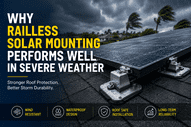
A rooftop solar system can look perfectly fine on installation day and still develop problems years later under heavy weather exposure.
That is usually the part homeowners do not think about. The real pressure test starts after repeated wind uplift, seasonal expansion, driving rain, rooftop heat, and freeze-thaw cycles begin to stress the roof structure beneath the array. In some cases, the panels themselves are not the issue at all. The mounting system underneath them becomes the weak point.
Contractors see this happen more often on rushed installations where attachment spacing, flashing details, or roof compatibility were treated like secondary concerns. A system may survive the first storm without issues, but long-term rooftop movement gradually exposes shortcuts.
That is why mounting integrity matters just as much as panel efficiency. According to the U.S. Department of Energy, homeowners should evaluate roof condition, structural considerations, and long-term system planning before moving forward with rooftop solar installation.
Modern railless solar mounting systems are designed to minimize unnecessary rooftop hardware while maintaining structural stability in changing weather conditions. For many installers, the goal is not simply to get panels attached quickly. The goal is to build a rooftop system that continues performing quietly through years of environmental stress.
Most experienced installers spend more time evaluating the roof itself than homeowners realize.
Before a single panel is mounted, contractors usually assess the roof condition, framing layout, wind exposure, attachment spacing, waterproofing details, and the roofing material’s response to long-term movement.
A newer standing-seam roof behaves very differently from an aging asphalt shingle system that has already spent 15 years expanding and contracting through seasonal weather cycles.
That difference matters.
One contractor working in a coastal wind zone explained that most mounting callbacks he sees are not catastrophic failures. More often, the problems develop slowly:
or hardware loosening after years of vibration and wind exposure.
The system may still operate normally electrically while the roof underneath starts experiencing wear around poorly planned attachment points.
That is one reason many installers prefer lower-profile railless systems on residential projects. Fewer rooftop components can reduce unnecessary complexity while still maintaining structural performance when the system is properly engineered.
Many contractors evaluating long-haul roof performance often look closely at how modern railless solar mounting systems handle attachment spacing, waterproofing integration, and structural movement under changing weather conditions.
The mounting hardware underneath the array carries far more responsibility than most homeowners realize.
As wind moves across the roof surface, pressure forms beneath the solar panels. That constant uplift force pulls against:
The outer roof edges and corners usually experience the highest stress during storms.
Roofs naturally expand and contract during temperature swings. Over time, thermal movement places repeated stress on:
A mounting system has to handle years of movement, not just one season.
Each roofing system responds differently under weather exposure.
For example:
That is why experienced contractors adjust mounting strategy based on the roof itself instead of using the same approach everywhere.
Most major mounting systems today are engineered to meet structural testing standards. The bigger issue usually comes down to installation quality in the field.
Even high-quality hardware can underperform if installers rush important details like:
Contractors occasionally find systems where attachment points missed framing members completely or where inconsistent spacing created uneven uplift stress across the array.
Those problems do not always show up immediately.
One installer described a reroofing project where the original solar system looked fine externally, but once the panels were removed, moisture damage had already formed around several poorly flashed penetrations beneath the shingles. The homeowner never noticed a problem until the reroof inspection exposed the hidden water intrusion.
Situations like that are part of the reason experienced roofers focus heavily on waterproofing integrity during solar installation.
The strongest rooftop solar systems are usually the ones homeowners rarely think about after installation.
A rooftop solar system may face:
all while remaining attached to a roofing system that is aging at the same time.
That long-haul exposure is where mounting quality becomes extremely important.
Railless solar mounting systems continue gaining popularity because they reduce excess rooftop hardware while still supporting strong structural attachment performance when installed correctly. Many contractors also prefer the cleaner residential appearance and simplified layout process on certain roof types.
Still, no mounting system performs well if installation shortcuts undermine the structural integrity underneath the array.
Most homeowners focus heavily on the solar panels themselves, but long-term reliability usually gets decided underneath the array. Roof attachments, flashing integration, structural spacing, and waterproofing details all play a major role in how a system handles years of environmental exposure.
For contractors, choosing a mounting strategy is rarely just about installation speed or appearance alone. Most experienced contractors are usually thinking five or ten years ahead, not just installation day
Railless solar mounting systems can offer strong long-haul performance when the roof condition, attachment layout, and waterproofing details are handled correctly from the start. That is why experienced installers typically spend more time planning the roof structure beneath the array than homeowners ever realize.
Before moving forward with any rooftop solar installation, it is worth looking closely at how the mounting system interacts with the roof itself. In many cases, long-term durability depends far more on mounting integrity than people expect.

© 2025 Crivva - Hosted by Airy Hosting Managed Website Hosting.