

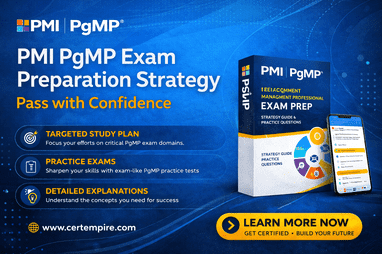
The PMI Program Management Professional credential is designed for professionals who manage multiple related projects as a coordinated program, not just individual projects. PMI describes PgMP as a certification for experienced program managers who can navigate complexity and align work to strategic objectives. That alone makes the exam different from many other certifications, because it expects mature judgment, cross-project thinking, and real-world leadership depth.
That is also why PgMP preparation cannot be treated like a simple memorization exercise. PMI’s certification handbook says candidates for portfolio, program, and project management credentials are tested through scenario-based questions that require applying concepts and experience to on-the-job situations. In other words, the exam is built around judgment, not just recall.
For professionals targeting PgMP in 2026, a smart preparation strategy starts with understanding the current blueprint, building a study plan around the official domains, and then practicing how to think like a program leader under exam pressure.
Before building a study plan, candidates need to understand what the current exam is measuring. PMI’s PgMP handbook and exam content outline show that the current blueprint was aligned in March 2024 with The Standard for Program Management, Fifth Edition, and that many domains, tasks, and skills were revised or reclassified compared with earlier versions.
The current PgMP exam blueprint is divided into five performance domains:
| PgMP Domain | Weight |
|---|---|
| Strategic Program Management | 15% |
| Program Life Cycle | 44% |
| Benefits Management | 11% |
| Stakeholder Management | 16% |
| Governance | 14% |
PMI’s current handbook shows Program Life Cycle is the largest area by far at 44%, which means a serious study plan should give that domain the most time.
This matters because many candidates study evenly across topics, even when the blueprint is not balanced evenly. A more effective strategy is to prioritize based on exam weight, while still making sure all five domains are covered.
Since nearly half the exam blueprint sits in Program Life Cycle, this is where a lot of candidates either win or lose the exam. The goal is not to memorize a list of process names. The goal is to understand how a program is defined, planned, delivered, monitored, adapted, and closed in a way that keeps benefits and strategy in view.
When studying this domain, focus on questions like:
These are the kinds of practical judgments that match PMI’s exam style.
Many candidates spend too much time on operational delivery and not enough on benefits. That is a mistake for PgMP. Program management is heavily tied to realizing strategic value, not just completing work.
Benefits Management may represent a smaller percentage than Program Life Cycle, but it is one of the areas that clearly separates program thinking from project thinking. Candidates should be able to reason through how benefits are identified, tracked, sustained, measured, and protected when conditions change. PMI’s own certification description emphasizes aligning programs to strategic objectives, which reinforces this importance.
Governance and Stakeholder Management together make up 30% of the current blueprint, which is too large to treat as secondary. PMI’s handbook and content outline show that the exam is built around applying experience in realistic situations, which means these areas are likely to appear in judgment-heavy questions.
For Governance, focus on decision rights, oversight, escalation paths, alignment with standards, and how program decisions should be structured and controlled.
For Stakeholder Management, focus on engagement, expectation balancing, communication choices, conflict handling, sponsorship alignment, and decision influence across a broad stakeholder set.
This is where many scenario questions become tricky, because multiple choices may sound acceptable, but only one reflects the best program-level response.
Because PMI’s exam format is scenario-based, practice questions are important. But they only help when used correctly. The right way is to use them to improve judgment and identify weak reasoning patterns. The wrong way is to memorize answer patterns.
A better approach is:
This is also why some learners supplement official materials with structured question-based practice resources such as Cert Empire, especially when they want more exam-style review while working through the PgMP blueprint.
A clean PgMP study strategy can be broken into four phases.
Read the handbook, exam content outline, and standard. Map the five domains. Understand the role difference between project and program management.
Study each domain in order, giving extra time to Program Life Cycle. Build notes in your own words. Use scenario framing instead of passive reading.
Move into exam-style questions by domain, then mixed full-length practice. Focus on reasoning quality and consistency.
Revisit weak domains, refine timing, and do realistic timed practice. At this stage, your goal is confidence, not cramming.
One common mistake is preparing for PgMP as though it were a project management exam with different vocabulary. It is not. Program management requires more strategic and benefits-focused thinking.
Another mistake is ignoring the current blueprint and relying on old prep materials. PMI’s current outline was revised and aligned in 2024, so older study content may not match the current structure well.
A third mistake is studying only theory without scenario practice. PMI’s own handbook is clear that these exams require application of concepts to on-the-job situations.
A fourth mistake is underestimating Governance and Stakeholder Management. Together, they form almost one-third of the blueprint.
Passing PgMP with confidence comes from preparation that is strategic, not random. Start with the current PMI blueprint. Use the 5th Edition program management standard as a core reference. Weight your study time based on domain percentages. Practice scenario-based questions the right way. Most importantly, prepare yourself to think like a program leader, not just a project executor. That is what the credential is really testing.
For a better understanding, check out Cert Empire’s YouTube Video.
1. Is the PgMP exam based on the latest PMI program management standard?
Yes. PMI’s current PgMP exam content outline says the exam was aligned in March 2024 with The Standard for Program Management, Fifth Edition.
2. Which PgMP domain should I study the most?The
Program Life Cycle deserves the most attention because PMI’s current handbook lists it at 44% of the blueprint, making it the largest exam domain.
3. Are PgMP questions mostly theory-based?
No. PMI’s certification handbook says these exams use scenario-based questions that require applying program management concepts and experience to job-like situations.
4. Is PgMP suitable for beginners?
No. PMI positions PgMP for experienced professionals and lists it among credentials for those with several years of program-level experience.

© 2025 Crivva - Hosted by Airy Hosting Managed Website Hosting.