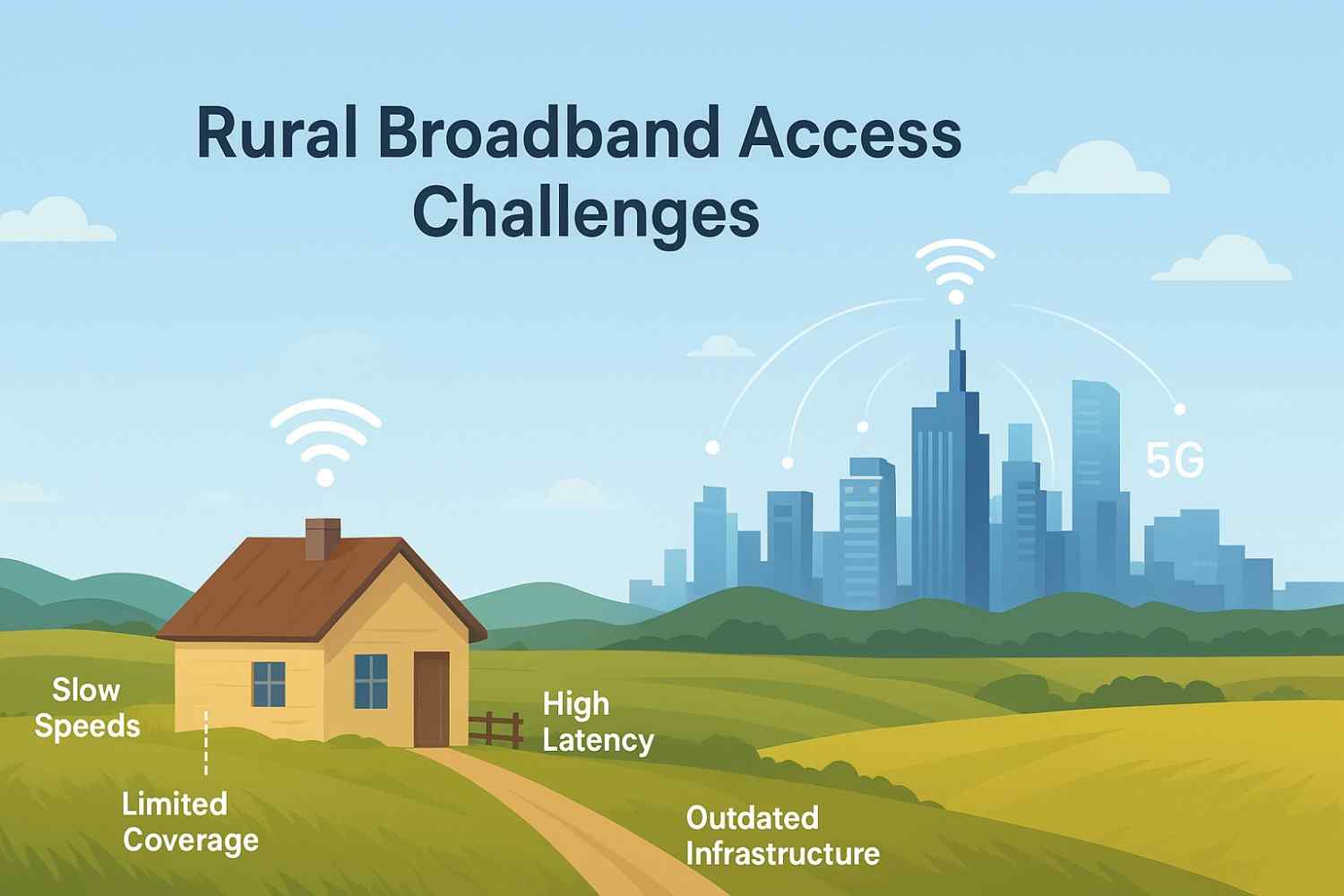
If you live in a rural community, you’ve probably faced slow, unreliable, or costly internet service. Video calls might freeze, your kids may struggle to stream lessons, and your work-from-home setup could take much longer to finish tasks. It’s frustrating, especially when high-speed internet seems like a basic need today.
You’re not alone. Rural broadband access challenges has been a persistent issue across the United States, impacting millions of households. While cities enjoy fast fiber connections, many rural homes still depend on outdated or limited networks. But there’s good news: solutions are available, and more are appearing every year.
Let’s look at the real challenges and, more importantly, the practical steps rural residents can take right now for better, faster, and more reliable internet.
To understand how to tackle rural internet access issues, it helps to know why they still exist today. It’s not just about being far from town.
Here are the big reasons:
It costs internet providers more to install infrastructure like fiber lines when homes are spread miles apart. Cities get upgrades first because they are more profitable.
Many rural areas still depend on DSL, which uses copper lines designed decades ago for landline phones not for streaming services, cloud storage, or Zoom calls for work.
In many rural regions, there’s often only one provider or none at all. Fewer choices usually mean higher prices and lower speeds.
Mountains, forests, valleys, and remote landscapes can hinder broadband expansion and weaken wireless signals. So yes, the struggle is real, but it is not hopeless.
Technology has evolved. In recent years, newer and smarter internet options for rural areas have appeared. Here are some of the most effective and accessible choices today:
This uses 4G or 5G LTE cellular networks to provide broadband service through a router.
Providers like UbiFi and Nomad Internet are becoming popular because they understand the needs of rural customers.
Satellite internet has always been a fallback for rural areas, but next-generation systems are improving speed and reducing latency.
Good for:
Downsides:
Government grants and private investments are gradually bringing fiber internet deeper into rural America. If fiber development is ongoing in your county, you’re in luck.
Mobile devices or hotspots can create a Wi-Fi network, which is useful for travelers and people using RVs. It works best with signal boosters.
You might not need to change providers. Sometimes, you just need to optimize the service you already have.
Old routers lead to slow speeds. Modern LTE routers, especially those designed for rural use, can significantly improve reliability.
A cellular booster strengthens weak 4G/5G signals coming into your home.
This is especially helpful if:
Apps like CellMapper or OpenSignal can help you find the nearest signal source. This allows you to position your external antenna for better reception.
Outside antennas can capture signals better than an indoor router alone. Combining an antenna with a booster and router is one of the most effective rural solutions.
Avoid data caps or throttle limits; they can ruin streaming and hurt work productivity.
A family living near the Ozarks used DSL for years, facing buffering and dropped calls. When their kids needed online schooling, they required a better solution quickly.
They switched to a 4G LTE router with an external antenna aimed at the nearest cell tower.
Results:
This is a common success story and shows how smart equipment choices can make a significant difference.
There’s no one-size-fits-all answer. It depends on distance, geography, and provider access.
|
Situation |
Best Option |
|
You have decent 4G/5G signal |
LTE Router / Fixed Wireless |
|
You have weak cell signal |
LTE Router + External Antenna + Booster |
|
No cellular signal at all |
Satellite Internet |
|
Fiber is available |
Get Fiber — no question |
If you’re unsure what works best for you, start by checking your signal strength. Simply looking at the signal bars on your phone can help.
Rural broadband access challenges are real, but they are not impossible to solve. The key is to understand your local conditions and choose the right technology for your area.
Whether it’s fixed wireless, satellite, signal boosters, or router upgrades, rural communities can achieve reliable, high-speed connectivity. As network investments grow and new options become available, rural internet is slowly advancing toward a better future.
Rural areas often lack fiber infrastructure and rely on outdated DSL lines or weak wireless networks due to low population density.
Rural areas often lack fiber infrastructure and rely on outdated DSL lines or weak wireless networks due to low population density.
For most areas, 4G/5G LTE fixed wireless offers the best mix of cost, speed, and reliability, especially with a good router and signal booster.
Yes. Storms, heavy clouds, and snow can disrupt satellite signals, causing slowdowns or outages.
Absolutely, especially with a strong signal and unlimited data plan. Many remote workers successfully use LTE-based providers.
Use:

© 2025 Crivva - Hosted by Airy Hosting Managed Website Hosting.