

Most commercial solar projects do not slow down because of major installation failures. More often, crews lose time making small alignment corrections that add up across the roof over the course of the install.
A rail that sits slightly uneven near one attachment point can create spacing inconsistencies several rows later. Installers end up revisiting earlier sections, adjusting rail height, or adding shims just to keep the array aligned properly across the roof surface.
Those corrections become even more noticeable on older commercial roofs, reroof retrofit projects, and low-slope buildings where slight deck inconsistencies already exist beneath the mounting layout. That is one reason one-step leveling systems have become more common in commercial solar mounting discussions.
For contractors evaluating simplified mounting workflows, systems like RT Apex are designed to streamline attachment leveling while maintaining long-term waterproofing compatibility and mounting stability under real-world rooftop conditions.
Before solar modules are installed, the mounting system must provide a stable, level structural foundation across the roof surface.
That sounds simple until crews start working on:
Even minor elevation differences can affect rail alignment over long spans.
Traditional rail-based systems often require installers to:
On large commercial projects, repeating those adjustments at hundreds of attachment points can considerably slow installation progress.
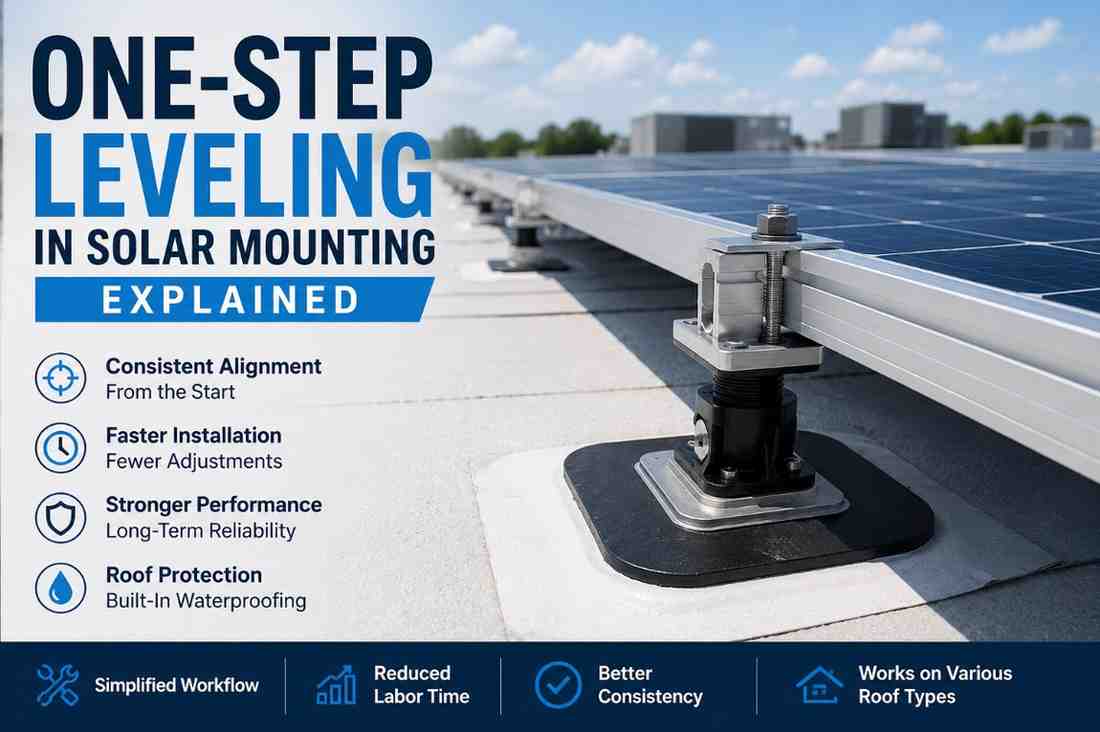
One-step leveling simplifies part of that process by allowing installers to level the mounting point during the initial attachment stage, rather than having to revisit alignment corrections later.
Instead of correcting inconsistencies downstream after the rails are installed, crews can achieve more consistent alignment from the start.
The goal is usually to reduce the frequency with which crews must revisit alignment corrections later in the installation.
That becomes especially useful on projects where:
In practice, the efficiency gain usually comes from reducing cumulative correction work rather than dramatically speeding up one specific task. The U.S. Department of Energy also notes that rooftop solar mounting systems must account for structural loading, weather exposure, and long-term installation reliability rather than focusing only on installation speed or material reduction.
Most commercial solar installation slowdowns happen gradually rather than all at once.
A rail that sits slightly high at one attachment point may not look serious at first glance. But over longer rail spans, those inconsistencies can compound, creating visible alignment issues further along the array.
Installers then spend additional time:
Some older low-slope roofs also develop slight deck movement over time, especially near heavily serviced mechanical areas. That can affect attachment consistency differently depending on how loads transfer through the mounting system.
This is one reason many commercial crews still pay close attention to rail system design and attachment layout before installation begins.
For contractors comparing mounting approaches more broadly, this breakdown explains where rail-based mounting still provides practical advantages on certain rooftop projects.
Installation efficiency only matters if the roof system remains reliable years later.
One issue contractors experience fairly often is crews becoming overly focused on installation speed while overlooking waterproofing details around penetrations and flashing assemblies.
A faster leveling process does not eliminate:
In fact, rushed attachment work can sometimes create:
That becomes especially important on:
The mounting system must still work with the roof assembly long after the installation crew leaves the project.
A reroof retrofit project in the Southwest highlighted this pretty clearly.
The installation crew was working around several large HVAC curbs on a low-slope commercial roof where slight elevation inconsistencies existed across different sections of the deck. Previous projects on similar buildings had required repeated shim adjustments later in the installation just to maintain rail consistency across longer spans.
This time, the crew used a mounting layout with integrated one-step leveling adjustments at the attachment stage.
The improvement was gradual rather than dramatic.
Fewer rail sections required downstream corrections later in the install. Alignment stayed more consistent across longer rows, and the crew spent less time revisiting earlier attachment points to compensate for cumulative spacing inconsistencies.
One installer described it pretty simply:
“The less time we spent chasing rail height corrections later, the smoother the whole roof went.”
That tends to be how operational improvements show up on commercial rooftops. Small efficiencies are repeated hundreds of times throughout the project.
One-step leveling is not really about flashy speed claims. The bigger advantage is reducing repeated alignment corrections across large rooftop solar installations.
By simplifying attachment leveling earlier in the process, these systems can help improve rail consistency, reduce installation variability, and create smoother workflow progression across the roof surface. But installation speed alone is never the full story.
Long-term waterproofing, attachment integrity, thermal movement, wind uplift resistance, and reroof compatibility continue to determine the system’s performance years after installation.
For contractors evaluating solar mounting systems, the more useful question is whether the leveling approach improves both installation efficiency and long-term roof reliability under real-world rooftop conditions.
The strongest mounting systems are usually the ones that simplify field work while still protecting the roof assembly through years of weather exposure, thermal movement, and routine rooftop service traffic. In commercial solar projects, the best mounting systems are usually the ones that save crews time without creating roofing problems five or ten years down the road.

© 2025 Crivva - Hosted by Airy Hosting Managed Website Hosting.