


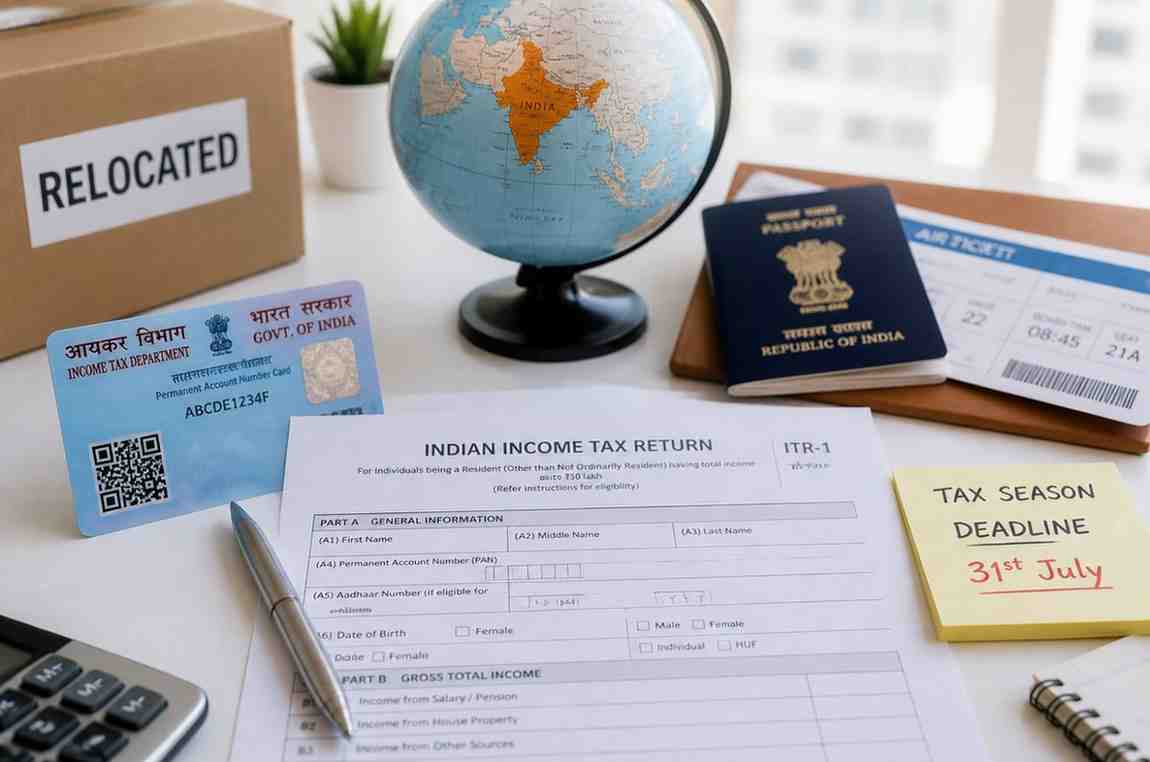
There’s a strange assumption a lot of people carry once they move abroad. It goes something like this: if I’m not living there anymore, the tax office has no real reason to think about me. It’s a comforting idea, and it’s also wrong in more cases than people expect.
Tax obligations don’t follow citizenship or where you sleep at night. They follow income, and specifically where that income comes from. Move to another country, and India’s tax authority doesn’t lose interest in you. It just starts paying attention to a narrower slice of your finances.
Most people who relocate assume their financial life splits cleanly in two. New country, new tax system, new set of rules, and the old country fades into the background. In practice, very few people’s finances actually work that way.
A rented-out flat, an old fixed deposit, a mutual fund started years ago, a family property with your name still on the title. None of these disappear just because you’re no longer physically present to manage them. They keep generating income, and that income keeps a paper trail whether anyone’s watching it or not.
This is usually where the property side and the tax side stop being separate problems and start overlapping. It’s part of why many NRIs eventually rely on a single point of contact instead of juggling different people for each piece, often through combined NRI tax and legal services India.
This is where a lot of confusion sets in. People assume that because they’re earning their salary somewhere else now, taxed under a different system entirely, nothing from India applies to them anymore. That’s only true for income earned outside the country.
Anything sourced from India works differently. Rent from a property, interest from a bank account held there, capital gains from selling shares or land, even dividends from Indian investments all count. The tax office cares about where the money came from, not where the person collecting it currently lives.
This distinction confuses a lot of people because their instinct runs the other way. They assume tax follows the person, when in most systems it actually follows the income itself. Once that clicks, the rest of the obligation tends to make a lot more sense.
NRO and NRE accounts get set up early, often right when someone first moves, and then get largely forgotten. Interest quietly accumulates in the background. Most people don’t think about them again until a bank statement surfaces during some unrelated errand.
That interest is taxable, and banks typically deduct tax at source on it automatically. What people miss is that deduction at source isn’t the same as being done with your obligations. A return still needs to be filed to reconcile what was deducted against what’s actually owed, and sometimes to claim money back.
Deadlines are easy to track when they’re attached to something visible, like a mortgage payment or a subscription renewal. Tax filing deadlines back home don’t have that same visibility once you’re not living there day to day. Nobody mentions it at the dinner table anymore because there isn’t a dinner table in that country.
The reminder that would have come from a colleague mentioning it at work, or a news segment playing in the background, simply isn’t there. Add a different calendar of financial deadlines in the new country, and the old one gets buried without anyone deciding to bury it. By the time it resurfaces, it’s often already late.
This isn’t a one-time risk either. It resets every financial year, which means the same gap in awareness can repeat itself again without anyone noticing a pattern forming. What felt like a one-off oversight the first year can quietly turn into a habit by the third.
The consequences aren’t always dramatic, but they compound in ways that catch people off guard. A missed filing can mean forfeited refunds on tax that was already deducted at source, essentially money left on the table. It can also mean penalty notices that show up months after the fact, once the return period has closed.
For anyone who eventually wants to sell property in India, transfer funds abroad, or bring in an investor for a business there, a spotty compliance history becomes a real obstacle. Banks and buyers increasingly ask for clean tax records before completing transactions. What felt like a minor oversight years ago turns into a documentation problem at exactly the moment speed matters most.
There’s also a quieter cost that doesn’t show up on any notice. People carry a background uncertainty about whether they’ve actually stayed compliant, without a clear way to check. Understanding how the requirements around NRI ITR filing India actually apply to a given situation tends to resolve that uncertainty faster than most people expect once they finally look into it.
The people who avoid this problem tend to do one thing consistently. They treat their Indian financial obligations as a fixed yearly task, not something to figure out only when a bank or a buyer asks for proof. It gets scheduled, it gets handled, and it stops being a source of background stress.
That shift matters more the longer someone lives abroad. Distance already makes it harder to notice small issues before they grow. Adding tax uncertainty on top of that is avoidable, and avoiding it usually just comes down to deciding, once, that this particular piece of paperwork gets the same attention as everything else that matters back home.
None of this requires becoming an expert in Indian tax law. It just requires acknowledging that moving away changes how income gets managed, not whether it needs to be.
Most people who run into trouble here didn’t ignore the rules on purpose. They simply assumed distance was enough to make the rules stop applying, and found out otherwise later than they would have liked.

© 2025 Crivva - Hosted by Airy Hosting Managed Website Hosting.