


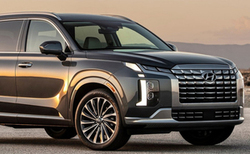
The 2026 Hyundai Palisade enters its second generation with a clear objective: expand powertrain choice, harden its off-road credentials, and tighten the competitive gap against the Toyota Grand Highlander and Honda Pilot. Hyundai rebuilt the platform architecture, introduced a new 2.5-liter turbo hybrid, and engineered a legitimate XRT PRO trim with measurable trail hardware.
This is not a mid-cycle refresh. It is a ground-up rework of Hyundai’s three-row flagship SUV, with specific attention to torque delivery, chassis rigidity, hybrid efficiency, and towing capability.
Looking at the data, Hyundai wants to own the sweet spot between family-hauler efficiency and real-world utility.
Hyundai stretched the second-generation Palisade to improve third-row usability and cargo capacity. Specifically, the wheelbase grows to approximately 116.9 inches, up from the outgoing model’s 114.2 inches. Overall length now pushes past 199 inches, depending on trim.
That additional wheelbase matters.
A longer wheelbase reduces pitch motions over uneven pavement, improves high-speed stability, and creates measurable legroom gains in the second and third rows. By comparison, the Toyota Grand Highlander runs a 116.1-inch wheelbase, while the Honda Pilot sits at 113.8 inches. Hyundai now competes at the top of the class for footprint.
| Specification | 2026 Hyundai Palisade | Toyota Grand Highlander | Honda Pilot |
|---|---|---|---|
| Wheelbase | ~116.9 in | 116.1 in | 113.8 in |
| Overall Length | ~199+ in | 201.4 in | 199.9 in |
| Width | ~78+ in | 78.3 in | 78.5 in |
| Height | ~69-71 in | 70.1 in | 71.0 in |
Consequently, Hyundai positions the Palisade directly against the largest midsize crossovers rather than the traditional Pilot-sized footprint.
Design-wise, Hyundai shifts to a more upright fascia, squared-off proportions, and vertical LED lighting signatures. The bodywork emphasizes horizontal mass, reinforcing width and stance. Specifically, the XRT PRO trim adds functional cladding and recovery-oriented hardware rather than decorative plastic.
2026 Hyundai Palisade expands its strategy with two distinct propulsion approaches:
The headline move is the 2.5T Hybrid powertrain. Hyundai pairs a turbocharged 2.5-liter four-cylinder with an electric motor integrated into a six-speed automatic transmission.
Estimated output:
The torque figure matters more than the horsepower headline.
By integrating the motor into the transmission housing, Hyundai delivers near-instant torque fill at low rpm. That architecture reduces turbo lag, improves launch smoothness, and allows taller final-drive gearing for highway efficiency. In addition, the system uses a lithium-ion battery pack sized for torque assist rather than extended EV-only range.
By comparison:
Looking at the data, Hyundai targets a balance between output and efficiency rather than outright segment dominance in horsepower.
Hyundai continues offering a V6 for buyers prioritizing simplicity and proven durability.
Expected specs:
From an expert perspective, Hyundai retains the V6 for fleet buyers, traditionalists, and customers in colder climates who distrust hybrid complexity.
Hyundai has not finalized EPA numbers, but internal targets suggest:
Specifically, the hybrid system uses aggressive regenerative braking mapping and optimized thermal management to reduce cold-start fuel penalties. That matters in northern U.S. markets where winter efficiency drops sharply.
By comparison:
| Model | Best Combined MPG |
|---|---|
| Hyundai Palisade Hybrid | ~32-34 mpg |
| Toyota Grand Highlander Hybrid | 36 mpg |
| Honda Pilot | 22 mpg |
Toyota still wins the absolute efficiency metric. Hyundai counters with stronger torque output and likely lower entry pricing.
Hyundai repositions the XRT PRO trim as a serious off-road variant rather than a styling package.
Approach angle improves to roughly 20+ degrees, with departure and breakover angles recalibrated for trail geometry. Specifically, Hyundai recalibrates the AWD clutch engagement logic to allow more rear torque bias in low-speed crawling scenarios.
By comparison:
Consequently, Hyundai directly challenges Honda in the light-overlanding niche.
Towing capability directly influences SUV purchase decisions.
Estimated ratings:
Hyundai integrates a transmission oil cooler and recalibrated torque management logic to prevent thermal overload under sustained grade towing.
Looking at the competition:
| Model | Max Towing |
|---|---|
| Hyundai Palisade V6 | 5,000 lbs |
| Toyota Grand Highlander | 5,000 lbs |
| Honda Pilot | 5,000 lbs |
Hyundai meets parity in raw capacity. The difference lies in torque curve delivery and cooling resilience.
Hyundai reworks the cabin around a dual-screen curved display cluster.
Specifically, the longer wheelbase increases third-row legroom by approximately 1.5-2 inches over the outgoing model. That improvement moves Palisade closer to Grand Highlander levels of comfort.
Cargo capacity estimates:
Hyundai also improves NVH insulation using thicker laminated glass and enhanced subframe mounting isolation.
Hyundai stiffens the unibody structure with additional high-strength steel cross-members.
Why that matters:
A stiffer chassis reduces suspension tuning compromise. Engineers can dial in more compliant damping without introducing float or imprecise steering feel.
Front: MacPherson strut
Rear: Multi-link independent suspension
Specifically, Hyundai retunes damper valving for improved rebound control, reducing secondary oscillations after large impacts.
By comparison:
Hyundai aims for a balanced midpoint.
The second-generation Palisade expands Hyundai SmartSense technology.
Expected features:
Specifically, Highway Driving Assist 2 adds semi-automated lane change capability when drivers signal.
Hyundai maintains strong IIHS performance expectations based on structural upgrades.
Wins:
Losses:
Wins:
Losses:
From a strategic standpoint, Hyundai attacks both rivals by offering more drivetrain choice in one platform.
Choose the 2.5T Hybrid if:
Choose the V6 if:
Torque fill refers to using an electric motor to provide immediate low-rpm torque while a turbocharger spools. This prevents lag and improves launch smoothness.
Hyundai likely positions pricing as follows:
Hyundai historically undercuts Toyota by $1,000-$2,000 in comparable trims.
If you are cross-shopping:
The 2026 Hyundai Palisade strengthens Hyundai’s position in the three-row SUV segment through expanded powertrain diversity, genuine off-road engineering in XRT PRO, and measurable improvements in interior space.
Looking at the data, Hyundai closes the gap to Toyota in efficiency while challenging Honda in packaging and torque delivery. That dual-front strategy makes the second-generation Palisade one of the most strategically positioned midsize SUVs heading into 2026.

© 2025 Crivva - Hosted by Airy Hosting Managed Website Hosting.