

Automation is no longer just a productivity trend. It has become the operational backbone of modern businesses. From startups streamlining customer onboarding to enterprises managing complex AI-driven workflows, companies are increasingly relying on automation platforms to reduce manual effort, improve efficiency, and scale faster without dramatically increasing operational costs.
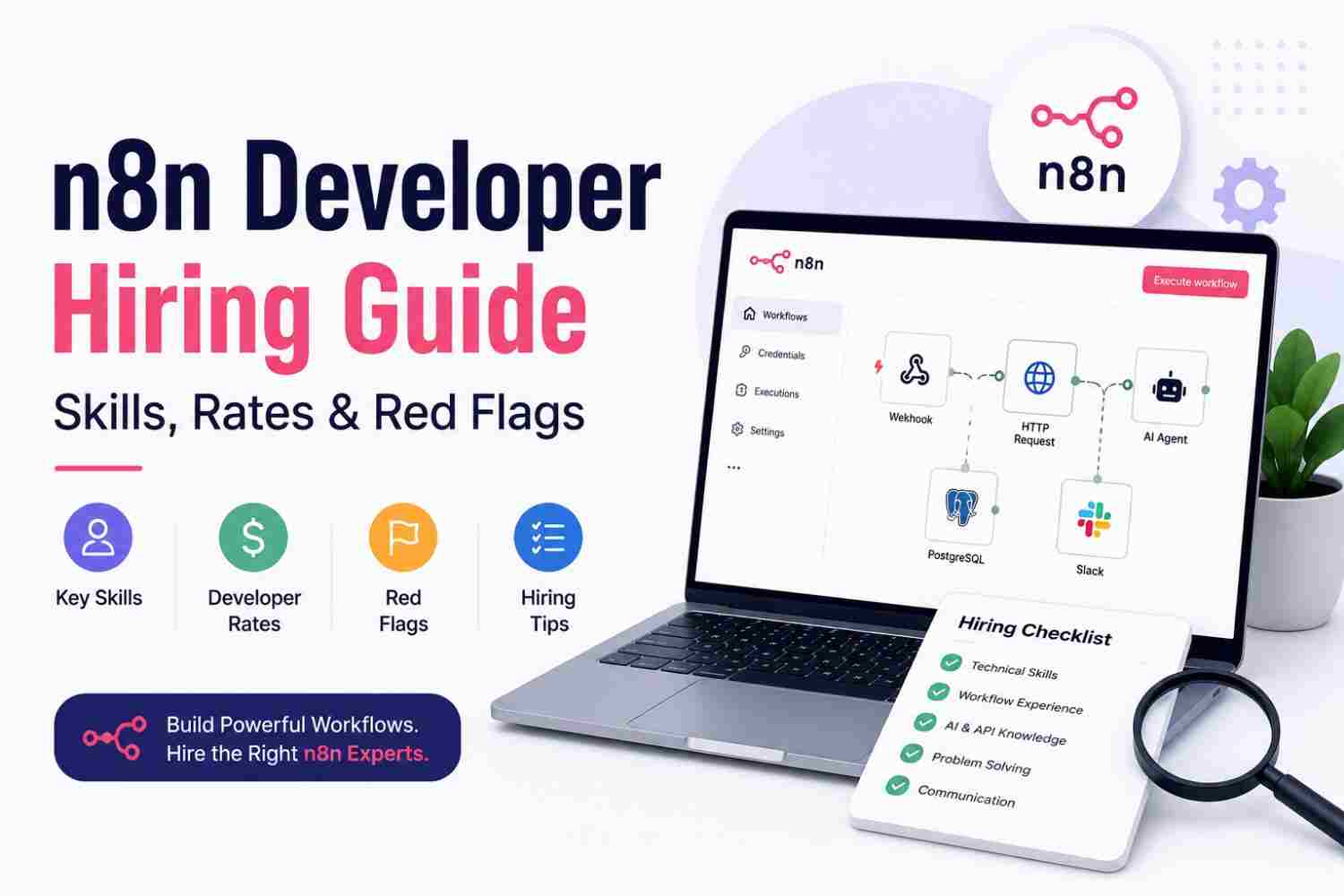
Among the many workflow automation platforms available today, n8n has emerged as one of the most powerful and flexible solutions for businesses looking to build customizable automations. Unlike rigid no-code tools, n8n gives companies far greater control over integrations, APIs, data flows, AI systems, and business logic. This flexibility is exactly why demand for skilled n8n developers has grown rapidly over the last two years.
However, hiring the right developer is where many businesses struggle.
In this guide, you’ll learn:
Whether you’re a startup exploring workflow automation for the first time or an enterprise expanding AI operations, this guide will help you make smarter hiring decisions.
At first glance, n8n may appear to be just another automation tool. In reality, it’s far more powerful than simple drag-and-drop automation platforms.
An experienced n8n developer designs intelligent workflows that connect applications, automate business logic, synchronize data, and integrate AI capabilities into operational systems. Their role often extends beyond workflow creation into backend architecture, API engineering, and process optimization.
Unlike basic automation builders, professional n8n experts understand how to create scalable, secure, and maintainable automation ecosystems that support real business growth.
Many businesses initially use n8n for basic automations such as:
However, experienced developers can build far more advanced systems.
For example, a fintech company may use n8n to automate investment alerts, fraud detection triggers, and AI-powered customer onboarding workflows. Meanwhile, an eCommerce business may automate inventory management, dynamic pricing, customer segmentation, and AI-generated support responses.
The difference lies in the developer’s ability to architect workflows strategically rather than simply connecting apps together.
One major reason businesses now actively hire n8n experts is the rise of AI-powered automation.
Modern companies want workflows that integrate with:
This shift has transformed n8n from a simple automation platform into a critical AI operations layer for businesses.
An experienced AI development company often combines n8n with machine learning systems, cloud infrastructure, and enterprise APIs to create intelligent operational workflows that reduce manual effort while improving decision-making speed.
One of the biggest hiring mistakes companies make is focusing only on whether someone has used n8n before. The platform itself is relatively easy to learn. What truly matters is the developer’s ability to design scalable, reliable, and intelligent workflows that solve real business problems.
Infrastructure knowledge is equally important. Many businesses underestimate the operational demands of workflow automation. A workflow that performs well during testing can quickly fail under production-level traffic if scalability planning is weak. Skilled n8n developers should understand Docker, cloud hosting, databases, queue systems, and deployment environments because automation systems often become mission-critical business infrastructure.
As AI adoption accelerates, companies also need developers who understand how to combine automation with intelligent systems. Modern businesses are increasingly integrating AI models into operational workflows for customer support, document analysis, predictive analytics, semantic search, and content generation.
Pricing for n8n development varies significantly depending on project complexity, developer experience, infrastructure requirements, and AI integration needs. Businesses often make the mistake of focusing entirely on hourly rates rather than long-term operational value.
Freelancers may charge anywhere from $25–$100 per hour depending on expertise.
They work well for:
However, freelancers may struggle with enterprise scalability, documentation, and long-term support.
Professional n8n workflow automation companies typically charge more but offer:
This model works best for businesses building long-term automation ecosystems.
Some enterprises partner with a full AI development company to build complex automation infrastructure integrated with enterprise systems, analytics platforms, and AI services.
These projects usually involve:
While the investment is higher, the long-term operational value is often significantly greater.
As automation demand increases, many inexperienced developers are positioning themselves as workflow experts despite having limited real-world implementation experience. This creates significant risks for businesses investing in automation infrastructure.
Some developers know how to create nodes in n8n but fail to understand operational processes.
Automation is not just technical execution, it’s business optimization.
A developer who cannot understand:
will likely create fragile workflows that fail under real business conditions.
Poor documentation becomes a nightmare during scaling.
Businesses should ask:
Without documentation, future maintenance becomes extremely difficult.
Professional n8n workflow automation companies usually follow structured documentation standards because enterprise clients require long-term maintainability.
Automation workflows often process sensitive business and customer data.
Developers who ignore:
create serious operational risks.
This becomes especially critical for industries like healthcare, fintech, legal services, and enterprise SaaS.
AI hype has created unrealistic expectations.
Some developers claim they can build “fully autonomous AI systems” without understanding model limitations, hallucination risks, or infrastructure complexity.
Businesses should look for realistic, technically grounded expertise rather than marketing-heavy promises.
Many workflows work initially but fail as data volume increases.
Developers should proactively discuss:
Scalability is often the difference between a useful automation system and operational chaos.
Choosing the right automation partner is not simply about technical execution. It’s about finding a team capable of supporting long-term digital transformation.
The best automation experts focus on solving business problems rather than showcasing tools.
Strong candidates ask questions like:
This consultative mindset often matters more than technical jargon.
Ask for examples of:
Practical experience matters far more than certifications.
Automation projects frequently involve multiple departments including:
Developers who communicate clearly and collaborate effectively tend to deliver stronger long-term results.
Automation systems evolve continuously.
Choose partners capable of:
This is why many companies prefer working with an established AI development company rather than relying solely on short-term freelancers.
The demand for workflow automation is growing rapidly as businesses seek faster operations, lower costs, improved efficiency, and scalable AI-driven systems. Platforms like n8n are becoming increasingly important because they allow organizations to build highly customized automations tailored to unique operational needs.
Businesses looking to hire n8n developers should focus on far more than workflow-building experience alone. The best developers understand APIs, cloud infrastructure, AI integrations, scalability planning, business operations, and long-term automation strategy. They create systems that remain reliable as businesses grow rather than workflows that collapse under operational complexity.
Businesses that invest in intelligent automation infrastructure today will be far better positioned to compete in tomorrow’s increasingly AI-powered digital economy.

© 2025 Crivva - Hosted by Airy Hosting Managed Website Hosting.