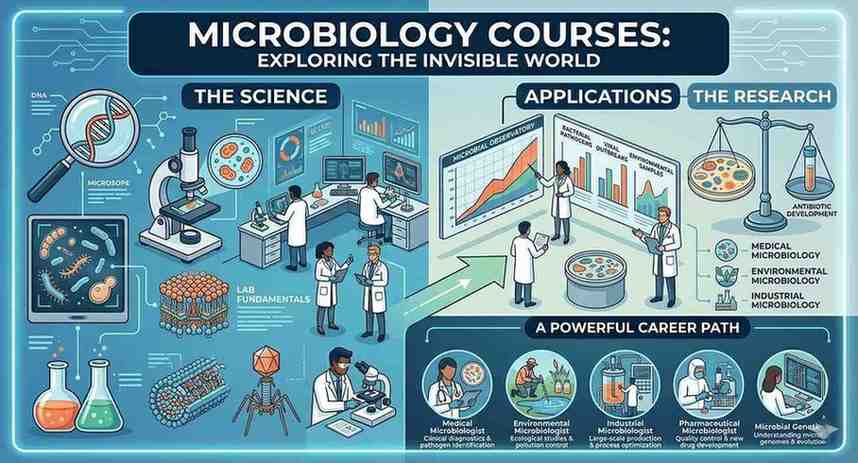
Building Expertise for a Global Scientific Career
As microbiology continues to expand across industries, students trained at Amity University Mohali gain a competitive edge in both national and international career markets. The program emphasizes not just academic excellence but also the development of technical proficiency in modern tools and techniques such as PCR, microbial culturing, sequencing, and bioinformatics analysis. These skills are highly valued in research institutions, pharmaceutical companies, and healthcare organizations worldwide.
Another key advantage of pursuing microbiology is the opportunity for global exposure, which significantly enhances both academic growth and career prospects. In today’s interconnected world, science is no longer confined within national boundaries. Research collaborations, scientific discoveries, and technological innovations happen on a global scale, and microbiology is at the center of many of these advancements. Students who build a strong foundation in microbiology are well-positioned to participate in international academic programs, research initiatives, and industry collaborations.
At Amity University Mohali, students are prepared for this global ecosystem through a curriculum that emphasizes not only subject knowledge but also research orientation and scientific communication. One of the most important aspects of global exposure is the ability to pursue higher education abroad. Countries like the United States, Canada, Germany, and Australia offer advanced research opportunities in microbiology, biotechnology, and life sciences. Students with a solid academic base and practical experience find it easier to secure admissions in reputed global universities.
Research experience plays a crucial role in this journey. Students who engage in research projects develop essential skills such as hypothesis formulation, experimental design, data analysis, and interpretation of results. These skills are highly valued by international institutions and research organizations. Participation in research also strengthens academic profiles, making students eligible for scholarships, fellowships, and funded programs.
Scientific communication is another critical skill developed during microbiology studies. Students learn to write research papers, prepare reports, and present their findings in seminars and conferences. This not only builds confidence but also prepares them to contribute to global scientific discussions. Many students get opportunities to present their work at conferences, helping them gain recognition and expand their professional network.
Collaboration is a cornerstone of modern microbiology. The field often intersects with genetics, bioinformatics, chemistry, and environmental science. Students trained in such interdisciplinary environments can easily collaborate with experts across domains and countries. This ability to work in diverse teams is highly valued in both research and corporate settings.
Internships and industrial exposure further strengthen global career opportunities. By working with pharmaceutical companies, research labs, and biotech firms, students gain practical insights into industry standards and applications. This real-world experience makes them job-ready and enhances their employability in competitive global markets.
In addition to academic and professional growth, global exposure contributes significantly to personal development. Interacting with people from different cultures broadens perspectives and improves communication, adaptability, and cultural awareness. These qualities are essential for thriving in international environments.
The rise of online learning and virtual collaboration has also expanded global opportunities. Students can now attend international webinars, enroll in global certification programs, and collaborate on research projects remotely. This accessibility allows them to stay updated with the latest advancements and connect with experts worldwide.
Microbiology also plays a vital role in global health initiatives. Organizations working on disease control, vaccine development, and public health rely heavily on microbiologists. Students with strong training and exposure can contribute to solving global challenges such as pandemics, antimicrobial resistance, and environmental issues.
International Research Collaborations
One of the most valuable aspects of global exposure in microbiology is the opportunity to participate in international research collaborations. Universities and research institutions across the world frequently partner on projects related to infectious diseases, vaccine development, antimicrobial resistance, and environmental sustainability. Students at Amity University Mohali can benefit from such collaborations through exchange programs, joint research initiatives, and academic partnerships.
These experiences allow students to work with advanced technologies, learn new methodologies, and gain insights from global experts. Exposure to different scientific approaches enhances problem-solving abilities and encourages innovative thinking. Working in international teams also helps students understand how global challenges are tackled collectively, making them more competent researchers.
Global Career Opportunities and Mobility
Microbiology offers excellent career mobility across countries, making it an ideal field for those seeking international careers. Skilled microbiologists are in demand worldwide, especially in sectors like healthcare, pharmaceuticals, biotechnology, and food safety. With the right education and exposure, students can explore job opportunities in multinational companies, global research labs, and international health organizations.
Many countries actively recruit life science professionals due to increasing demand in research and public health sectors. This creates strong pathways for students to build successful careers abroad. With globally relevant skills, microbiology graduates are not limited by geography—they can build careers across borders while contributing to global scientific progress.
Moreover, the field offers flexibility and lifelong learning opportunities. As new technologies and discoveries emerge, microbiologists continuously upgrade their skills. This dynamic nature keeps professionals engaged and ensures long-term career growth.
In essence, microbiology is more than just a subject—it is a gateway to innovation, discovery, and global impact. With strong academic support, practical exposure, and a forward-thinking approach, students can confidently step into a future where science meets purpose and passion transforms into meaningful contributions.