

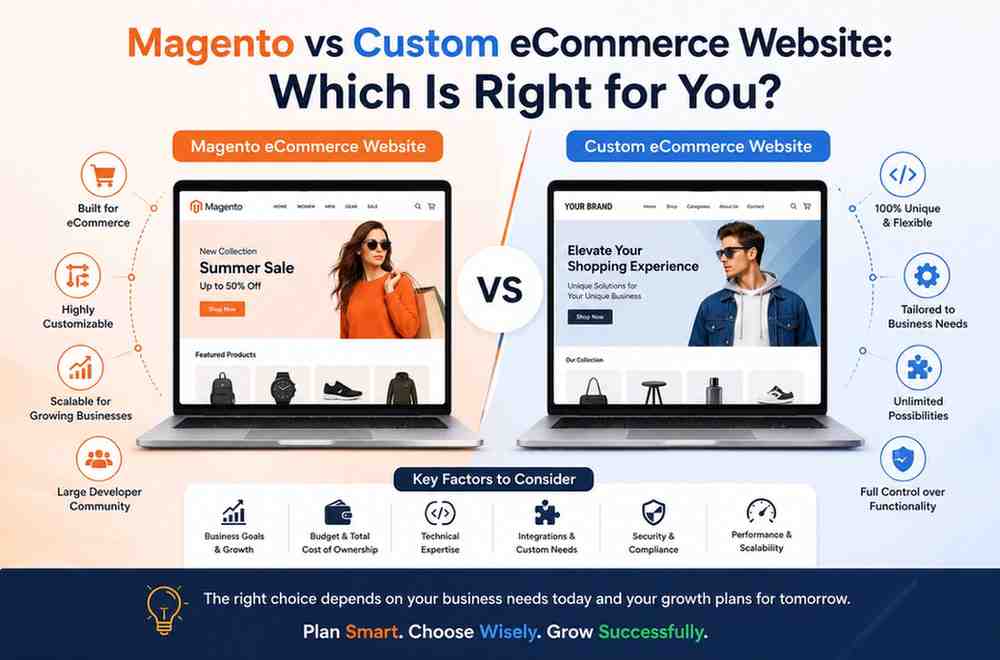
If you’re comparing Magento vs custom eCommerce websites, you’re likely planning an online store that can support your business for years to come. Both options offer flexibility and scalability, but they differ in development time, customization, maintenance, and long-term costs. Understanding these differences before investing can help you choose a solution that aligns with your business goals and future growth.
Magento and custom eCommerce websites are both powerful options, but they serve different purposes. Magento provides a robust, feature-rich framework that businesses can customize extensively, while a fully custom website is built from the ground up to meet highly specific requirements.
If you’re evaluating these options, understanding their strengths and limitations will help you make a more informed investment.
At first glance, both solutions allow businesses to sell products online, manage customers, and process orders. However, the way they’re built and maintained differs significantly.
Magento is an open-source eCommerce platform designed specifically for online stores. It includes built-in commerce features such as catalog management, promotions, customer segmentation, payment integrations, and inventory management.
A custom eCommerce website, on the other hand, is developed from scratch using programming frameworks. Every feature, workflow, and integration is designed according to unique business requirements, giving organizations complete control over functionality.
The decision isn’t about which platform is universally better; it’s about choosing the solution that best aligns with your current needs and future business objectives.
Magento has become a preferred solution for medium-sized and enterprise businesses because it combines flexibility with extensive commerce capabilities. Instead of building every feature from scratch, businesses can leverage a mature platform while customizing it to fit their operations.
Some of the biggest advantages include:
For businesses planning long-term growth, Magento ecommerce provides a flexible foundation that supports complex product catalogs, personalized shopping experiences, and enterprise-level functionality without requiring an entirely custom-built commerce system.
Although Magento offers exceptional flexibility, there are situations where a fully custom website may be the better investment.
Businesses with highly specialized workflows, proprietary business models, or unique customer experiences sometimes require functionality that extends beyond traditional eCommerce capabilities.
A custom solution may be appropriate if you need:
While custom development provides maximum flexibility, it typically requires a larger budget, longer development timeline, and ongoing technical maintenance.
Choosing an eCommerce platform shouldn’t be based solely on features. Instead, evaluate how well the solution supports your long-term business strategy.
Before making a decision, consider the following factors:
It’s equally important to think about the customer experience. A fast, secure, and easy-to-navigate website builds trust and encourages repeat purchases. Beyond technology, businesses should also follow Google’s guidelines for helpful, reliable, people-first content to create valuable content that answers customer questions, demonstrates expertise, and improves overall website quality.
For most growing businesses, Magento strikes a practical balance between flexibility and efficiency.
Instead of investing significant time and resources into building every commerce feature from scratch, businesses can focus on customizing an established platform that already supports complex eCommerce operations.
Magento is particularly well-suited for businesses that:
On the other hand, businesses with highly unconventional workflows or unique operational requirements may benefit more from a fully custom solution despite the higher development costs.
The right decision ultimately depends on how much customization your business truly needs versus the capabilities already available within a mature commerce platform.
Selecting an eCommerce platform isn’t just about solving today’s challenges; it’s about preparing for tomorrow’s opportunities.
As customer expectations evolve, businesses often need additional integrations, workflow automation, personalized shopping experiences, and improved operational efficiency. Choosing a scalable solution from the beginning reduces the likelihood of costly migrations later.
Organizations looking to extend platform capabilities often invest in custom Magento solutions to drive business growth, enabling them to build tailored features while continuing to benefit from Magento’s proven commerce framework. This approach provides the flexibility to adapt without having to replace the entire platform as business needs change.
There isn’t a one-size-fits-all answer when comparing Magento and custom eCommerce development.
If your business needs a reliable platform with advanced commerce features, scalability, and extensive customization options, Magento offers an excellent balance between flexibility and development efficiency. Businesses that require highly specialized functionality unavailable in existing platforms may find greater value in a fully custom solution.
The most successful projects begin with clearly defining business goals before selecting technology.
Rather than focusing solely on features, evaluate how each solution will support your operations over the next three to five years. This long-term perspective helps ensure your investment continues delivering value as your business grows.
Choosing the right eCommerce platform is about more than launching an online store; it’s about building a foundation that supports future growth. Both Magento and custom eCommerce websites offer distinct advantages, but the best choice depends on your business model, operational complexity, and long-term objectives.
Before making a decision, assess your current requirements, anticipate future needs, and prioritize solutions that can scale alongside your business. By balancing flexibility, functionality, and customer experience, you’ll be better positioned to build an online store that delivers sustainable success in an increasingly competitive digital marketplace.
Magento is an open-source eCommerce platform with built-in commerce features like catalog management, payment integrations, and scalability. A custom eCommerce website is developed from scratch, offering complete flexibility but typically requiring more time, budget, and ongoing maintenance.
Yes. Magento can work for small businesses with growth ambitions, but it’s especially well-suited for medium-sized and enterprise businesses that need advanced features, customization, and scalability.
Magento is designed to support business growth with features such as multi-store management, large product catalogs, and extensive integrations. While a custom-built website can also scale, it often requires additional development effort as business needs evolve.
Start by evaluating your business goals, budget, customization requirements, expected growth, and integration needs. Selecting a platform that aligns with your long-term strategy will help reduce future migration costs and support sustainable business growth.

© 2025 Crivva - Hosted by Airy Hosting Managed Website Hosting.