

“Every channel claims to be the best way to talk to customers. The honest answer is that they’re not competing — they’re built for different moments. The mistake is picking just one.”
If you’ve ever sat in a meeting debating live chat vs WhatsApp vs email — wondering which is the best customer support channel for your business — you’re not alone. Choosing where to put your limited time and budget is one of the most common questions small business owners face.
So we pulled together the real numbers — response time, conversion rate, cost, and what each channel is actually good at — and compared them honestly, side by side. No single channel wins everything. But one of them is almost certainly underperforming for you right now, and we’ll show you which.
Response time is the single biggest factor in whether a support conversation converts into a sale or resolves a complaint before the customer gives up and goes elsewhere. Here’s how the three channels typically stack up:
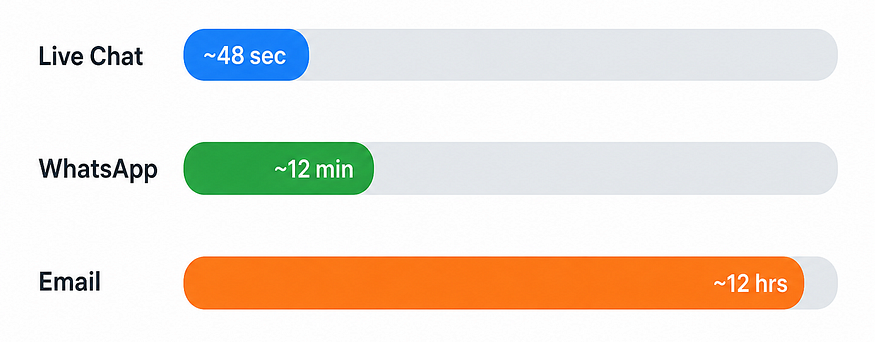
Speed matters because it directly drives conversion. A visitor with a buying question who gets an instant answer is far more likely to complete a purchase than one who has to wait.
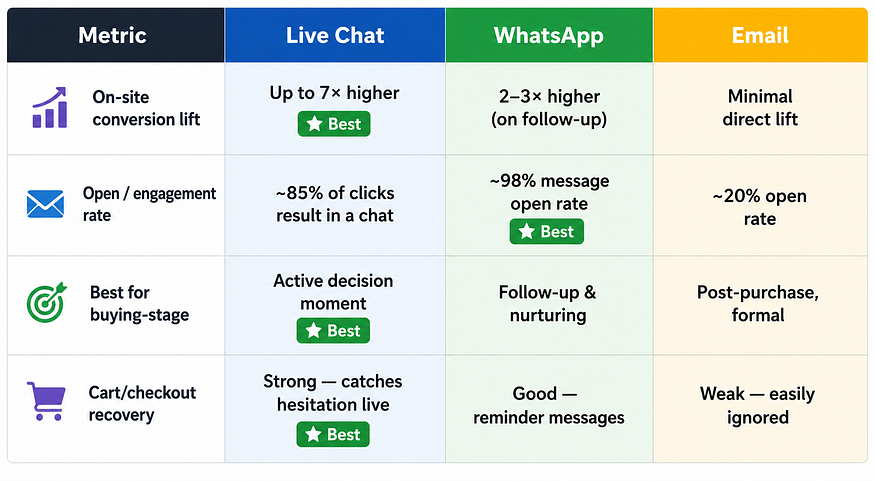
Live chat consistently shows the strongest direct conversion lift because it intercepts a visitor at the exact moment they’re deciding whether to buy. WhatsApp’s strength shows up afterward — in following up with leads who didn’t convert immediately, where its near-universal open rate makes it dramatically more effective than email.
This is where the comparison gets interesting, because cost isn’t just about subscription fees — it’s about agent time and tooling.
The real cost comparison:
It’s rarely about software pricing — most live chat and WhatsApp tools are free or near-free for small teams. The real cost difference is agent productivity. One support agent can resolve far more live chat conversations per hour than email threads, simply because chat exchanges are shorter and immediate.
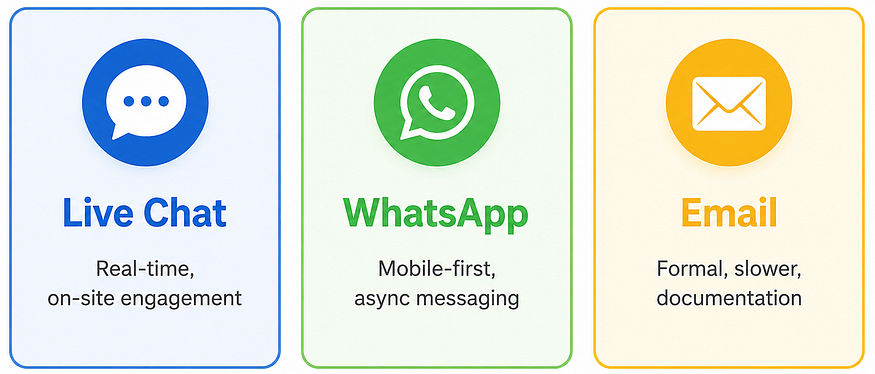
Rather than picking a single “best” channel, the smarter question is: what is each one actually built for? Here’s the honest breakdown:
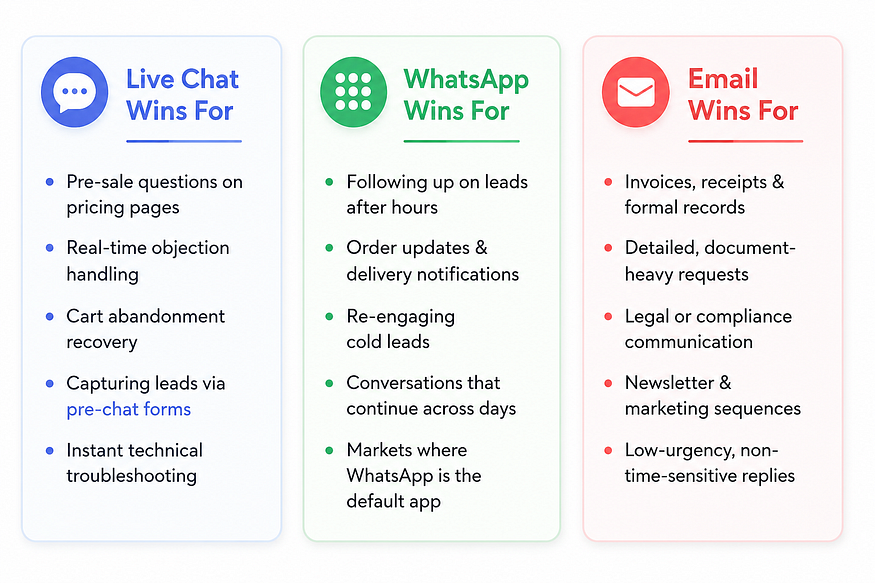
The businesses that win on customer experience don’t pick a favourite — they build a multichannel support strategy by layering all three channels based on the customer’s stage in the journey. Here’s what that looks like in practice:
Visitor lands, has a question, chats live
Conversation continues, lead followed up
Order confirmed, receipt & records sent
This is exactly why Chatlivo was built around live chat and WhatsApp working together from one inbox — not because email is obsolete, but because the first two channels handle the moments that actually decide whether a sale happens, while email handles what comes after.
The practical takeaway
If you only have time to set up one thing this week, set up live chat with WhatsApp connected behind it. That combination covers the moment of highest buying intent (live chat) and the highest-engagement follow-up channel (WhatsApp) — together responsible for the vast majority of conversion lift across all three channels.
Use it to catch buying intent the second it appears. This is where pricing questions get answered and carts get rescued.
Use it to keep conversations alive after the website session ends, and to re-engage leads who didn’t convert immediately.
Keep it for receipts, confirmations, and anything that needs a paper trail — but don’t rely on it for time-sensitive support.
Best for Conversion
Best for Engagement
Best for Records
Choosing the right customer communication channel can make or break your conversion rate. Live Chat, WhatsApp, and Email each promise better engagement — but which one actually delivers paying customers?
The answer depends on response time, user intent, and your business type. Live Chat catches visitors in the moment, WhatsApp builds personal rapport, and Email nurtures leads over time. Each has a role — but not every channel performs equally when it comes to closing sales.
In this guide, we break down real conversion rates, average response times, setup costs, and best-fit use cases for each channel. Whether you run an eCommerce store, a SaaS product, or a service business, this comparison gives you the data to pick the channel that actually grows revenue — not just inbox volume.
There’s no single best customer support channel — there’s only the right one for the right moment. Live chat wins the conversion battle because it catches buying intent in real time. WhatsApp vs email support isn’t even close for speed and engagement; WhatsApp’s near-instant open rates make it the strongest follow-up channel by far. Email earns its place for formal records and post-purchase communication, but it’s too slow to drive sales on its own.
The businesses that grow fastest aren’t choosing between these channels — they’re running a multichannel support strategy that uses all three in sequence. If you’re a small business figuring out where to start, the live chat and WhatsApp combination covers the moments that matter most: first contact and follow-up. Set those two up first, and add email workflows around them.
Chatlivo makes this easy — live chat and WhatsApp in one free inbox, with no credit card required. Start free today →

© 2025 Crivva - Hosted by Airy Hosting Managed Website Hosting.