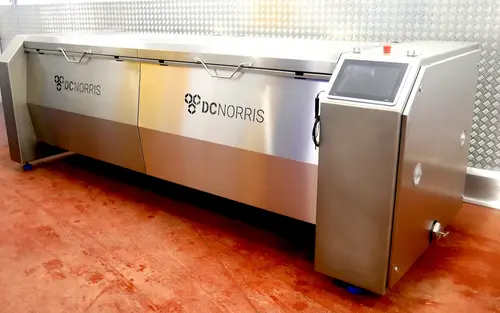
Sous vide is no longer limited to fine dining kitchens. Over the past decade, it has become a powerful tool in large-scale food production. From ready meals to premium protein lines, manufacturers are turning to industrial sous vide equipment to deliver consistent results at scale.
If you’re exploring sous vide equipment for commercial or industrial use, this guide will walk you through what it is, how it works, and what to look for when investing in a system.
Sous vide means “under vacuum.” In simple terms, food is vacuum-sealed in heat-stable pouches and cooked in precisely controlled water or steam at a consistent temperature for a set time.
In restaurants, this might mean cooking a few steaks in a water bath. In industrial settings, it means processing hundreds or thousands of portions per hour with strict temperature control, food safety compliance, and repeatable quality.
The key difference is scale, automation, and integration into a production line.
Large-scale food production comes with challenges: inconsistent texture, moisture loss, overcooking, and yield reduction. Sous vide addresses many of these issues.
Here’s why manufacturers adopt it:
Precise temperature control ensures that every batch cooks evenly. Whether you’re producing chicken breast fillets or beef portions, the internal temperature remains uniform across all units.
Traditional cooking methods often lead to moisture loss. Sous vide minimizes shrinkage, which improves weight retention. Over time, this translates into significant cost savings.
When combined with proper pasteurization and hygienic packaging, sous vide products can achieve extended refrigerated shelf life without compromising quality.
Slow, controlled cooking preserves natural juices and enhances tenderness. This is particularly valuable for proteins like beef, lamb, poultry, and seafood.
Industrial systems are designed for continuous operation, reducing labor dependency and improving throughput.
At its core, the process includes three main stages:
Food portions are placed in high-barrier, heat-resistant pouches. Air is removed using industrial vacuum sealers. Some operations also include marinade or brine before sealing.
Sealed products enter a thermal processing unit. This can be:
Water immersion systems
Steam-based systems
Hybrid water-steam systems
The equipment maintains extremely tight temperature tolerances, often within ±0.5°C. Products remain inside for a defined time to achieve pasteurization and the desired texture.
After cooking, products are quickly chilled to safe storage temperatures. Rapid cooling prevents bacterial growth and preserves product quality.
Not all systems are built the same. The right setup depends on production volume, product type, and facility layout.
These are ideal for medium-scale production or specialty product lines. Food is loaded into racks or baskets and processed in controlled cycles.
Best for:
Smaller production runs
Multiple recipe variations
Pilot production facilities
Designed for high-volume manufacturing, these systems move products through different temperature zones in a steady flow.
Best for:
Large ready-meal manufacturers
High-output protein processing
Automated facilities
Some operations require a fully integrated solution that connects vacuum sealing, cooking, chilling, and packaging in one streamlined process.
This reduces manual handling and improves hygiene control.
When evaluating equipment, focus on functionality and long-term performance rather than just upfront cost.
The entire value of sous vide depends on accurate temperature control. Look for systems with advanced control panels, real-time monitoring, and data logging.
Proper water circulation or steam distribution prevents hot and cold spots. Uneven heating can compromise both quality and food safety.
Food-grade stainless steel construction, smooth welds, and easy-to-clean surfaces are essential. Equipment should support full washdown procedures.
Industrial cooking systems consume significant energy. Efficient heat recovery systems and insulation can reduce operating costs.
Modern systems often integrate with plant management software. Temperature logs, batch records, and traceability data are critical for regulatory compliance.
Industrial sous vide equipment is used across multiple sectors:
Pre-cooked meats for chilled ready meals benefit from consistent doneness and improved texture.
Beef, poultry, pork, and seafood processors use sous vide to enhance tenderness and reduce cooking loss.
Pre-cooked, vacuum-sealed proteins simplify final preparation for consumers while ensuring food safety.
Hospitals, airlines, and large catering operations use sous vide to standardize quality across high volumes.
Sous vide relies on precise control to ensure pasteurization. Industrial equipment must support:
Validated time-temperature combinations
Rapid post-cook chilling
Strict hygiene protocols
Full traceability documentation
Regulatory compliance is not optional. HACCP integration is critical for safe production.
It helps to understand how sous vide differs from other large-scale cooking methods.
|
Feature |
Traditional Cooking |
Industrial Sous Vide |
|---|---|---|
|
Temperature Control |
Moderate |
Highly precise |
|
Moisture Retention |
Lower |
High |
|
Yield |
Moderate |
Higher |
|
Texture Consistency |
Variable |
Uniform |
|
Labor Dependency |
Higher |
Lower with automation |
While initial equipment costs may be higher, long-term savings in yield and quality often justify the investment.
Like any industrial process, sous vide has considerations.
Low-temperature cooking requires longer processing times compared to high-heat roasting or grilling.
High-quality vacuum pouches are essential. Inferior materials can fail during cooking.
Rapid cooling equipment is just as important as the cooking unit itself.
Planning your production layout carefully avoids bottlenecks.
Return on investment depends on multiple factors:
Reduced weight loss
Lower rework rates
Fewer quality complaints
Labor savings
Premium product positioning
Manufacturers often find that improved yield alone offsets equipment costs over time.
Before purchasing industrial sous vide equipment, ask:
What is the maximum throughput per hour?
How precise is temperature control?
Does the system integrate with existing lines?
What maintenance and service support is available?
Is the design compliant with local food safety standards?
Request trials or product validation where possible. Seeing performance with your actual product is critical.
Consumer demand for high-quality, minimally processed, ready-to-eat foods continues to grow. At the same time, manufacturers face pressure to improve efficiency and reduce waste.
Sous vide technology aligns with both goals.
Expect future systems to include:
Enhanced automation
Real-time cloud-based monitoring
Energy optimization features
Greater integration with smart factory systems
As production demands increase, precision cooking will play an even larger role in industrial food processing.
Industrial sous vide equipment is more than just a scaled-up version of restaurant water baths. It’s a precision-driven, efficiency-focused solution for modern food production.
When implemented correctly, it delivers consistent quality, higher yields, improved safety, and better profitability. But success depends on choosing the right system, integrating it properly, and maintaining strict process control.
For food manufacturers aiming to compete in today’s market, sous vide is not just a trend. It’s a strategic production advantage.

© 2025 Crivva - Hosted by Airy Hosting Managed Website Hosting.