


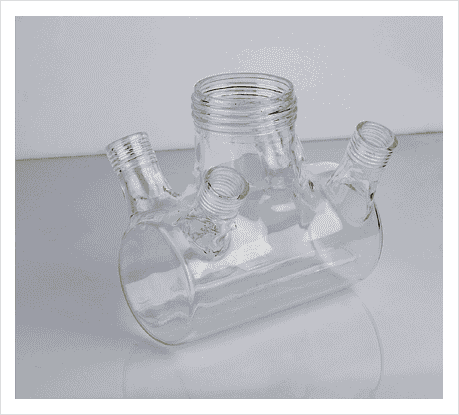
In advanced manufacturing and precision-driven industries, materials are selected based not on availability but on performance in extreme conditions. In this consideration, one exemplary material is industrial quartz glass-very pure, resistant, and up to the highest thermal challenges. Complementing industrial quartz glass, there exists quartz glassware playing a very important role in laboratories, research centers, and high-tech production units. Both of them complement each other and form the backbone of many of our advanced industrial and scientific applications.
Industrial quartz glass is fabricated from very pure silica and engineered to resist temperatures that would destroy ordinary glass. The dependability of its performance at very extreme heat conditions makes it indispensable for industries such as semiconductor manufacturing, optics, lighting, and chemical processing. Apart from ordinary glass, this material has a very low coefficient of thermal expansion, indicating that it resists cracking or other sorts of deformation even upon rapid temperature changes.
Probably, the exemplary property that dictates the prestige of industrial quartz glass is its transparency to light. It allows passage in the UV, visible, and IR parts of the light spectrum without any serious distorting effect. This accounts for its value in those areas where accuracy and clarity are mandatory, such as UV lamps, optical fibers, and laser systems. This is also expressed in its chemical inertness in that it virtually does not react with the majority of acids, gases, or solvents, ensuring purity and performance during long-term uses.
Complementary to these industrial applications is a specialized category of products in quartz glassware, designed for laboratory and scientific applications. From beakers and flasks to tubes and crucibles, quartz glassware is valued for its ability to support high temperatures while maintaining structural integrity. Assuring accurate results with consistent performance, such glassware is used where contamination control is at a premium in the laboratories.
Other advantages of quartz glassware include resistance to thermal shock. Many laboratory procedures involve the moving of equipment from extreme heat to open air; if the item is made of regular glass, it will crack under such stress. Quartz-based products handle such transitions with ease, therefore becoming the best choice for experiments that employ temperature cycles, chemical reactions, or direct exposure to flames.
Industrial quartz glass can barely stay within the confines of a laboratory. It finds its wide applications in the electronics industry, especially in wafer processing, diffusion tubes, and furnace linings. This material itself is so pure that it cannot contaminate sensitive manufacturing processes; therefore, it ensures better yields with superior-quality products. Correspondingly, in the solar industry, quartz components have their place in the creation of high-efficiency photovoltaic cells.
It also supports innovation in education and research due to quartz glassware. Various universities and other research institutes consider the use of this material when carrying out experiments that need both accuracy and safety. It is durable enough to reduce the chances of breakages and clear enough to facilitate easy observation of reactions or processes.
Other reasons why industrial quartz glass continues to be important relate to its sustainability. By lasting long and being resistant to wear, it requires fewer replacements, translating into less waste. Manufacturers appreciate materials that can consistently perform over time, and quartz glass meets those expectations while supporting efficient production cycles.
The quartz glassware also contributes by ensuring the making of safer, more reliable laboratories, as it minimizes the chances of chemical reaction with containers and withstands heat: protecting both researchers and results. Such reliability is important in pharmaceutical development, advanced material research, and chemical analysis. To put it succinctly, industrial quartz glass and quartz glassware are much more than highly specialized materials-they are modern technology and scientific progress enablers. Their unique properties related to thermal resistance, optical clarity, chemical stability, and durability explain their use across so many industries. As technology continues its headlong drive, the need for such high-performance materials is expected to do nothing but increase, securing their place as indispensable tools in innovation-driven environments.
Apart from conventional usage, industrial-grade quartz glass is increasingly setting the agenda for the future of new technology. In industries where accuracy, purity, and reliability are not negotiable, this product possesses unmatched advantages. For instance, in aircraft and defense industries, parts constructed from industrial-grade quartz glass are used in sensor packaging, protective screens, and hot observation ports. Such industries require materials with unmatched resistance to high pressure, radiation, and temperatures without impairing functionality.
Quartz glassware is very important in the medical and pharmaceutical industry for keeping asepsis and accuracy. Diagnostic machinery, analysis devices, and sterilization units all extensively make use of devices constructed from quartz. Quartz does not leach out impurities, thus ensuring that lab samples with very low tolerance remain pure and spot on. In pharmaceutical research and laboratory analysis, accuracy is a matter of using a margin of error equal to zero.
The increasing need for clean energy sources has increased the application of industrial-grade quartz glasses. In hydrogen production, thermal processing, and renewable energy studies, the resistance offered by quartz parts to aggressive environments and their role in energy conservation make them invaluable. Their capability to survive in high-temperature environments for a considerably long time makes them suitable for reactor systems, thermal shielding, and insulation in high-energy processes.
Customization is another important benefit of using quartz glassware. Quartz glassware can be shaped in a way that standard lab glassware can’t. The requirements of different industries can be fulfilled in this way. Customized tubes, complicated labware, and other specialized optics can be produced from quartz glassware.
In addition, industrial-grade quartz glass promotes innovation in the illumination and optics industry. High-intensity discharge lamps, infrared heaters, and UV curing lamps require quartz because of its high light transmittance and thermal stability. With industries embracing new illumination technology in their production and sterilization processes, the level of demand for high-quality quartz glass rises.
On a safety front, Quartz Glassware provides a sense of security in environments where safety is a major concern. Since Quartz Glassware is less prone to cracking under thermal shocks, laboratories and industries become safer environments. Such qualities are most in demand in an educational institution or a research lab where devices are consistently subjected to varying temperatures.
The production technique of industrial quartz glass is a factor that adds to the quality of this product. With highly pure silica and sophisticated melting technology, a very pure product is produced. No defects arise in different applications, especially in semiconducting industries, where a microscopic impurity can cause heavy defects.
As industries keep transforming, sustainability continues to be an important consideration. Industrial Quartz Glass and Quartz Glassware are very much in line with environmentally responsible approaches because they have a long life and can be recycled.
In conclusion, the increasing application of industrial-grade quartz glass and quartzware points to their significance in today and tomorrow’s technology. Whether in research and development or in mass production, these materials have continued to offer reliability, accuracy, and endurance. Going forward, with increased innovation in various sectors, these solutions will continue to be a prerequisite in these industries to enable them to reach hitherto unheard-of heights without compromising on standards.

© 2025 Crivva - Hosted by Airy Hosting Managed Website Hosting.








