

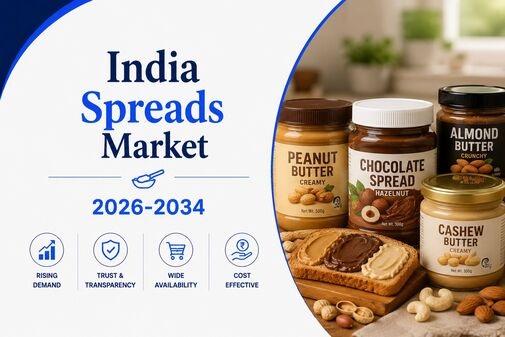
India Spreads Market Outlook
The India Spreads Market outlook is experiencing robust growth driven by rising health consciousness among consumers, rapid urbanization, and increasing disposable incomes across income segments. The heightened innovations in the FMCG sector, coupled with expanding organized retail infrastructure and e-commerce penetration, have transformed consumer purchasing behaviors.
Quick commerce platforms have emerged as significant distribution channels, offering ultra-fast delivery services that cater to convenience-seeking urban consumers. The growing preference for protein-rich, organic, and functional food products is reshaping product development strategies across manufacturers.
Market Snapshot
India Spreads Market Key Drivers
Growing preference for protein-rich, organic, and functional food products is reshaping product development strategies, with nut butters, low-sugar formulations, and plant-based alternatives gaining traction. Manufacturers are responding by introducing fortified variants enriched with vitamins, minerals, and functional ingredients addressing specific dietary requirements including protein supplementation, sugar reduction, and organic certification. Consumer awareness around lifestyle-related health conditions such as diabetes, obesity, and cardiovascular diseases has accelerated demand for low-sugar, high-fiber, and antioxidant-rich spreads aligned with preventive healthcare approaches.
Ultra-fast delivery services now account for the majority of e-grocery orders in metropolitan areas, transforming distribution dynamics and consumer accessibility. Quick commerce platforms operating through dense dark store networks deliver products within 10 to 30 minutes, fundamentally reshaping consumer expectations around convenience. In 2024, Amazon unveiled plans to launch its own quick commerce service in India targeting delivery in 20–30 minutes, further intensifying competition in this rapidly evolving distribution channel.
Rising purchasing power across income segments, particularly among upper-middle-income households earning between INR 5.5 lacs and 27.5 lacs annually — which represent 34% of the market in 2025 — is driving premiumization and demand for quality spread variants. India’s nominal GDP per capita is projected at approximately USD 2,878 in 2025, reflecting sustained economic growth that has expanded middle-class purchasing power and consumption capacity for branded, premium food products.
India Spreads Market Emerging Trends
Traditional jam and chocolate spread categories are expanding to include health-focused variants such as nut butters, low-sugar formulations, and plant-based alternatives with functional benefits including high protein content and organic certification. This wellness-oriented shift is particularly pronounced among urban millennials and fitness enthusiasts. In 2025, the Ministry of Health and Family Welfare instructed government offices to display Sugar and Fat Boards highlighting nutritional content of food items, further reinforcing consumer awareness around healthier dietary choices.
Consumers increasingly seek products with clean-label ingredients free from artificial preservatives and additives, driving manufacturers to reformulate product offerings across categories. The upper-middle income segment, which leads market share at 34% in 2025, demonstrates a clear willingness to pay premium prices for organic, fortified, and plant-based spread variants. West and Central India, commanding 28% of the market, leads this premiumization trend, anchored by Mumbai and Pune’s high per capita incomes and cosmopolitan consumer preferences open to international food trends.
In 2025, Tata Consumer Products Ltd was in advanced talks to purchase Danone SA’s nutraceuticals and specialized nutrition business in India, a potential step that could greatly enhance its position in the thriving health and protein sector. Complementing this, in December 2025, Reliance Consumer Products Limited relaunched the 75-year-old legacy brand SIL — expanding into jams, spreads, sauces, and ketchups — signaling that India’s spreads market, valued at USD 425.52 million in 2025 and projected to reach USD 1,764.13 million by 2034 at a CAGR of 17.12%, is attracting major conglomerate investment as competitive intensity accelerates across the sector.
India Spreads Market Challenges
Despite robust momentum, the India spreads market faces several structural headwinds:
India Spreads Market Segment Insights
By Product Type
By Distribution Channel
By Income Group
Regional Insights
Competitive Landscape
The report offers an in-depth examination of the competitive landscape, including market structure, key player positioning, leading strategies for success, a competitive dashboard, and a company evaluation quadrant.
Frequently Asked Questions (FAQ)
The India spreads market was valued at USD 425.52 Million in 2025, driven by rising health consciousness, rapid urbanization, and increasing disposable incomes.
The market is projected to reach USD 1,764.13 Million by 2034, growing at a CAGR of 17.12% during 2026–2034, supported by quick commerce expansion and health-focused product innovation.
Jam leads with a 24% share in 2025, driven by traditional breakfast consumption patterns and cultural preferences for fruit-based spreads.
West and Central India leads with a 28% share in 2025, anchored by Mumbai and Pune’s strong organized retail presence, high per capita incomes, and sophisticated consumer preferences.
Leading players include Agro Tech Foods, Dr. Oetker India, Ferrero India, G.D. Foods, Hershey India, Hindustan Unilever, and Mapro Garden.
Conclusion
The India spreads market presents a compelling growth opportunity, underpinned by rising health consciousness, quick commerce transformation, and increasing disposable incomes.
Three transformational forces will reshape the market through 2034: health-focused product innovation extending beyond traditional categories; quick commerce platforms revolutionizing distribution; and premiumization becoming a baseline expectation among middle-income households.
Organizations that invest in product innovation, omnichannel capabilities, and health-focused formulations will be best positioned to capture disproportionate value.
Source: IMARC Group

© 2025 Crivva - Hosted by Airy Hosting Managed Website Hosting.