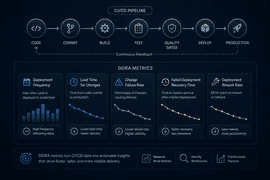
Improving DORA metrics is a common goal for modern engineering teams. Faster deployments, lower failure rates, and quicker recovery all signal a healthy software delivery process. However, many teams try to improve these metrics by adding more processes, more tools, or more manual checks.
That approach often leads to the opposite result. It increases engineering overhead, slows down development cycles, and creates friction across teams.
The real challenge is not just improving DORA metrics. It is improving them without making systems heavier or more complex. The most effective teams achieve better performance by optimizing how work flows through their systems, not by increasing the amount of work.
To improve metrics meaningfully, teams must understand what they represent in practice. The current set of DORA metrics includes:
These metrics are interconnected. Improving one often influences the others.
For example:
Instead of treating these metrics separately, teams should view them as indicators of overall delivery efficiency.
It is tempting to improve metrics by adding safeguards. More approvals, more tests, more validation steps. But this often introduces friction.
Common side effects include:
In many cases, these changes reduce risk in theory but create bottlenecks in practice.
High-performing teams take a different approach. They focus on removing inefficiencies instead of adding controls.
Improving DORA metrics without increasing overhead requires a shift in mindset. The focus should be on system design, not effort expansion.
Before introducing new tools or steps, evaluate current workflows.
Ask:
Often, teams find that removing unnecessary steps leads to immediate improvements in lead time and deployment frequency.
A common mistake is equating more tests with better quality.
In reality:
Instead, teams should focus on:
This improves both speed and reliability without increasing overhead.
Flaky tests are one of the biggest hidden sources of inefficiency.
They lead to:
Fixing flaky tests improves trust in the pipeline and reduces unnecessary work.
Automation should reduce effort, not create complexity.
Effective automation focuses on:
Over-automation in low-value areas can increase maintenance without improving outcomes. The goal is targeted automation that directly impacts DORA metrics.
Faster feedback improves both speed and quality.
Teams can achieve this by:
Shorter feedback loops reduce lead time and prevent issues from propagating.
One of the main reasons for high change failure rate and rework is the gap between test environments and production behavior.
Many teams rely on synthetic test data and predefined scenarios. These often fail to capture real usage patterns.
A more effective approach is to incorporate real system behavior into testing. For example, tools like Keploy generate test cases from actual API interactions. This allows teams to validate realistic scenarios without manually creating additional test cases.
This improves:
All without adding extra effort.
Improving failed deployment recovery time does not require more processes. It requires better systems.
Teams should focus on:
When recovery is fast and reliable, the impact of failures is minimized, which improves overall delivery performance.
Instead of adding more checks before deployment, improve visibility after deployment.
Observability helps teams:
Key elements include:
Better observability reduces debugging time and supports faster recovery, improving multiple DORA metrics simultaneously.
Manual steps introduce delays and inconsistencies.
They often include:
Reducing manual intervention leads to:
Automation should replace repetitive manual tasks wherever possible.
Even experienced teams sometimes introduce inefficiencies while trying to improve metrics.
Common mistakes include:
These practices increase workload without improving outcomes.
In real-world systems, improving DORA metrics is not about working harder. It is about designing systems that reduce friction.
High-performing teams:
As a result, they achieve:
All without increasing engineering overhead.
To improve DORA metrics effectively:
These steps help teams improve delivery performance while keeping systems efficient.
Improving DORA metrics does not require more processes or more effort. It requires better system design.
By focusing on efficiency, automation, and real-world validation, teams can improve deployment speed, reduce failures, and recover faster without increasing engineering overhead.
The key is simple. Remove friction, not add complexity.

© 2025 Crivva - Hosted by Airy Hosting Managed Website Hosting.