

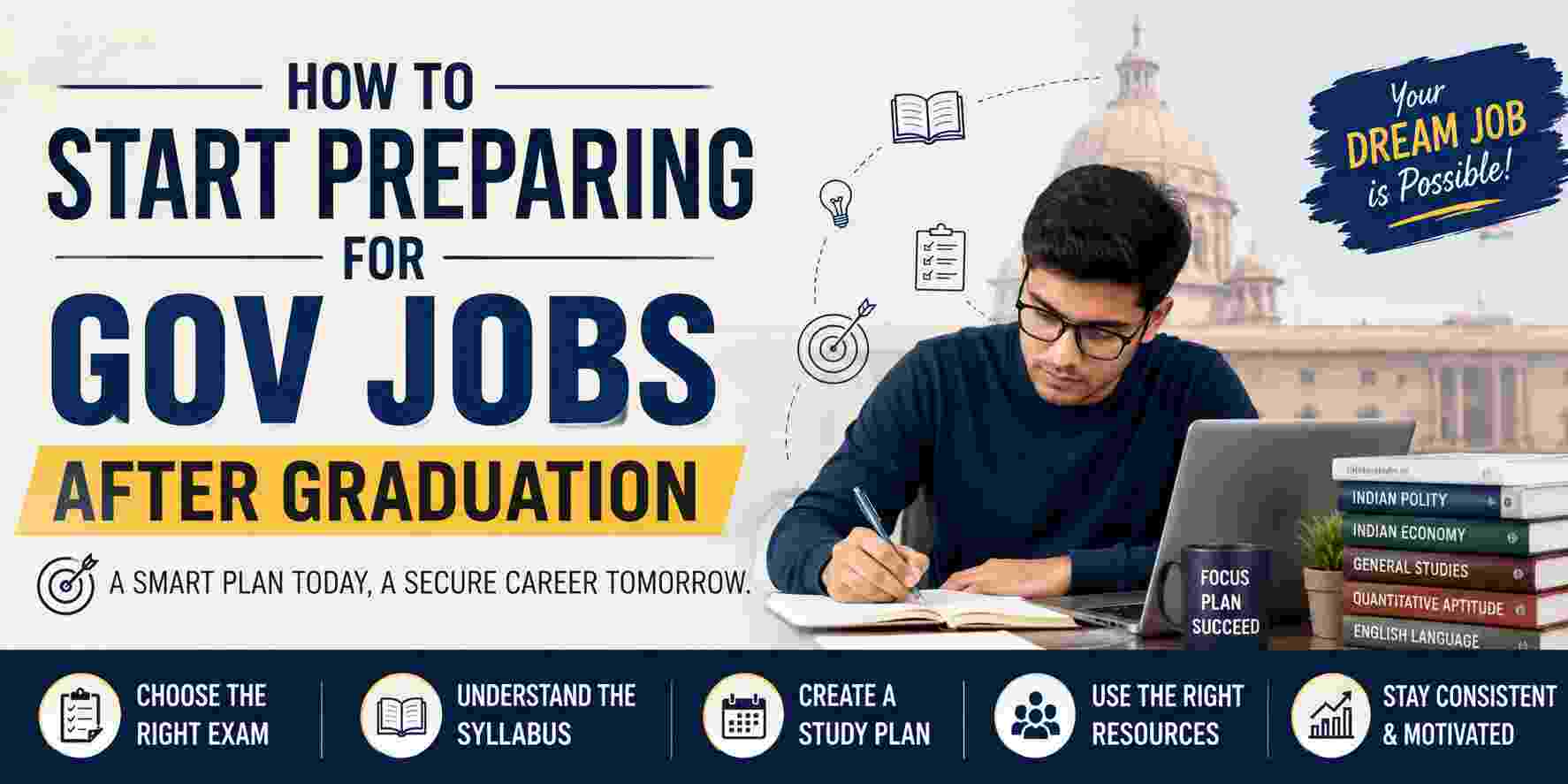
So you have just finished your graduation and you are thinking about government jobs. Good choice. But where exactly do you start? What do you study? Which exam should you go for? These are the questions that confuse most freshers — and that confusion often leads to wasted months.
This guide breaks everything down in a simple, practical way so you can start your government job preparation on the right foot.
Let us be honest about why so many graduates chase government jobs after graduation. It is not just about the salary. It is the job security, the pension, the medical benefits, the respect, and the work-life balance that a private job rarely gives you.
Once you clear a government exam, no one can pull the rug from under your feet. You work your years, you get your pension, and your family has stability. That is a big deal — and that is why lakhs of students sit for these exams every single year.
The first mistake most students make is jumping into preparation without knowing which exam they are preparing for. There are dozens of competitive exam preparations you could go after. Here are the most common ones based on graduation:
Pick one or two exams that match your graduation stream, your interest, and your timeline. Do not try to prepare for everything at once — that is a sure way to prepare for nothing.
Once you know your target exam, download its official notification and read the syllabus carefully. Every government exam preparation journey starts with knowing exactly what is being tested.
Most competitive exams share these common sections:
Go through 3 to 5 years of previous year question papers. This alone will tell you the type of questions asked, the difficulty level, and which topics carry the most weight.
A study plan does not have to be complicated. It just needs to be consistent. Here is a simple structure to follow when starting your government job preparation:
Morning (2–3 hours): Study your toughest subject when your mind is fresh. For most people, that is Maths or Reasoning.
Afternoon (1–2 hours): Read current affairs, newspapers, or general awareness topics. Avoid heavy analytical work in post-lunch hours.
Evening (2 hours): Practice questions and mock tests. Revise whatever you studied in the morning.
Weekly: Take at least one full-length mock test. Review every wrong answer — not just to know the right answer, but to understand why you went wrong.
Give yourself one day a week for revision only. Do not add new topics on that day. Revision is what actually makes things stick.
Do not fall into the trap of buying 15 books and reading none of them properly. For a solid competitive exam preparation, here is what works:
For current affairs, use monthly magazines like Pratiyogita Darpan or free YouTube channels and apps that give daily updates.
You can study for months but if you never sit for a timed mock test, you will struggle on the actual exam day. Mock tests do two things — they build your speed, and they show you exactly where you are losing marks.
Start with sectional tests when you are still covering the syllabus. Move to full-length mocks once you have finished at least one round of the entire syllabus. After each mock, spend as much time reviewing it as you spent taking it. That review time is where real improvement happens.
This is the part nobody talks about enough. Government exam preparation is not a sprint. It can take 6 months for banking exams, 1 to 2 years for SSC, and 2 to 4 years for UPSC. In that time, you will have days when motivation drops.
On those days, do not wait for motivation to show up. Just open your book and start with something easy. The habit of showing up every day — even when you do not feel like it — is what separates candidates who crack exams from those who keep trying.
Keep your phone away during study hours. Set small daily targets instead of looking at the entire syllabus. Celebrate small wins.
Q1. Which is the best government job after graduation for freshers?
For most freshers, SSC CGL and banking exams like IBPS PO or SBI PO are the best starting points. They have a clear syllabus, regular exam cycles, good salaries, and relatively faster results compared to UPSC. If you are aiming higher, UPSC is the ultimate goal, but it requires more time and patience.
Q2. How many hours should I study daily for government exam preparation?
There is no magic number, but 6 to 8 hours of focused study per day is considered a good benchmark. Quality matters more than quantity. Three hours of focused, distraction-free study is better than six hours of half-hearted reading. As your exam date approaches, gradually increase your practice time.
Q3. Can I prepare for government exams without coaching?
Yes, absolutely. Thousands of candidates crack government exams every year through self-study. Good books, free online resources, YouTube channels, and regular mock tests are more than enough. Coaching can provide structure and guidance, but it is not mandatory. What matters most is consistency and the right study material.
Q4. How do I stay updated with current affairs for competitive exam preparation?
Read a national newspaper every day — even 20 to 30 minutes is enough if you are focused. Use monthly current affairs magazines like Pratiyogita Darpan. Follow reliable YouTube channels or apps that give daily government exam-focused news updates. Make short notes of important events, dates, and facts for quick revision later.
Q5. Is graduation stream important for government job preparation?
For most central government exams like SSC CGL, IBPS PO, and RRB NTPC, any graduation stream is accepted. However, for some specific posts — like engineering services, law officers, or specialist officers in banks — your stream matters. UPSC also allows any graduation stream, but your optional subject choice often relates to your academic background. Always check the official eligibility criteria before applying.
Starting government job preparation right after graduation gives you a real advantage — your mind is sharp, your time is your own, and you have years of eligibility ahead of you. Pick your exam, build your plan, and start today. Every day you delay is a day of preparation someone else is getting ahead of you.
Stay consistent. Stay patient. The results will follow

© 2025 Crivva - Hosted by Airy Hosting Managed Website Hosting.