

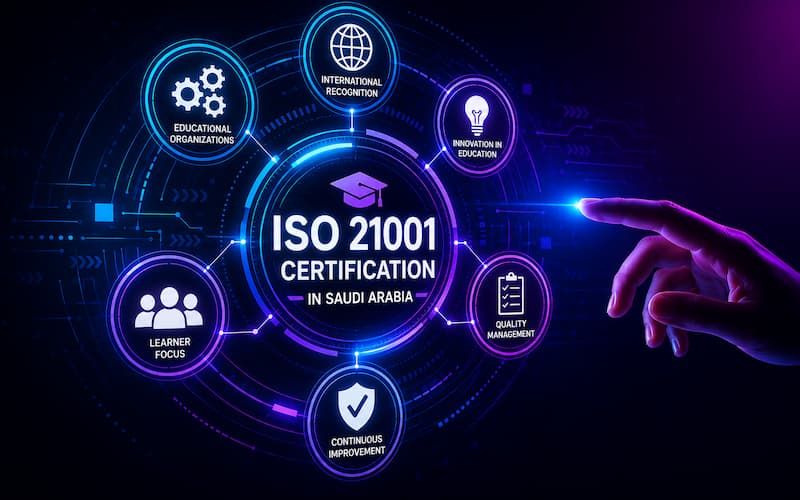
The modern day schools and colleges are increasingly under pressure to deliver quality learning experiences to their students, parents, regulatory bodies and other stakeholders. With the growing number of competition in the education sector, organizations should ensure that they are concerned with excellence, transparency and constant improvement. One of the most effective ways to achieve this is by implementing ISO 21001, an internationally recognized standard specifically developed for Educational Organizations Management Systems (EOMS). The ISO 21001 Certification Audit Preparation is an important process that should be used by learning institutions that wish to enhance their efficiency in operations, student satisfaction and their overall credibility.
To organizations planning to be iso 21001 certification in Saudi Arabia, knowing how to go about the audit and how to prepare can greatly influence the attainment of successful certification. An audit is not a mere compliance activity, it is a chance to examine how well an institution can handle its educational services and live to the expectations of the stakeholders. Through effective planning, robust leadership backing, employee involvement and documentation, educational institutions can take the certification exercise with certainty. Scube.ltd can also assist institutions with professional support to prepare and make everything more aligned to the ISO 21001 requirements.
Understanding the ISO 21001 Certification Audit
Before beginning preparations, organizations should understand what an ISO 21001 Certification Audit involves. An accredited certification body is the one that undertakes the audit to determine whether a management system of an educational institution complies with the ISO 21001 requirements.
The certification process can have two stages:
Stage 1 Audit
This first phase is concerned with looking at the information in writing. Auditors review policies, procedures, goals and records to find out whether the organization is prepared to undergo the certification audit.
Stage 2 Audit
The second stage includes the assessment of the real performance of the management system by the auditors. They monitor operations, examine records, conduct interviews with employees and evaluate the effectiveness of operations.
Knowledge of these stages assists the educational organizations to develop a straight path towards successful certification.
Conduct a Thorough Gap Analysis
The gap analysis is among the most significant processes in the preparation of audits. It assists in determining the differences between the existing practices and the ISO 21001 requirements.
Examples of areas that have to be evaluated include:
Gaps can be detected early before the audit process and organizations can make the relevant improvements.
Establish Strong Leadership Commitment
Leadership is an important process towards the success of any management system. The ISO 21001 lays a lot of emphasis on the participation and dedication of top management.
Leadership responsibilities include:
The interviews, meeting records, and evidence of strategic involvement are some of the most common ways in which auditors assess the management commitment in the ISO 21001 Certification Audit.
The more the leadership promotes the management system, the more employees accept quality practices and organizational objectives.
Develop Comprehensive Documentation
An effective Educational Organization Management System is documented.
Key documents include:
Educational Policies
The policies need to articulate the mission, vision, quality goals and the organizational commitment to the learners.
Process Procedures
Monitoring, provision, planning and improving of educational services should be documented.
Risk Assessment Records
Organizations ought to keep documents that show the identification, evaluation, and management of risks and opportunities.
Performance Monitoring Reports
Reports on learner satisfaction, educational outcomes and operational effectiveness are a good source of evidence during audits.
Documented work is properly structured to enable auditors to confirm compliance and show that the processes are effectively controlled.
Train Employees and Increase Awareness
Employee awareness is essential for certification success. Each employee needs to know what role they play towards achieving goals and compliance in the organization.
The training programs ought to include:
The employees are expected to be in a position to clarify their duties and show how they adhere to laid down procedures.
In the course of the audit, the auditors often communicate with staff to determine how they know the management system.
Perform Internal Audits Regularly
Internal audits give a chance to test the performance of the system prior to the certification body performing its audit.
Internal audits have the following benefits:
The competent personnel should plan, document and conduct internal audits.
Results of internal auditing must be dealt in a timely manner so that problems can be rectified prior to the certification audit.
Implement Effective Corrective Actions
Organizations should develop an effective system of dealing with nonconformities and corrective measures.
The corrective action process entails:
Identifying the Issue
Clearly document the problem or nonconformity.
Analyzing Root Causes
Explore causes of the problem as opposed to symptoms.
Implementing Solutions
Design and put in place measures that remove root causes.
Verifying Effectiveness
Check outcomes to ensure that remedial measures have been effective in averting the repeat.
Auditors tend to look at records of corrective actions to evaluate the dedication of an organization towards the idea of continuous improvement.
Focus on Learner Satisfaction
Among the main goals of ISO 21001, there is the increase of the satisfaction and results of learners.
Processes should be put in place by educational organizations:
Having a learner-centered approach proves the organizational stance when it is under inspection with ISO 21001 Certification.
Monitor Performance Metrics
One of the important requirements of ISO 21001 is performance evaluation.
Organizations ought to set quantifiable indicators that concern:
These indicators can be regularly monitored to help organizations track trends, measure their performance, and make informed decisions.
The performance data is another important evidence that can be used in the certification process.
Conduct Management Reviews
Management reviews give the senior leadership a chance to review the performance of Educational Organization Management System.
The review meetings ought to appraise:
Managing records indicate that there is leadership involvement and dedication to continuous improvement.
These reviews are also useful in making sure that the strategic objectives are consistent with the organizational goals.
Prepare Employees for Auditor Interviews
The normal certification process includes auditor interviews.
Employees should be prepared to discuss:
Organizations ought to be concerned with assisting the workers to gain insight into processes and not reciting by heart.
Self-assured and informed employees leave a good impression when conducting the audit.
Organize Audit Evidence Efficiently
The pre-preparation of audit evidence may greatly enhance the efficiency of the audit.
The most requested records are:
Having a centralized system of documentation helps in rapid access to information and lessens delays in the audit.
Common Mistakes to Avoid
Numerous institutions of learning have difficulties due to preventable errors.
There are some typical problems such as:
These areas could be discussed prior to the audit and significantly enhance certification preparation.
Benefits of a Successful ISO 21001 Certification
Certification can be of great benefit to a well prepared organization.
These benefits include:
Certification is a show of excellence and continuous improvement, which assists institutions in a competitive environment in education.
Conclusion:
Preparing for an ISO 21001 Certification Audit requires careful planning, strong leadership support, employee involvement, effective documentation, and a commitment to continuous improvement. Schools that take the time to carry out gap analysis, carry out internal audits, and take corrective measures, as well as monitor performance indicators, have higher chances of successful certification results. Formalized strategy is not only able to increase audit-readiness, but the effectiveness of educational services in general.
Finally, an ISO 21001 Certification Audit is not merely a compliance solution but the chance to enhance organizational performance, enhance the experiences of learners, and establish trust with the stakeholders. With the adoption of the concepts of the ISO 21001 and the culture of continuous improvement, educational organizations will be able to attain sustainable success, as well as provide the learners and the rest of the population with outstanding value.

© 2025 Crivva - Hosted by Airy Hosting Managed Website Hosting.