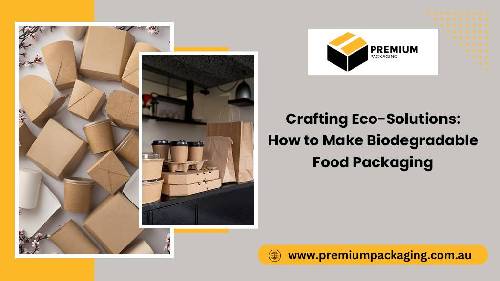
As global demand for eco-friendly food packaging grows, businesses in Australia are actively seeking sustainable alternatives that meet consumer expectations and comply with environmental regulations. Whether you’re a small café, a food manufacturer, or a packaging supplier, knowing how to make biodegradable packaging can position your business as a responsible player in a competitive market.
This guide explores everything from raw materials and production techniques to design considerations and supply chain integration—tailored for those wanting to lead in sustainable food packaging in Australia.
Biodegradable food packaging refers to materials that naturally break down into non-toxic components under composting or environmental conditions. Unlike conventional plastics, which take hundreds of years to decompose, biodegradable packaging breaks down in a matter of weeks or months, depending on the conditions and materials used.
Biodegradable options are particularly useful in foodservice, takeaway, and delivery sectors—offering convenience without lasting environmental damage.
Australians dispose of over 1.9 million tonnes of packaging waste annually, and food packaging accounts for a significant portion of that. With government-led initiatives like the 2025 National Packaging Targets, there’s increasing pressure on brands to embrace sustainable packaging design.
Benefits include:
Understanding the materials is the first step in crafting effective biodegradable food packaging. The following are widely used for their compostability, food safety, and availability:
Derived from fermented plant starch (such as corn, cassava, or sugarcane), PLA is ideal for clear containers and film wraps. It’s compostable in industrial facilities but not always suitable for high-heat applications.
A by-product of sugarcane processing, bagasse is widely used in Australia for making sturdy clamshells, plates, and bowls. It withstands both heat and moisture—making it ideal for takeaway and delivery services.
Recyclable and biodegradable, these materials are commonly used in sandwich wraps, burger boxes, and drink trays. When lined with plant-based coatings instead of plastic, they maintain an eco-friendly status.
Made from recycled paper, bamboo, or other natural fibres, moulded pulp is used in egg cartons, tray inserts, and even food containers. It’s biodegradable, compostable, and made using minimal energy.
Transitioning from concept to creation involves technical planning and environmentally conscious decision-making. Here’s a simplified overview of the process:
Partner with reliable suppliers of certified biodegradable raw materials. For Australian businesses, local sourcing reduces transport emissions and supports domestic industries.
Tip: Look for certifications such as AS 4736 (the Australian Standard for Compostability) or the Seedling logo.
Work with a packaging engineer or lab to blend the chosen material (e.g., PLA with starch or fibre) into a mixture suitable for moulding, extruding, or pressing. Conduct strength, heat resistance, and permeability tests to ensure food safety and quality.
Depending on the desired product (tray, cup, box), choose the right method:
Use eco-friendly inks (soy or water-based) and digital printing to minimise waste. Sustainable branding should reflect the product’s values—informing customers that it is biodegradable and safe.
Laser or die-cutting machines shape the packaging for assembly. Automated folding systems help streamline production while reducing handling contamination.
Store finished goods in humidity-controlled environments to prevent premature degradation, particularly for materials such as paperboard or bagasse.
Sustainable packaging design is not just about using the right materials. It’s about reducing the environmental impact at every stage.
At Premium Packaging, our design consultants help clients engineer solutions that are both functional and sustainable.
Being a package supplier in Sydney means more than offering boxes and wraps. It means creating a responsible supply chain that supports Australia’s green economy.
At Premium Packaging, we provide:
With rising demand for packaging supplies in Sydney, local production ensures faster turnaround, lower freight emissions, and consistent compliance with environmental guidelines.
Like any innovative sector, producing biodegradable packaging comes with its challenges:
Biodegradable materials can be more expensive than conventional plastics due to the higher costs associated with sourcing and processing. However, bulk ordering and government incentives may offset this.
Some biodegradable packaging has a shorter shelf life or lower barrier protection. This must be taken into account when planning the shelf life of food.
Biodegradable doesn’t always mean recyclable. It’s essential to educate consumers on the correct disposal method to avoid contamination of recycling streams.
Certain materials, like PLA, require industrial composting conditions. Without access to commercial facilities, breakdown may not occur as intended.
The success of biodegradable packaging depends partly on consumer awareness and education. Brands should include:
This ensures the environmental benefits extend beyond your warehouse.
As sustainability continues to evolve, innovations in eco-friendly food packaging are reshaping the industry:
Premium Packaging actively monitors new technologies and integrates proven solutions into our offering to meet the evolving demands of the Australian market.
Transitioning to biodegradable food packaging is no longer optional—it’s a necessary step for future-forward businesses. Whether you’re looking to develop your own sustainable packaging or source it locally, knowing the process, materials, and best practices will place your business ahead of regulatory and consumer demands.
Premium Packaging is your reliable partner in crafting eco-solutions that work. From raw materials to finished products, we help Australian food businesses deliver packaging that’s as thoughtful as the food it holds.
For tailored packaging solutions, reach out to Premium Packaging—your trusted package supplier and innovator in sustainable packaging design.
Know more https://premiumpackaging.com.au/blog/biodegradable-food-packaging-guide/

© 2025 Crivva - Hosted by Airy Hosting Managed Website Hosting.