

Running a successful online store involves far more than listing products and processing orders. As your business grows, repetitive tasks such as updating inventory, transferring customer information, tracking shipments, and managing orders across multiple platforms can quickly become overwhelming. These manual processes not only consume valuable time but also increase the likelihood of costly errors that affect both operations and customer satisfaction.
The good news is that most of these repetitive tasks can be automated. By connecting the right systems and streamlining workflows, businesses can reduce administrative work, improve accuracy, and create a better experience for both employees and customers.
In this guide, we will explore why manual data entry slows business growth, which ecommerce processes should be automated, and how connected systems can help your online store operate more efficiently.
Manual processes may seem manageable when an online store is just getting started. However, as sales increase, they often become a major operational bottleneck.
Consider a business that receives hundreds of orders every day. Updating inventory manually, copying customer details between systems, or generating shipping labels one by one doesn’t just waste time; it increases the risk of mistakes that can lead to delayed deliveries, inaccurate stock levels, and dissatisfied customers.
Some of the most common challenges include:
Instead of focusing on business growth, employees often spend valuable hours performing repetitive administrative tasks that software can handle automatically.
Automation allows businesses to eliminate repetitive work while maintaining greater accuracy across their operations.
Some of the most valuable processes to automate include:
Automatically transferring order information among your ecommerce platform, warehouse, and shipping providers helps reduce delays and improve fulfillment accuracy.
Keeping inventory updated across multiple sales channels prevents overselling and minimizes stock-related issues.
Customer information should automatically sync across your ecommerce platform, CRM, and marketing tools, ensuring every department has access to accurate, up-to-date data.
Automated payment verification speeds up order confirmation while reducing manual financial reconciliation.
Customers expect real-time updates. Automated shipping notifications improve transparency while reducing customer support inquiries.
By automating these everyday tasks, businesses can improve operational efficiency and allow their teams to focus on strategic activities rather than repetitive data entry.
Many operational challenges arise because business applications operate independently rather than automatically sharing information.
For example, if your ecommerce platform isn’t connected to your inventory system, employees may need to update stock manually after every purchase. Likewise, disconnected CRM software often requires sales teams to enter customer information multiple times across different platforms.
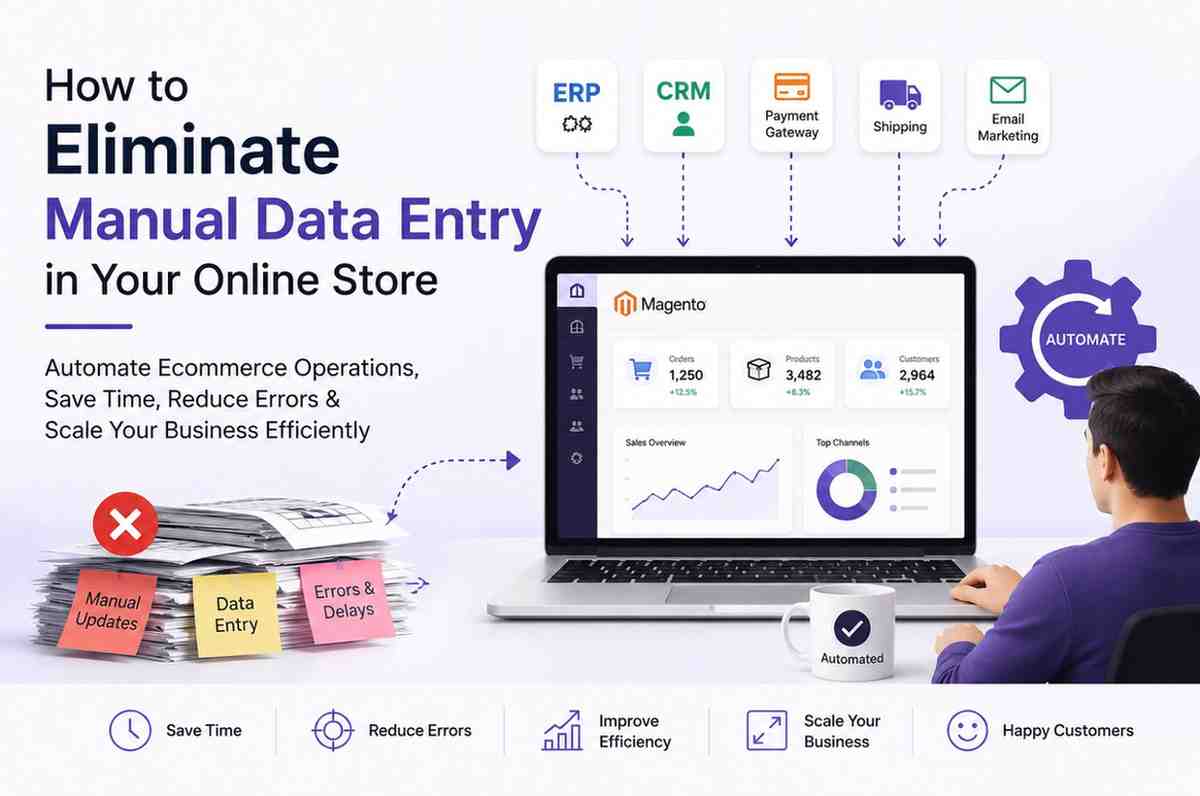
Connecting these systems through Magento integration enables information to move automatically between your ecommerce store, ERP, CRM, payment gateways, shipping providers, and marketing platforms. As a result, businesses spend less time managing data manually while improving accuracy throughout the customer journey.
Rather than treating each business application as a separate tool, connected systems create a unified workflow that supports faster decision-making and more efficient daily operations.
Not every automation delivers the same results. Successful ecommerce businesses begin by identifying repetitive processes before implementing technology.
When planning your automation strategy, consider the following:
Reliable integrations are built on well-designed APIs that allow systems to exchange information securely and consistently. Following API integration best practices helps businesses create scalable connections between ecommerce platforms and business applications while reducing maintenance challenges as operations expand.
A thoughtful integration strategy ensures that automation supports your business goals rather than creating additional complexity.
Business requirements evolve over time. New products, additional sales channels, international expansion, and changing customer expectations often require new functionality beyond the capabilities of a standard ecommerce setup.
Instead of replacing existing systems, many businesses extend their online stores by adding specialized features that improve operational efficiency and customer experience.
For example, Magento 2 extensions for store automation can simplify inventory management, enhance search functionality, improve checkout experiences, and automate routine backend tasks. These extensions allow businesses to scale their operations while continuing to build on an existing Magento ecosystem.
Choosing flexible solutions from the beginning makes it easier to adapt as your business grows without disrupting day-to-day operations.
Automation isn’t a one-time project. As your ecommerce business grows, customer expectations, technology, and operational processes continue to evolve.
Regularly reviewing workflows helps identify new opportunities to eliminate repetitive tasks, improve data accuracy, and optimize team productivity. Small, consistent improvements often have a greater long-term impact than large-scale system changes implemented all at once.
Businesses that treat automation as an ongoing process are typically better positioned to respond to market changes, support business growth, and deliver a seamless customer experience.
Manual data entry may seem manageable in the early stages of an ecommerce business, but it quickly becomes a barrier to efficiency as operations expand. Automating repetitive tasks allows businesses to reduce errors, improve productivity, and create a smoother experience for both customers and employees.
By connecting business systems, streamlining workflows, and investing in scalable automation strategies, online stores can spend less time managing routine operations and more time focusing on innovation and growth. Whether you’re handling dozens of orders each week or thousands each day, eliminating manual processes is an investment that delivers long-term operational value.
Manual data entry increases the risk of human error, slows order processing, creates inventory inaccuracies, and consumes valuable time that could be spent on business growth.
Businesses should begin by automating order management, inventory synchronization, customer data updates, payment processing, and shipping notifications, as these tasks often require the most repetitive manual work.
Magento integration connects your ecommerce platform with systems such as ERP, CRM, payment gateways, and shipping providers, allowing data to flow automatically between applications while reducing manual effort and improving accuracy.
Connected systems improve operational efficiency, reduce duplicate work, enhance data accuracy, accelerate order fulfillment, and deliver a better customer experience by keeping information synchronized across multiple business applications.

© 2025 Crivva - Hosted by Airy Hosting Managed Website Hosting.