

Agriculture in India is evolving rapidly. It is no longer limited to traditional methods. Modern technology, advanced machinery, and digital tools are helping farmers increase productivity, reduce labor, and improve profitability. The main goal of smart farming is simple—less effort, lower cost, and higher yield.
Today, drone surveys, soil testing, smart irrigation systems, mobile apps, and high-performance tractors are taking farming to the next level. Farmers now receive real-time updates about weather, soil conditions, crop diseases, and market prices on their smartphones, helping them make informed decisions and avoid losses.
With the help of technology, farmers can determine the right crop, the right soil, and the right amount of inputs required. This ensures efficient use of resources and improves crop quality.
Modern machines and tractors complete tasks much faster than traditional methods. This allows farmers to cultivate more land in less time, increasing overall efficiency.
Smart irrigation systems and sensor-based technologies ensure that water, fertilizers, and pesticides are used only when required. This reduces wastage and keeps crops healthier.
Farmers now rely on mobile apps and digital platforms for weather alerts and market trends. Knowing accurate prices helps them decide the best time to sell their produce.
Smart farming refers to the use of modern technology, data-driven solutions, digital tools, and high-performance machinery to improve agricultural efficiency. The idea is simple: combine traditional knowledge with modern science to achieve better results.
This includes tools like:
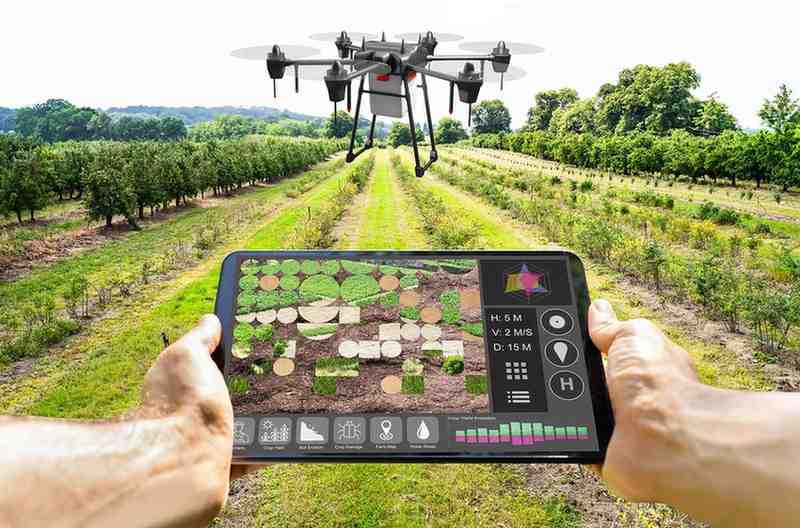
Drone surveys for mapping and crop monitoring
Soil health testing for nutrient-level assessment
GPS-based farming for precision agriculture
Mobile apps offering weather and market alerts
AI-based crop disease prediction
Smart irrigation systems that conserve water
Advanced tractors and farm machinery
These innovations help farmers plan more accurately, reduce wastage, use resources wisely, and achieve higher yields.
Modern agriculture faces several challenges:
Climate change
Unpredictable weather patterns
Rising input costs
Shortage of skilled labor
Market volatility
Soil degradation
Smart farming directly addresses these issues. It enables farmers to farm smarter—not harder—by allowing data, machines, and technology to do the heavy lifting.
One of the main benefits of smart farming is its ability to increase crop yield with the same amount of land. Precision agriculture tools like soil sensors, satellite data, and AI-based recommendations help farmers:
Apply the right amount of fertilizers
Water crops based on actual need
Prevent diseases and pests early
Select crops suitable for the soil condition
This leads to healthier crops, better quality produce, and significantly higher output.
Smart farming helps farmers cut unnecessary expenses.
For example:
Smart irrigation reduces water wastage
Precision tools reduce excess use of fertilizers
Drones help detect issues before they destroy crops
Advanced tractors complete tasks faster, saving time and labor
Farmers can save thousands of rupees every season simply by adopting efficient technologies.
Traditional farming often relies on estimation. But smart farming uses measurable data, allowing farmers to manage:
Water
Soil health
Fertilizers
Crop rotation
Land usage
Smart irrigation systems ensure every drop of water is used wisely. Soil sensors tell farmers exactly what nutrients are needed, preventing overuse of chemicals. This protects the environment and keeps the soil fertile for generations.
India faces a growing labor shortage in rural areas. Young workers are moving to cities, leaving farms understaffed.
Smart machinery—tractors, harvesters, transplanters, rotavators—fills this gap effectively. A single machine can complete the work of 20–30 laborers in a fraction of the time.
Unpredictable weather is one of the biggest threats to farming. Smart farming tools give farmers real-time updates on:
Rainfall
Temperature
Humidity
Storm alerts
Wind speed
Mobile apps and government portals also provide daily mandi prices. This helps farmers decide:
When to sow
When to harvest
When to sell
Which crops give maximum profit
Such informed decisions reduce risk and increase income.
Role of Powerful Tractors in Modern Farming
Machinery has become essential in today’s farming. Tractors not only handle tilling and ploughing but also assist in sowing, harvesting, and transporting crops. This is why farmers prefer strong, reliable, and multi-utility tractors that can support them throughout the agricultural season.
Swaraj 855 FE: A Dependable and Powerful Tractor for Farmers
In modern agriculture, powerful tractors play a key role, and the Swaraj 855 FE stands out as a preferred choice among Indian farmers. With its 52–55 HP engine, high torque, and low maintenance needs, this tractor is ideal for heavy-duty operations and larger fields. It performs effortlessly with implements like rotavators, cultivators, harrows, threshers, and loaders. Its fuel-efficient engine ensures long hours of work without high operational costs, making it a valuable asset for smart and progressive farming.
While data and digital solutions are essential, the backbone of smart farming remains strong and efficient farm machinery. Tractors, tillers, sprayers, loaders, harvesters, and other implements automate the most labor-heavy tasks.
Modern tractors, especially, have evolved into multi-purpose machines capable of:
Soil preparation
Sowing
Haulage
Spraying
Harvesting
Land leveling
Instead of owning multiple machines, farmers now prefer tractors that perform all tasks with ease, consume less fuel, and deliver high torque even in tough field conditions.
A key example of a reliable and high-performance tractor for modern agriculture is the Swaraj 855 FE. Designed for Indian soil conditions and heavy-duty operations, this tractor is particularly favored by medium and large-scale farmers. With 52–55 HP, it delivers impressive power and torque, making it ideal for equipment like rotavators, cultivators, harrows, threshers, and loaders.
What sets the Swaraj 855 FE apart is its ability to operate for long hours without excessive fuel consumption—saving farmers money each season. Its robust build, low maintenance cost, and excellent load-handling capacity make it a strong asset for smart farming. Whether it’s ploughing deep fields, transporting harvests, or powering heavy implements, the Swaraj 855 FE stands out as a dependable partner in modern, technology-driven agriculture.
Drones help farmers monitor crop growth, detect diseases, spray pesticides, and map their fields. This reduces manual effort and saves time.
These tools analyze soil structure, pH level, and nutrient content, guiding farmers on which fertilizers to use.
AI-based systems predict crop diseases, provide yield estimates, and give personalized recommendations.
Drip irrigation, rainwater sensors, and automated watering improve water efficiency and crop health.
Apps like Kisan Suvidha, IFFCO Kisan, and CropIn offer valuable insights for real-time decision-making.
The coming years will see an even deeper integration of technology in agriculture. Farmers will adopt:
Autonomous tractors
AI-based advisory systems
IoT sensors
Weather-smart farming tools
Renewable energy solutions
Vertical and hydroponic farming
Smart farming will bring predictability, sustainability, and higher profitability. It will also empower the next generation of farmers with better tools and knowledge.
Smart farming is not just a technological revolution; it is a mindset shift. By combining modern tools with agricultural experience, farmers can increase productivity, reduce risks, and improve their financial stability. Technologies like drones, mobile apps, and soil sensors—along with reliable tractors like the Swaraj 855 FE—offer farmers a powerful foundation for a more successful future.
As India continues to innovate in the agricultural sector, smart farming will pave the way for a more sustainable, efficient, and profitable farming ecosystem.

© 2025 Crivva - Hosted by Airy Hosting Managed Website Hosting.