

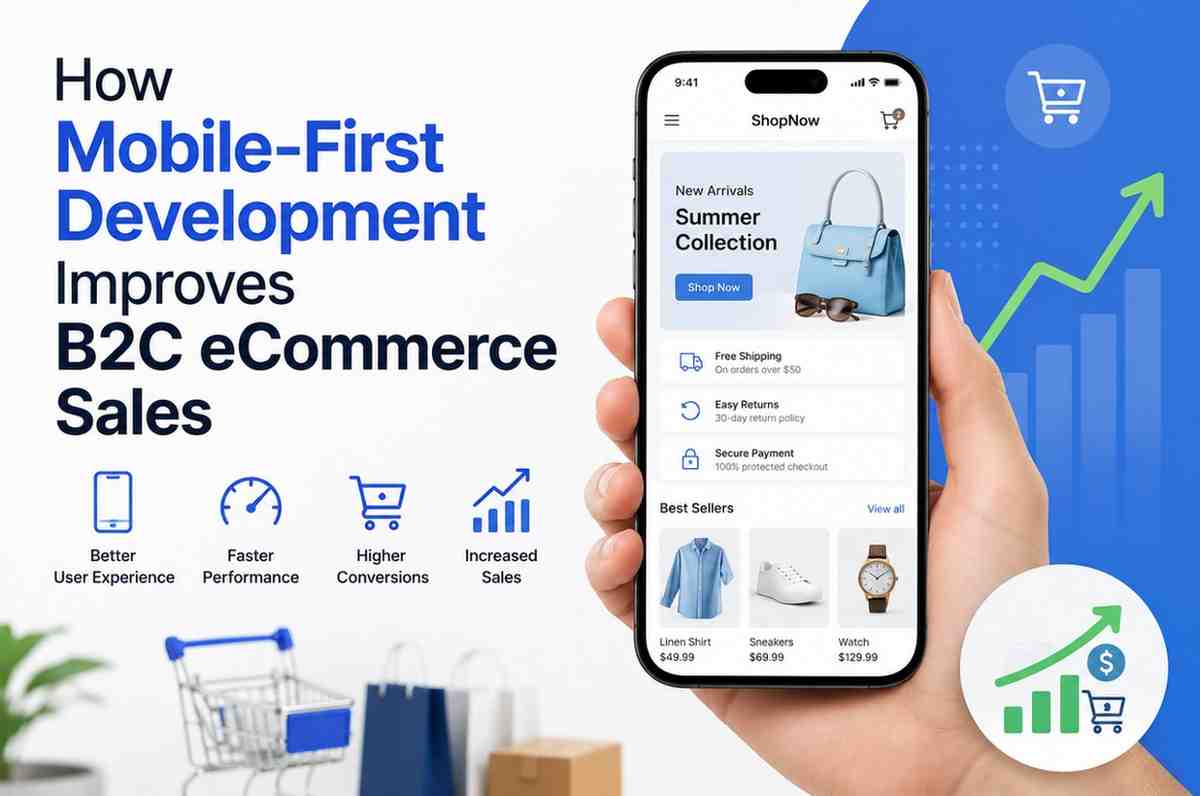
Your customers are shopping on their phones right now, probably in a queue, on a couch, or between meetings. Mobile devices already generate the majority of eCommerce traffic worldwide, and that share keeps climbing every year. Yet many B2C brands are still losing sales because their online stores were designed for desktop screens first and then squeezed onto mobile devices as an afterthought.
That gap between how people shop and how stores are built is exactly what mobile-first development fixes. In this article, we’ll break down what mobile-first development actually means, why it directly impacts your B2C eCommerce revenue, and how partnering with the right B2C eCommerce agency can help you close the mobile conversion gap for good.
What Is Mobile-First Development?
Mobile-first development is a design and engineering philosophy where a website or app is built for the smallest screen first, then progressively enhanced for tablets and desktops. Instead of designing a full desktop experience and shrinking it down (a “desktop-first” or “responsive-as-an-afterthought” approach), developers start with mobile constraints, limited screen space, touch input, variable network speed, and build up from there.
##Why Mobile-First Matters More Than Ever for B2C eCommerce
The numbers make the case better than any opinion can. Mobile devices now account for roughly 75–78% of all eCommerce website traffic, and mobile’s share of global retail eCommerce sales has climbed to around 59–60% according to Statista-sourced data compiled by DemandSage. In markets like South Korea, mobile already drives over 77% of online sales.
But here’s the catch: traffic doesn’t automatically translate into revenue. Mobile conversion rates have historically lagged behind desktop, and cart abandonment on mobile web sits at a steep 78–83%, largely due to friction at checkout, according to research summarized by Ringly and the Baymard Institute’s cart abandonment benchmarks. That’s the “mobile conversion gap”: brands are getting the visitors, but not converting them at the same rate as desktop shoppers.
##How Mobile-First Development Directly Improves B2C eCommerce Sales
###1. Faster Load Times Mean Fewer Abandoned Sessions
Mobile shoppers are impatient by nature; they’re often browsing on the go, on variable networks, with a dozen other tabs and apps competing for attention. Mobile-first development prioritizes lightweight code, optimized images, lazy loading, and minimal render-blocking scripts from the ground up. The result is a store that loads in under three seconds instead of seven or eight, and every second shaved off load time correlates directly with lower bounce rates and higher conversions.
###2. Streamlined, Thumb-Friendly Navigation
Desktop navigation menus with dozens of dropdown categories simply don’t translate to a five-inch screen. Mobile-first design forces simplified information architecture: sticky search bars, collapsible menus, larger tap targets, and product grids optimized for one-handed scrolling. This reduces the cognitive load on shoppers and makes it easier for them to find what they want and buy it instead of giving up out of frustration.
###3. Frictionless, Mobile-Optimized Checkout
Checkout is where most mobile sales are lost. Long forms, tiny input fields, and forced account creation drive shoppers away right before they convert. Mobile-first checkout flows use autofill, digital wallets like Apple Pay and Google Pay, guest checkout, and one-tap payment options. Streamlined one-tap checkout adoption has grown significantly in recent years precisely because it removes the friction points that cause cart abandonment, and implementing wallet-based payments has been shown to meaningfully reduce mobile drop-off rates.
###4. Native App-Like Experiences Without the App Store
Progressive Web Apps (PWAs) are a core piece of modern mobile-first strategy. They combine the reach of a website with the speed, offline capability, and push-notification features of a native app without requiring a download. Brands adopting PWAs are seeing strong year-over-year growth in adoption because they close much of the performance gap between mobile web and native apps, which have historically converted at rates well above standard mobile browsing.
###5. Personalization That Feels Native to Mobile
Mobile-first development pairs naturally with AI-driven personalization, smart product recommendations, dynamic search results, and tailored homepage content based on browsing behavior. Because mobile screens have limited real estate, showing the right product first matters more than on a desktop, where users can scan more options at once. AI-personalized recommendations have been shown to lift mobile average order value by double-digit percentages, making personalization one of the highest-leverage investments a mobile-first store can make.
6. Better Rankings Through Mobile-First Indexing
Google has used mobile-first indexing for years, meaning it primarily crawls and ranks the mobile version of your site. A slow, clunky mobile experience doesn’t just hurt conversions; it actively hurts your visibility in search results, according to Google’s own developer documentation on mobile-first indexing. A mobile-first build is, in effect, an SEO investment as much as a UX one.
7. Higher Engagement Through AR and Visual Commerce
Augmented reality, letting shoppers visualize furniture in their living room or try on shoes virtually, is no longer a novelty; it’s a proven conversion driver on mobile. Products featuring AR content have shown conversion rate increases as high as 94% in some studies, alongside meaningful reductions in product returns, because customers make more confident purchase decisions before checking out.
8. Reduced Cart Abandonment, Higher Repeat Purchases
When the entire mobile journey from landing page to payment confirmation is fast and frustration-free, shoppers are more likely to complete their first purchase and come back for a second one. Mobile-first brands frequently see improvements not just in conversion rate but in customer retention, since a smooth experience builds the kind of trust that turns a one-time buyer into a repeat customer.
##Mobile-First vs. Responsive Design: What’s the Difference?
It’s a common misconception that “responsive” and “mobile-first” mean the same thing. Responsive design adjusts layout based on screen size, but it often starts from a desktop-first codebase, meaning mobile users get a resized version of a desktop experience, not one built for their context. Mobile-first development flips that priority: the mobile experience is the default, and desktop is the enhancement. For B2C brands where most traffic and a growing share of revenue comes from phones, that distinction has a real, measurable impact on sales performance.
##Why B2C Brands Need Specialized Mobile-First Development Services
Building a genuinely mobile-first B2C store isn’t just a front-end tweak; it touches your platform architecture, checkout logic, third-party integrations, image pipeline, and performance monitoring. Getting it right requires B2C eCommerce development services that understand both the technical fundamentals of speed and performance, and the behavioral psychology of how mobile shoppers browse, compare, and buy.
##What to Look for in a B2C eCommerce Development Company
If you’re evaluating partners to lead your mobile-first transformation, look for a B2C eCommerce development company that can demonstrate the following:
– A performance-first engineering mindset: Core Web Vitals, image op timization, and sub-three-second load times shouldn’t be an afterthought; they should be baked into the build process.
– Experience with PWAs and headless commerce: so your store can deliver app-like speed and offline functionality without forcing customers into an app store download.
– Checkout and payments expertise: including digital wallets, one-tap payment flows, and guest checkout options proven to reduce cart abandonment.
– A track record with your platform: whether that’s Shopify, Magento (Adobe Commerce), WooCommerce, or a custom headless stack.
Data-driven UX design: decisions grounded in conversion research and real user behavior data, not just visual trends.
– Post-launch optimization support: mobile-first isn’t a one-time project; ongoing A/B testing and performance monitoring are what sustain conversion gains over time.
Choosing a partner with this depth of experience turns mobile-first development from a technical checkbox into a genuine growth lever for your business.
##Final Thoughts
Mobile is no longer just one channel among many for B2C eCommerce for most brands; it’s the primary way customers discover, evaluate, and buy products. The businesses winning in this environment aren’t the ones with the most traffic; they’re the ones that have closed the gap between mobile visits and mobile revenue through deliberate, performance-driven mobile-first development.
If your current store still feels like a shrunk-down desktop experience, it’s costing you sales every single day. Partnering with a capable B2C eCommerce agency to rebuild your mobile experience from the ground up isn’t just a design refresh; it’s one of the highest-ROI investments you can make in your eCommerce business this year.
##Mobile-First Development: Quick FAQs
1. Is mobile-first development more expensive than a standard responsive redesign?
Not necessarily. The upfront investment can be comparable, but mobile-first builds typically pay for themselves faster because they directly target the conversion gap where most B2C brands are losing revenue. A responsive retrofit often requires additional rework later to fix performance issues that mobile-first architecture avoids from day one.
2. Do I need a separate mobile app, or is a mobile-first website enough?
For most B2C brands, a well-built mobile-first website or Progressive Web App covers the majority of use cases without the cost and maintenance overhead of a native app. A dedicated app becomes worth considering once you have a loyal, high-frequency customer base that would benefit from push notifications, offline browsing, and app-exclusive perks.
3. How long does a mobile-first eCommerce redesign typically take?
Timelines vary by platform and scope, but most B2C mobile-first rebuilds covering UX redesign, checkout optimization, and performance tuning take anywhere from six to twelve weeks with an experienced development team. Larger, headless commerce migrations can take longer.

© 2025 Crivva - Hosted by Airy Hosting Managed Website Hosting.