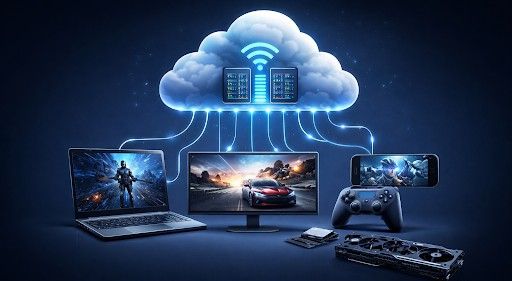
Cloud gaming fundamentally reduces hardware requirements and frees the user from GPU dependency. In this model, you can access online server-based services where high-end hardware is already configured, and you can run advanced games without upgrading your system.
Looking at gaming overall, users are naturally inclined to invest in this field. They build dedicated setups, select components, and try to maintain a system that meets their performance expectations. This approach is effective, but it is not feasible for every user.
Due to budget limitations, many users cannot assemble a high-performance PC. Installing a powerful GPU, keeping hardware updated, and maintaining consistent performance is a costly process. Because of this, users either compromise on their experience or explore alternative solutions.
Cloud gaming addresses this gap. In this model, the game does not execute on the local system but runs on remote servers where processing, storage, and graphics handling are already optimized. The user’s device only provides an access layer through which the game is streamed, while the actual rendering is handled by backend infrastructure.
The direct impact of this is that the user does not need to make heavy investments in their system. Maintaining an expensive GPU, high-end CPU, and large storage becomes optional. The user can access gaming through their existing device, whether it is a basic PC or a mobile, while the core workload is managed by cloud infrastructure.
The difference between a gaming PC and cloud gaming is not just about the platform, but about the execution model. A traditional gaming PC fundamentally relies on local hardware, where the entire workload, rendering, processing, and asset handling, is performed by the components installed within the system. This means that for a proper gaming experience, the user has to maintain a complete setup, which includes a desktop system, an updated CPU, a dedicated GPU, and a compatible memory configuration. These components are not just present for formality, but are critical for performance stability. If the installed CPU or GPU becomes outdated or does not meet the game’s requirements, frame consistency breaks, input delay increases, and the overall experience degrade.
On the other hand, cloud gaming introduces a different execution layer where the user’s device is no longer the primary compute unit. The game runs on a remote server where an already optimized hardware environment is available. The user’s system only acts as an interface that sends inputs and receives processed output. Due to this approach, hardware dependency is significantly reduced, especially for users who cannot afford high-end components.
An important shift here is that in gaming PCs, performance is directly linked to the user’s investment, whereas in cloud gaming, performance is defined by backend infrastructure. Because of this, beginners or budget users can still access a playable experience on their existing devices, whether it is a basic PC or a mobile device. They do not need to assemble a dedicated setup; instead, they utilize a service-based model where storage, processing, and graphical execution are already managed on remote servers.
In traditional PC gaming, the GPU is the central execution unit of the system. The rendering pipeline, frame generation, texture processing, and advanced features such as ray tracing or upscaling technologies all depend directly on GPU capability. Because of this, if there is no proper balance between the GPU and CPU, conditions like GPU bottleneck or CPU bottleneck are created, where one component restricts the performance of the other. This mismatch appears in real gaming scenarios in the form of frame drops, unstable FPS, and inconsistent load distribution. To accurately identify such issues, a bottleneck calculator is used, where the user can analyze their CPU and GPU combination to detect which component is causing the limitation.
Cloud gaming fundamentally shifts this dependency. Here, the GPU requirement is not eliminated, but it is completely removed from the user’s system. The game’s rendering workload is executed on remote infrastructure where enterprise-grade GPUs are deployed, optimized to handle virtualization and parallel workloads. This means the end user’s device does not participate in graphical processing and instead only performs the role of an input-output interface.
The direct implication of this shift is that user-side GPU selection becomes irrelevant. Your local system may be running on integrated graphics or a basic configuration, yet you can still access high graphical settings because the actual processing is handled by the remote server. This scenario is particularly important for users who cannot afford high-end GPUs or have not upgraded their systems.
In a conventional setup, the CPU operates as the orchestration layer of the game engine. It handles game logic, physics calculations, AI behavior trees, draw calls, and system-level scheduling. Even with a powerful GPU, a weak CPU can create bottlenecks—especially in open-world or simulation-heavy titles.
Cloud gaming removes that workload from the local environment entirely. All core execution, game loops, physics systems, and AI processing run on the server. The client device is no longer responsible for running the game; it’s responsible for maintaining the session. That distinction changes how CPU performance should be evaluated.
On the client side, the CPU’s responsibilities narrow down to three functions:
However, this doesn’t mean the CPU becomes irrelevant. The critical factor is no longer raw processing power, but efficiency in handling data flow. Poor CPU scheduling, lack of hardware acceleration support, or inefficient background processes can still introduce micro-stutters, input lag, or delayed frame presentation.
In traditional PC gaming, RAM and storage directly impact performance because game assets are loaded and processed locally. In cloud gaming, this entire data-handling process shifts to the server side, where high-speed memory and NVMe storage are already integrated. Because of this, the role of asset loading on the user’s device is eliminated.
After this change, local RAM only supports the operating system, streaming application, and video playback, rather than handling game data. Similarly, the role of storage is also removed from the execution pipeline, as games are not installed and large files do not need to be managed locally.
As a result, RAM and storage are no longer performance drivers; instead, they become basic requirements. As long as the system meets the minimum threshold, further upgrades do not have a measurable impact on the gaming experience.
In cloud gaming, performance control shifts from local hardware to the network. System processing power is no longer the decisive factor; instead, it depends on how efficiently the connection can send and receive data.
Every input, whether mouse movement or controller action, travels to the server, is processed there, a frame is generated, and then it is streamed back to the device for display. If there is any delay or instability in this round trip, it directly affects responsiveness.
Latency is the core variable here because it defines the delay between input and on-screen response. High latency means a noticeable lag, with actions and outputs not synchronized. Bandwidth sets the upper limit of visual quality, but a stable experience cannot be achieved through bandwidth alone.
Jitter and packet loss create real instability. Due to inconsistent data delivery, frame pacing is disturbed, the stream degrades, and sudden input delays are introduced. This is why a stable low-speed connection can perform better than a fluctuating high-speed connection.
In practical terms, consistent mid-range bandwidth is required for 1080p streaming, while 4K requires significantly higher throughput. However, if the connection is not stable, even higher bandwidth cannot deliver usable performance.
The core limitation here is that network issues cannot be compensated for by local hardware. No matter how powerful the system is, if latency is high or packet loss is unstable, the gaming experience will degrade.
In this model, the performance hierarchy is reversed: it is no longer the system, but the connection that determines how smooth the gameplay is.
Cloud gaming introduces a model where the importance of hardware ownership is significantly reduced, and access becomes more important. The user no longer needs to maintain a high-end GPU or an expensive setup, because processing and rendering are already handled by remote servers.
There are multiple reliable platforms available in the market, such as NVIDIA GeForce NOW, Xbox Cloud Gaming, and PlayStation Now, through which users can directly access cloud-based gaming. These platforms provide optimized infrastructure where performance is managed at the backend level.
In practical use, this model is effective for users who do not want to invest in hardware upgrades. GPU dependency on the user side is almost eliminated, which means the type of device does not matter. Whether you are using a basic PC, a laptop, or a mobile device, you can access high-standard games through streaming.

© 2025 Crivva - Hosted by Airy Hosting Managed Website Hosting.