

Early childhood development plays a critical role in shaping how blind and partially sighted children understand the world, build confidence, and develop independence. Specialist charities dedicated to visual impairment support provide structured services that go far beyond basic care. Their work focuses on communication, sensory learning, education access, emotional wellbeing, and family support. These services are designed to ensure that children are not limited by vision loss but are instead equipped with the tools and confidence needed to thrive from an early age.
Children learn about their surroundings through exploration, observation, and interaction. When a child experiences vision loss, they may require additional support to access information and engage with the world around them. Charities specialising in support for blind children bridge this gap by providing tailored resources, expert guidance, and practical interventions that promote healthy development and equal opportunities.
One of the most important services offered by charities supporting blind children is early intervention. This involves identifying developmental needs as early as possible and creating tailored support plans. Early assessment often includes evaluating sensory development, communication skills, mobility awareness, and cognitive growth.
By intervening early, support services can help children build essential foundations such as spatial awareness, tactile recognition, and auditory processing. These skills are crucial for later independence, learning, and social integration.
Early intervention professionals often work closely with families to monitor progress and adjust support strategies as children grow. Regular assessments help identify strengths and challenges, ensuring that support remains relevant and effective throughout different stages of development. Research consistently shows that early intervention significantly improves long-term educational, social, and emotional outcomes for children with visual impairments.
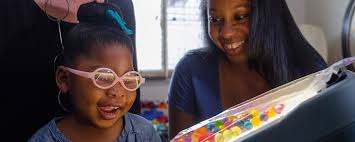
For blind and partially sighted children, sensory-based learning is essential. Charities provide resources that replace or enhance visual information through touch, sound, and sometimes smell or movement-based interaction.
These resources may include tactile books, textured diagrams, audio-described learning materials, and raised illustrations that help children understand concepts in a physical and interactive way. Such tools allow children to engage with storytelling, literacy, and numeracy in ways that are fully accessible and developmentally appropriate.
Accessible reading materials also support early literacy development by encouraging familiarity with language structure, narrative progression, and imagination-building activities.
In addition, many charities create customised educational kits designed to stimulate curiosity and exploration. These kits may include sensory toys, tactile puzzles, braille resources, and interactive learning materials that encourage independent discovery. By adapting educational content to meet individual needs, charities help children participate more fully in learning experiences both at home and in school.
Developing strong communication skills is another core service area. Children with visual impairments may require adapted approaches to speech, language, and interaction. Specialist support helps children develop verbal communication, listening skills, and social language understanding.
Many programmes also encourage alternative communication methods when needed, ensuring that every child has a reliable way to express needs, emotions, and ideas. This is essential for building confidence and reducing communication barriers in both educational and social environments.
Communication specialists often work with children through structured activities that encourage conversation, active listening, and language development. Since blind children cannot rely on visual cues such as facial expressions or body language, they may need additional support to understand social interactions. Programmes designed by charities help children develop these skills through role-play, guided interaction, and social communication exercises.
Developing independence is a long-term goal of early support services. Mobility training helps children understand how to move safely and confidently within different environments, whether at home, school, or in public spaces.
This includes orientation skills, environmental awareness, and safe movement techniques. As children grow, these foundational skills support greater autonomy and reduce reliance on constant assistance, helping to build confidence and resilience.
Specialist mobility instructors teach children how to identify landmarks, navigate familiar and unfamiliar environments, and understand spatial relationships. Some programmes introduce age-appropriate mobility tools and techniques that prepare children for increasing independence as they get older. Learning these skills early can have a significant impact on self-esteem and participation in everyday activities.
The emotional impact of visual impairment affects both children and their families. Charities provide counselling, peer support networks, and parental guidance to help families navigate early challenges.
Parents and carers are often given training and practical advice on how to support learning at home, adapt communication methods, and encourage independence in everyday routines. This collaborative approach ensures that children receive consistent support across all environments.
Family support services also provide reassurance and access to valuable information during what can often be an overwhelming period following a diagnosis. Connecting families with others who have shared experiences helps reduce feelings of isolation and creates opportunities for mutual support. Emotional wellbeing is a crucial part of a child’s development, and strong family support contributes significantly to positive outcomes.
Social interaction and play are vital for early childhood development. Specialist services create inclusive play opportunities that are accessible and meaningful for blind children. These activities encourage interaction with peers, development of social confidence, and participation in group learning environments.
Inclusive play also helps children develop problem-solving skills, emotional awareness, and teamwork abilities in a supportive setting.
Many charities organise playgroups, workshops, recreational activities, and community events specifically designed to accommodate visual impairments. These environments allow children to build friendships, develop communication skills, and experience a sense of belonging. Through guided play and social engagement, children gain confidence in interacting with others and participating in community life.
Modern technology plays an increasingly important role in supporting blind and partially sighted children. Many charities provide access to assistive technologies that enhance learning, communication, and independence.
Examples include screen readers, braille displays, talking devices, educational apps, and audio-based learning tools. These technologies enable children to access information more independently and participate more fully in educational settings.
Charities often provide training for both children and parents to ensure these tools are used effectively. Early exposure to assistive technology can improve digital literacy and prepare children for future educational and employment opportunities.
Another valuable service provided by charities is advocacy. Families often require guidance when navigating educational systems and securing appropriate support for their children.
Charities may assist with school placements, educational planning, accessibility requirements, and communication with teachers and educational professionals. By advocating for inclusive practices and equal access to learning opportunities, these organisations help ensure that children receive the support they need to succeed academically.
Educational advisors may also provide resources and training for schools, helping staff better understand how to support students with visual impairments in classroom environments.
Services like a blind charity for children are comprehensive, structured, and deeply impactful. From early intervention and sensory learning to mobility training and emotional support, these programmes are designed to build independence and confidence from the earliest stages of development. By combining education, accessibility, family guidance, technology support, and advocacy, these organisations help ensure that blind and partially sighted children have equal opportunities to learn, grow, and thrive in everyday life.
Through dedicated support and specialised expertise, charities play a crucial role in helping children overcome barriers, reach their full potential, and develop the skills needed for a successful and fulfilling future.

© 2025 Crivva - Hosted by Airy Hosting Managed Website Hosting.