

People often notice infrastructure only when something fails. A cracked slope after monsoon rains, water pooling near a foundation, or a service road that deforms under repeated loads. These outcomes usually trace back to decisions made much earlier-often to materials that never remain visible once a project is finished.
Across transportation, utilities, and industrial development, engineers are paying closer attention to how reinforcement and containment materials influence durability over decades rather than months. The conversation has shifted away from surface finishes and toward what happens underground, behind retaining walls, and within soil layers that carry stress year after year.
This article looks at how material behavior, site conditions, and system design intersect, and why certain supporting materials have become reference points for solving recurring field problems-without turning those materials into the central focus of the discussion.
No matter how advanced a structure appears above ground, it ultimately relies on soil that responds to load, water, and time. Soil is not static. It compresses, drains, expands, and migrates depending on particle size, moisture, and confinement.
Many construction issues stem from underestimating how soil behaves once disturbed. Excavation loosens natural compaction. Backfilling rarely restores original density. Rainwater finds paths of least resistance. Heavy loads apply uneven pressure.
Traditional approaches relied heavily on over-excavation and replacement with granular fill. This works in some contexts but becomes impractical as projects scale, especially in constrained urban or industrial sites. Moving large volumes of soil adds cost, time, and environmental impact.
That reality has pushed engineers toward reinforcement strategies that work with existing soil rather than against it.
One of the quiet shifts in civil engineering over the last two decades has been the move from “material replacement” to “material interaction.” Instead of assuming soil must be removed to improve performance, designers now look at how containment, confinement, and load distribution can change soil behavior.
This approach treats soil and reinforcement as a composite system. When done well, weaker soils can support loads they never could on their own. Slopes remain stable with less excavation. Pavements distribute stress more evenly. Drainage paths become predictable.
These systems are rarely visible once installed, which is why they are often under-discussed outside technical circles.
Polymer-based construction materials entered mainstream infrastructure slowly. Early skepticism centered on durability, UV resistance, and long-term creep. Over time, field performance and standardized testing addressed many of these concerns.
What made these materials attractive wasn’t novelty but consistency. Manufactured products behave the same way across sites, unlike natural aggregates that vary widely depending on source. This predictability matters when projects span large areas or must meet uniform performance criteria.
In practice, these materials are rarely used alone. They function as part of layered systems that include soil, aggregates, drainage elements, and sometimes concrete.
Industrial yards, container storage areas, and access roads often sit on soils that were never meant to carry repeated heavy loads. Traditional solutions involve thick aggregate layers or deep foundations, both expensive options.
Reinforcement systems allow thinner sections to perform reliably by spreading loads laterally rather than vertically. This doesn’t eliminate settlement entirely, but it controls differential movement-the type that causes cracking and rutting.
Cut slopes and embankments present ongoing maintenance challenges, particularly in regions with seasonal rainfall. Hard retaining walls solve some problems but introduce others, including drainage pressure and visual impact.
Reinforced slopes offer a more flexible alternative. By working with the soil’s internal friction, these systems reduce reliance on rigid structures while maintaining safety factors.
Water is often the hidden variable in structural issues. Poor drainage leads to softened soils, increased hydrostatic pressure, and long-term deterioration.
Integrated systems that manage both load and water movement reduce the risk of future intervention. This is especially relevant for basements, underground utilities, and industrial flooring where access after construction is limited.
Within this broader context, products classified under industrial net applications often appear not as headline solutions but as enabling layers. Their function is usually to separate, contain, or support other materials so that the system performs as intended.
Engineers encounter these materials when dealing with erosion control, drainage layers, or separation between dissimilar soils. Their value lies in preventing unintended mixing and maintaining design geometry over time.
Because these materials operate out of sight, their contribution is measured less by immediate visual impact and more by reduced maintenance calls years later.
Two-dimensional reinforcement works well in many scenarios, but some sites demand more. Highly deformable soils, steep slopes, and heavy cyclic loads require confinement in all directions.
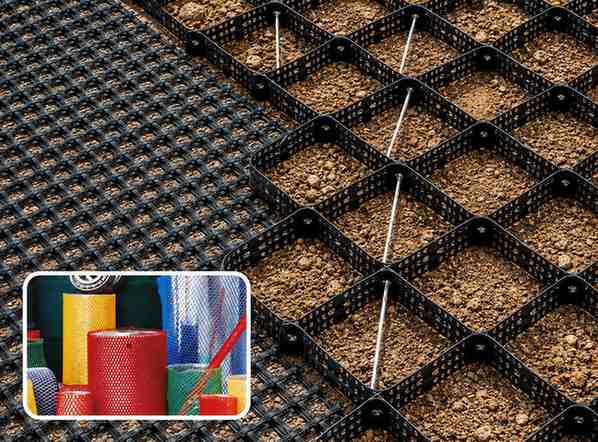
This is where geocell systems are sometimes introduced-not as a universal answer, but as a response to specific constraints. By creating a network of interconnected cells, the infill material behaves as a semi-rigid mass rather than loose fill.
The result is improved load distribution and reduced lateral movement. For designers, this opens options that would otherwise be dismissed due to soil limitations.
It’s worth noting that these systems demand proper installation. Poor infill selection or inadequate compaction undermines performance, reinforcing the idea that materials alone do not solve problems-systems do.
One recurring lesson across infrastructure projects is that installation often determines success more than the specification sheet. Even well-tested materials fail when placed incorrectly.
Common issues include:
Experienced contractors understand that these materials are not forgiving. They must be installed with attention to sequence and site conditions. This is why training and supervision remain critical, even for materials considered routine.
Beyond structural performance, material selection increasingly reflects environmental and logistical pressures. Projects are judged not only on upfront cost but also on carbon footprint, transport requirements, and future adaptability.
Reinforcement systems that reduce the need for imported aggregates or deep excavation often score better on these metrics. Fewer truck movements mean lower emissions and less disruption to surrounding areas.
From a logistics standpoint, lightweight, modular materials simplify handling on constrained sites where heavy equipment access is limited.
Infrastructure budgets are often squeezed, tempting teams to prioritize initial cost over lifespan. History shows that this approach usually backfires. Repairs, downtime, and retrofits cost more than building correctly the first time.
Materials that support soil behavior rather than mask its weaknesses tend to deliver steadier performance over decades. They don’t eliminate maintenance, but they make it predictable.
Engineers who have dealt with repeated failures on similar projects tend to remember which systems quietly worked and which demanded constant attention.
Specifications are necessary, but they rarely capture the full complexity of site conditions. Experienced professionals read beyond them, asking how materials will interact with soil, water, and load cycles specific to the project.
This mindset treats reinforcement and containment materials not as products to be purchased, but as components within a broader structural narrative. When used this way, they become tools for managing uncertainty rather than sources of it.
That perspective-grounded in observation rather than promotion-is what ultimately leads to infrastructure that performs well long after the construction phase fades from memory.

© 2025 Crivva - Hosted by Airy Hosting Managed Website Hosting.