

The most important part of any infrastructure project is usually the part you never see once construction is finished. Beneath roads, behind retaining walls, and below railway embankments, decisions made at the foundation level determine whether a structure performs reliably for fifty years – or begins deteriorating within a decade.
For a long time, the standard response to ground instability was to add more material. More concrete, more aggregate, more depth. It worked, but it was expensive, resource-heavy, and often impractical in remote or difficult terrain. The widespread adoption of geosynthetic reinforcement has fundamentally shifted this equation.
Today, geosynthetic grids are specified on highway projects, rail corridors, slope stabilization schemes, and foundation reinforcement works across the world. Understanding why – and understanding which type of geosynthetic to use in which situation – matters more than most procurement teams realize.
Soil handles compressive loads reasonably well. It handles tensile stress poorly. When a road carries traffic, when an embankment carries its own weight on soft ground, or when retained earth pushes against a wall, the failure mode is almost always tensile – the soil mass wants to spread, slide, or pull apart at some plane of weakness.
Geosynthetic grids work by intercepting those tensile forces. Placed horizontally within a soil mass, they act as a distributed tension element – essentially doing what soil cannot do on its own. The result is a composite system where the grid and the soil work together, each contributing where the other is limited.
What makes this approach so effective in practice is that it is precise. Instead of adding bulk material across the entire cross-section, engineers can place reinforcement exactly where the analysis shows it is needed, at the depths and spacings that match the stress distribution. This leads to leaner, more efficient designs without compromising structural performance.
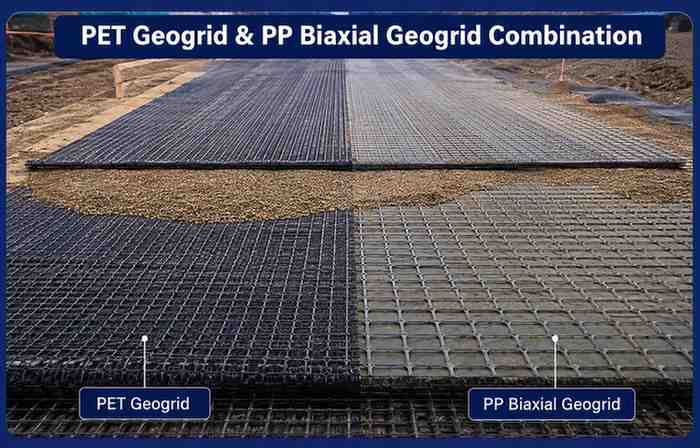
Geosynthetic grids are primarily manufactured from two polymer families: polypropylene (PP) and polyester (PET). Both are commercially available, widely used, and will appear in project specifications. They behave quite differently under sustained load, and treating them as interchangeable is an engineering mistake that often only becomes visible years after construction.
PP grids are semi-crystalline thermoplastics. They have good short-term tensile strength, excellent chemical resistance across a wide pH range, and a manufacturing process that allows for tight aperture geometry – which improves aggregate interlock with surrounding fill material.
Their practical limitation is creep. Under sustained load over long periods, polypropylene deforms slowly and progressively. For moderate-stress applications – road base reinforcement, pavement stabilization, shallow slope treatment – this is manageable. The pp geogrid remains a trusted and cost-effective solution for these everyday stabilization applications, particularly where the chemical environment is aggressive or where long-term tensile demands are within polypropylene’s range.
PET grids are manufactured from woven or knitted polyester yarn, typically coated for protection against installation damage and environmental degradation. Polyester’s mechanical behavior under sustained load is substantially better than polypropylene – its creep resistance is significantly higher, and it maintains dimensional stability across a broader range of conditions.
For structural applications where load is permanent and design life is measured in decades, this matters enormously. Retaining walls, bridge abutments, steep reinforced slopes, and embankments over soft ground all impose sustained tensile demands on the reinforcement layer. The pet geogrid is the specification of choice in these conditions because its long-term design strength – after applying the required creep reduction factor – remains meaningfully higher than an equivalent PP grid.
The distinction between ultimate tensile strength and long-term design strength is one that experienced geotechnical engineers understand well but that procurement teams often miss. Two grids with identical quoted tensile strengths may have very different allowable design strengths once creep and installation damage factors are applied. Substituting one for the other on cost grounds can silently undermine the design.
Reinforced earth retaining walls are among the most demanding applications for geosynthetic grids. These structures are not passive – every layer of reinforcement is actively resisting the lateral earth pressure of the retained fill, every day, for the life of the structure. There is no redundancy. There is no capacity to redistribute load if one layer creeps significantly.
This is why retaining wall specifications almost always call for PET grids in permanent applications. The long-term tensile behavior of polyester provides the design certainty that polypropylene cannot match at equivalent short-term strengths. Wall deformation, face displacement, and eventual structural compromise are the predictable outcomes when reinforcement creeps beyond design tolerances.
Construction sequence also interacts with grid selection in ways that are worth understanding. Stiffer grids – which PET grids generally are, at equivalent strength grades – hold their geometry better during compaction of successive fill layers. This produces more consistent wall geometry during construction and reduces the risk of localized deformation that can be difficult to correct once the facing is in place.
Highway and rail embankments over soft, compressible ground present a different challenge from retaining walls. Here, the dominant concern is differential settlement – the tendency of a soft foundation to consolidate unevenly under the weight of the embankment fill, causing the road or rail surface above to deform irregularly over time.
Geosynthetic reinforcement at the embankment base helps by spreading load more evenly across the foundation, reducing stress concentrations that cause localized failure or excessive settlement in weaker zones. In extreme cases, this is combined with pile foundations or stone columns, with the geosynthetic forming the spanning element between supports.
The reinforcement in this role must maintain its geometry and strength while the foundation consolidates – a process that can take years in highly compressible soils. Long-term tensile behavior is again the governing criterion, which is why PET grids are heavily specified in these applications internationally.
Polymer selection is not only about mechanical performance. The chemical environment of the installation site matters.
Polyester is susceptible to hydrolysis in strongly alkaline or strongly acidic conditions. Most natural soils are within a pH range where this is not a concern, but contaminated sites, industrial brownfields, and certain geological formations can present conditions that degrade unprotected PET over time. Coating systems on modern PET grids provide significant protection, but the degree of protection must be verified against actual site chemistry.
Polypropylene has much broader chemical resistance and performs reliably across a wider pH range without special protection. In chemically aggressive ground conditions, PP grids are often the correct choice even where creep performance would otherwise favor polyester – the right answer depends on the specific conditions, not on a general preference for one polymer over the other.
This is why geotechnical site investigation should always include chemical characterization of the soil and groundwater, not just mechanical properties. Specifying geosynthetics without this information is working with incomplete data.
There is a pattern in infrastructure procurement where geosynthetics are specified to a performance standard in the design but then value-engineered during the procurement phase. A contractor proposes an alternative product that matches the headline tensile strength but may have different creep characteristics, a different coating system, or a different installation damage profile.
These substitutions rarely cause problems in year one. The structure looks fine at handover. The issues emerge at year fifteen or year twenty-five, when the structure is well past warranty and the procurement decision is buried in archived records. By then, attributing the deformation to the original substitution is difficult, and the cost of remediation falls entirely on the asset owner.
The practical countermeasure is clear specification writing – specifying not just ultimate tensile strength but long-term design strength, creep reduction factor requirements, installation damage reduction factors, and chemical resistance class. When specifications define what the grid must actually do over its design life, rather than just what it measures on a test rig, substitution becomes much harder to justify on cost alone.
There is a sustainability argument for geosynthetic reinforcement that is rarely stated clearly in project documentation. When a geosynthetic layer allows a road base to be thinner, or an embankment to use less fill, or a retaining wall to be built without mass concrete, it directly reduces the volume of quarried, processed, and transported material in the project.
Across a national highway program, those savings in aggregate volume, concrete volume, and transport fuel add up to a significant reduction in embodied carbon. The polymer manufacturing impact of the geosynthetic itself is real but generally much smaller than the material savings it enables.
The decisions that determine whether a geosynthetic installation performs as designed are largely made before any material arrives on site. The site investigation defines the soil conditions. The design analysis determines the required long-term tensile strength. The specification translates that requirement into measurable product criteria. The procurement process either protects that specification or erodes it.
Each of those steps depends on the one before it. Poor site investigation leads to incorrect design assumptions. Incomplete design analysis leads to underspecified products. Vague specifications invite substitutions. Uninformed procurement allows them.
The foundations we build today will carry traffic, trains, and structures for decades. They deserve the same level of attention as the visible parts of the infrastructure they support.

© 2025 Crivva - Hosted by Airy Hosting Managed Website Hosting.