


Australian search is shifting fast in 2026. Google still dominates, but user behaviour is being reshaped by mobile habits, AI Overviews, zero-click results, and the growing role of LLM-style discovery. The key takeaway for businesses is simple: you can no longer optimise only for rankings. You need to optimise for visibility, answers, and brand demand across Google, Maps, and AI-influenced results.
This blog explains how Australians use search engines in 2026, what’s changing, and how to respond with modern SEO, AEO, and strategy that reflects real user behaviour. It covers market share, devices, intent, local and voice search, organic vs paid clicks, and AI-driven changes, with a focus on practical actions Australian businesses can take.
We reviewed competitor content structure and topics (statistics, implications, and recommendations), then built an Australia-first dataset using publicly available market share and usage sources. Market share and platform splits are sourced from StatCounter’s Australian datasets, supported by Australian digital context sources and local commentary on AI in search.
Search engine market share refers to the proportion of search referrals each engine receives. Platform share shows desktop, mobile, and tablet usage. Zero-click means a search ends without a click to an external website. AI Overviews are Google’s AI-generated summaries shown above the results for some queries. AEO targets being the best answer, not just the top link.
What is the most popular search engine in Australia in 2026?
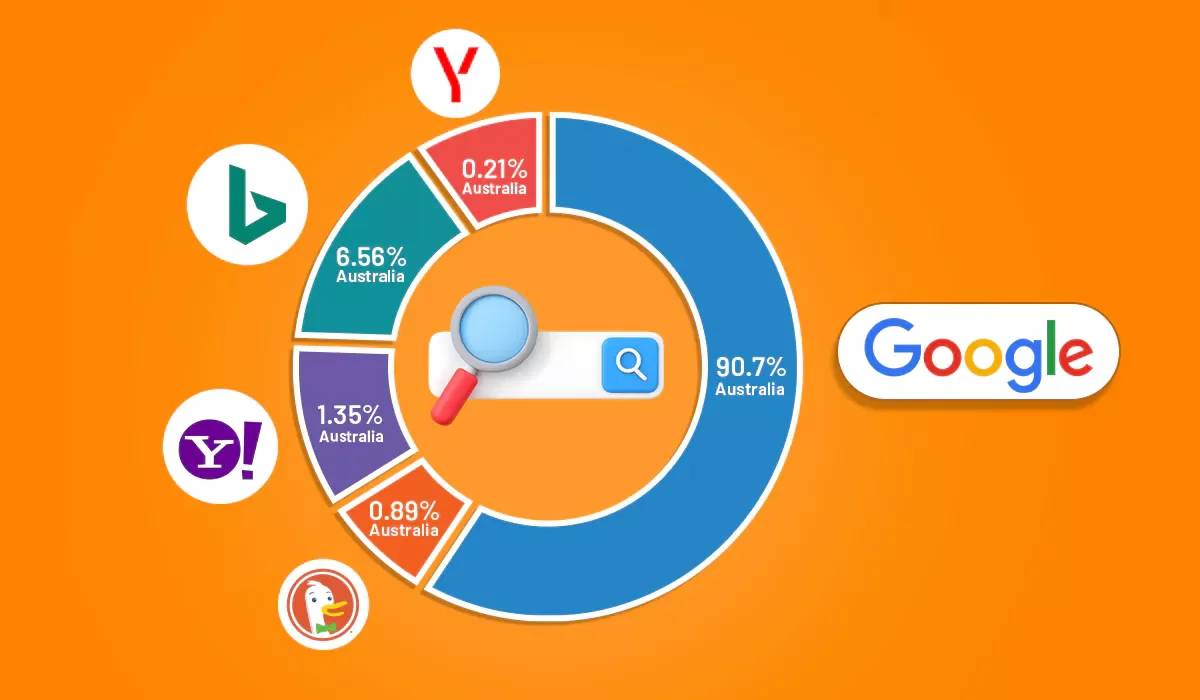
Google remains Australia’s most popular search engine by a wide margin, with around 90.7% market share in January 2026. Bing follows at 6.56%, then Yahoo at 1.35%, and DuckDuckGo at 0.89%. This matters because most “Australia Google search engine optimisation” work still lives or dies in Google’s ecosystem, even when you also plan for alternative discovery channels.
How concentrated is search behaviour in Australia?
Australia is unusually concentrated compared to global averages. In January 2026, Google held 90.7% of the Australian search engine market, while its global share stood at 89.82%. That gap is small, but the bigger difference is that Australia’s “long tail” of engines is thinner, meaning fewer meaningful alternatives for scale. For most brands, Google remains the main acquisition lever.
Market share snapshot (January 2026)
| Search engine | Australia market share | Global market share |
| 90.7% | 89.82% | |
| Bing | 6.56% | 4.45% |
| Yahoo | 1.35% | 1.37% |
| DuckDuckGo | 0.89% | 0.74% |
| Yandex | 0.21% | 1.95% |
Has Google’s dominance changed in Australia over recent years?
Year-on-year movement in Australia has been modest compared with other markets. From 2023 to 2025, Google’s lead remains stable, with slight shifts primarily benefiting Bing and privacy-oriented alternatives. The practical implication is that you can forecast search demand and channel mix more confidently in Australia than in markets with bigger swings. You still need to adjust tactics, but not your entire channel strategy every quarter.
Is Google stronger in Australia than globally?
Yes, slightly. Google’s share is 90.7% in Australia versus 89.82% worldwide (January 2026). That difference is slight, but strategically important: Australian businesses are more exposed to Google algorithm volatility, SERP layout changes, and AI features that reduce clicks. If Google reduces organic visibility through AI summaries or more in-SERP answers, the impact lands harder in Australia because there is less alternative search volume elsewhere.
Do Australians search more on mobile or desktop in 2026?
Australia is close to a 50-50 split. In January 2026, desktop accounts for 50.43% of platform share, mobile 46.21%, and tablet 3.36%. This is different from the common assumption that mobile dominates everywhere. For marketers, it means optimising for mobile-first experiences without neglecting desktop conversion paths, especially for considered purchases and B2B research.
Which browsers shape search behaviour in Australia?
Browsers influence default search settings, privacy features, and how users experience AI features and SERP layouts. In January 2026, Chrome leads at 52.06%, followed by Safari at 31.3%, and Edge at 7.77%. Safari’s significant share matters for iPhone-heavy audiences and local campaigns. Chrome’s lead reinforces Google’s position, as many users stay within Google’s ecosystem.
How does age affect search behaviour in Australia?
Working-age Australians are typically the heaviest users of AI tools and multi-format search (text, voice, visual). At the same time, older demographics tend to rely on traditional search patterns and brand navigation. Recent Australian survey summaries suggest around 49% of Australians have used generative AI in the past 12 months, with adoption highest among ages 18–44. This matters because younger users are more likely to accept “answer-first” experiences and click less often.
Do search patterns vary by region in Australia?
Yes. Proximity needs, service availability, and connectivity shape regional behaviour. Metro areas often exhibit higher paid search competition, stronger “near me” intent, and more map-led discovery. Regional and suburban regions can see higher brand and category queries tied to practical needs (trades, healthcare, education), and a heavier reliance on local results. The best approach is to pair suburb- and service-area-focused content with strong Google Business Profile optimisation.
What types of intent dominate Australian searches?
Australian searches commonly split into navigational (brand or destination), informational (learning), and transactional (buy or book). The critical shift in 2026 is that informational intent is increasingly satisfied directly on the results page through AI summaries, featured snippets, and rich results. For businesses, that means you need content that wins the click when it matters, and also content that builds brand recognition even when there is no click.
Australians commonly search for news and current events, shopping and product research, local services, entertainment, health, travel, finance, and government services. What matters for strategy is matching the page format to intent: service pages for bookings, guides for research, comparison pages for decision-making, and local pages for “near me” demand.
How important is local search in Australia in 2026?
Local search is a major driver of leads for service businesses. A large share of searches has local intent, and map-led discovery is often the first point of contact. Australian local SEO research also highlights the growing impact of “open now” and proximity-based queries. The practical move is to treat your Google Business Profile like your second homepage: services, categories, reviews, photos, and consistent NAP details.
Is voice search changing SEO in Australia?
Voice search pushes SEO towards natural language and question-based content. People speak differently from how they type. They use longer phrases, ask location-based questions, and want quick answers. Even when voice search volume is hard to measure precisely, its influence is evident in query wording and “near me” behaviour. Optimising for conversational headings, short answers, and local modifiers helps you capture voice-style searches.
Common Australian voice use cases include driving directions, nearby services, business hours, quick comparisons, and simple how-to questions. Voice queries also align with urgency. If your pages are slow or unclear, voice-driven users bounce faster. Focus on page speed, clear service coverage, and visible trust signals above the fold.
How does video influence search in Australia?
Video increasingly supports discovery and decision-making, particularly for product research, tutorials, and reviews. Even when the search starts on Google, users often end up on video results or on platforms Google prominently features. This matters because video can capture top-of-funnel attention while your website captures conversions. The simplest win is embedding short, helpful videos on key pages and using clear titles and schema-friendly structure.
Search is no longer one box and ten links. In 2026, Australians move across text, maps, images, and video, often in the same journey. Your job is to keep your brand visible at multiple touchpoints: local listings, organic pages, video results, and increasingly, answer-style placements.
Is organic search still worth it in Australia?
Yes, but you must measure it differently. Organic can drive high-quality traffic, but zero-click experiences reduce total clicks for informational queries. Australian commentary on search behaviour notes a growing share of searches that end without a click, while paid placements remain strong for commercial queries. The best approach is to use paid search for immediate demand and SEO for compounding visibility, trust, and lower acquisition costs over time.
Organic builds authority and reduces dependence on fluctuating ad costs. Paid gives speed and control. Together, they let you own the whole funnel: paid captures bottom-of-funnel buyers; organic nurtures researchers and builds brand recall.
In 2026, businesses that win tend to do three things: invest in content that answers real questions, improve conversion paths (forms, calls, booking), and build brand searches through consistent presence across channels.
Learn more: https://www.digitalzoop.com.au/google-search-statistics/

© 2025 Crivva - Hosted by Airy Hosting Managed Website Hosting.