

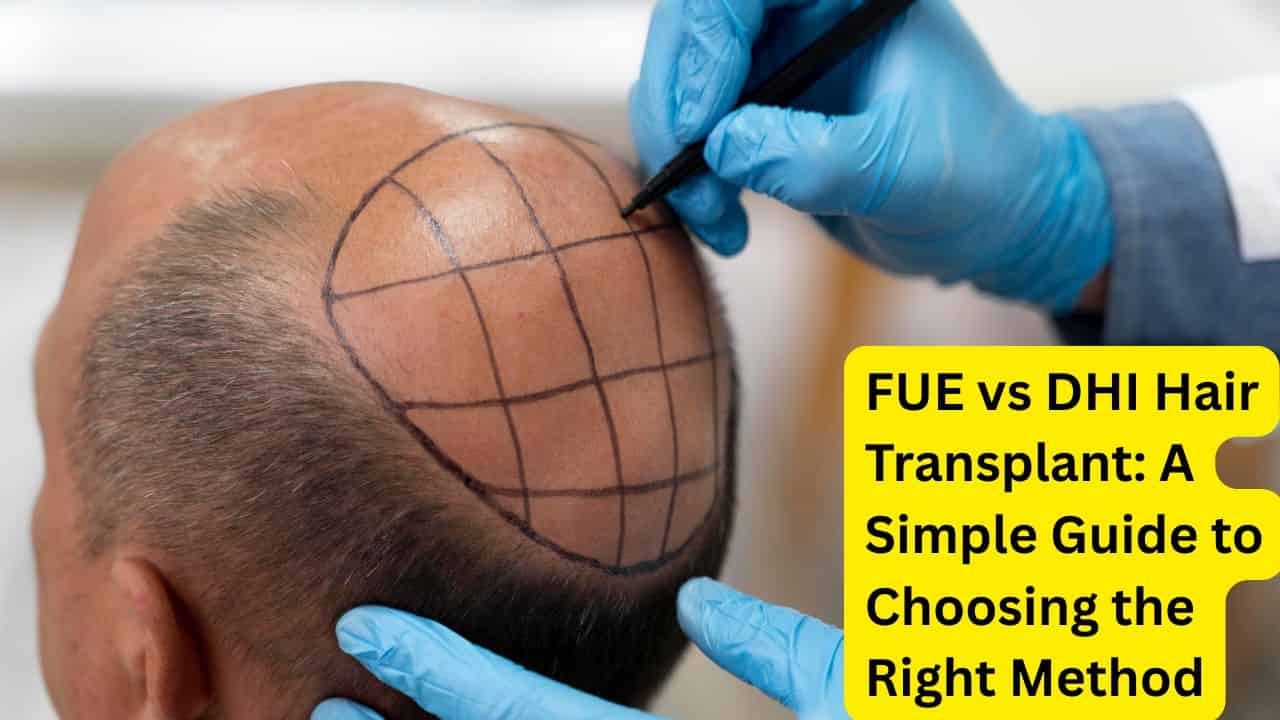
Hair loss affects millions of people worldwide, and modern hair transplant methods have made it easier to restore natural-looking hair without major surgery. Among the most popular techniques available today are FUE (Follicular Unit Extraction) and DHI (Direct Hair Implantation). If you’re comparing FUE vs DHI hair transplant procedures, it’s important to understand how each method works, their differences, benefits, drawbacks, and which option may suit you better.
This detailed guide breaks down everything you need to know about FUE vs DHI, explained in simple words so you can make an informed decision.
FUE (Follicular Unit Extraction) is one of the most commonly performed hair transplant techniques around the world. It involves extracting individual hair follicles from the donor area—usually the back or sides of the head—and implanting them where hair is thinning or missing.
This method avoids a long linear scar, making it a popular and safe option.
Because FUE allows the surgeon to extract large numbers of grafts in one session, it is often recommended for patients with extensive hair loss.
DHI (Direct Hair Implantation) is a more advanced variation of FUE. The extraction process is similar, but the implantation is done using a special tool called the Choi implanter pen.
This allows for better precision, especially in the hairline and small, targeted areas.
DHI is especially recommended for patients who want detailed refinement, natural hairlines, and dense packing in small areas.
Understanding the difference between FUE vs DHI helps you choose the right method.
|
Feature |
FUE |
DHI |
|
Incisions |
Pre-made slits required |
No pre-incisions; pen implants directly |
|
Implantation |
Manual placement |
Choi implanter pen |
|
Density |
Good |
Very high |
|
Cost |
Lower |
Higher |
|
Healing Time |
Fast |
Slightly faster |
|
Best For |
Large bald areas |
Precision + hairline |
This is one of the most commonly asked questions when comparing FUE vs DHI hair transplant.
The truth is:
✔ Both methods are effective, and neither one is universally better.
✔ The best technique depends on your hair goals, budget, and hair loss pattern.
In summary:
While DHI has many advantages, it also comes with limitations that should be considered before choosing this method.
DHI is more expensive because:
The implantation process is slower. Covering 3,000–4,000 grafts in DHI can take much longer than FUE.
The success of DHI depends heavily on the surgeon’s expertise. If the surgeon is not highly experienced with the Choi pen, results may be uneven.
Very curly or thin donor hair can be difficult to load into the pen, limiting suitability for some patients.
For higher graft numbers, DHI sessions may need multiple days.
Both FUE and DHI can give natural results when performed by an experienced surgeon.
However:
Both methods have quick recovery, but DHI may heal slightly faster because it uses finer tools and requires fewer incisions. Most patients resume normal activities within 2–5 days for either technique.
Both FUE and DHI provide permanent results because they use permanent hair follicles from the donor area. The longevity depends more on:
Rather than the technique itself.
The FUE vs DHI hair transplant comparison shows that both procedures are safe, effective, and capable of producing natural, long-lasting hair. The right method depends on your needs:
Consultation with a qualified hair transplant surgeon will help determine the best method based on your scalp condition, hair quality, and goals.
Book a Free Hair Transplant Consultation today and get a personalized treatment plan tailored to your hair type, budget, and restoration goals.
Take the first step toward a fuller, natural-looking hairline.

© 2025 Crivva - Hosted by Airy Hosting Managed Website Hosting.