


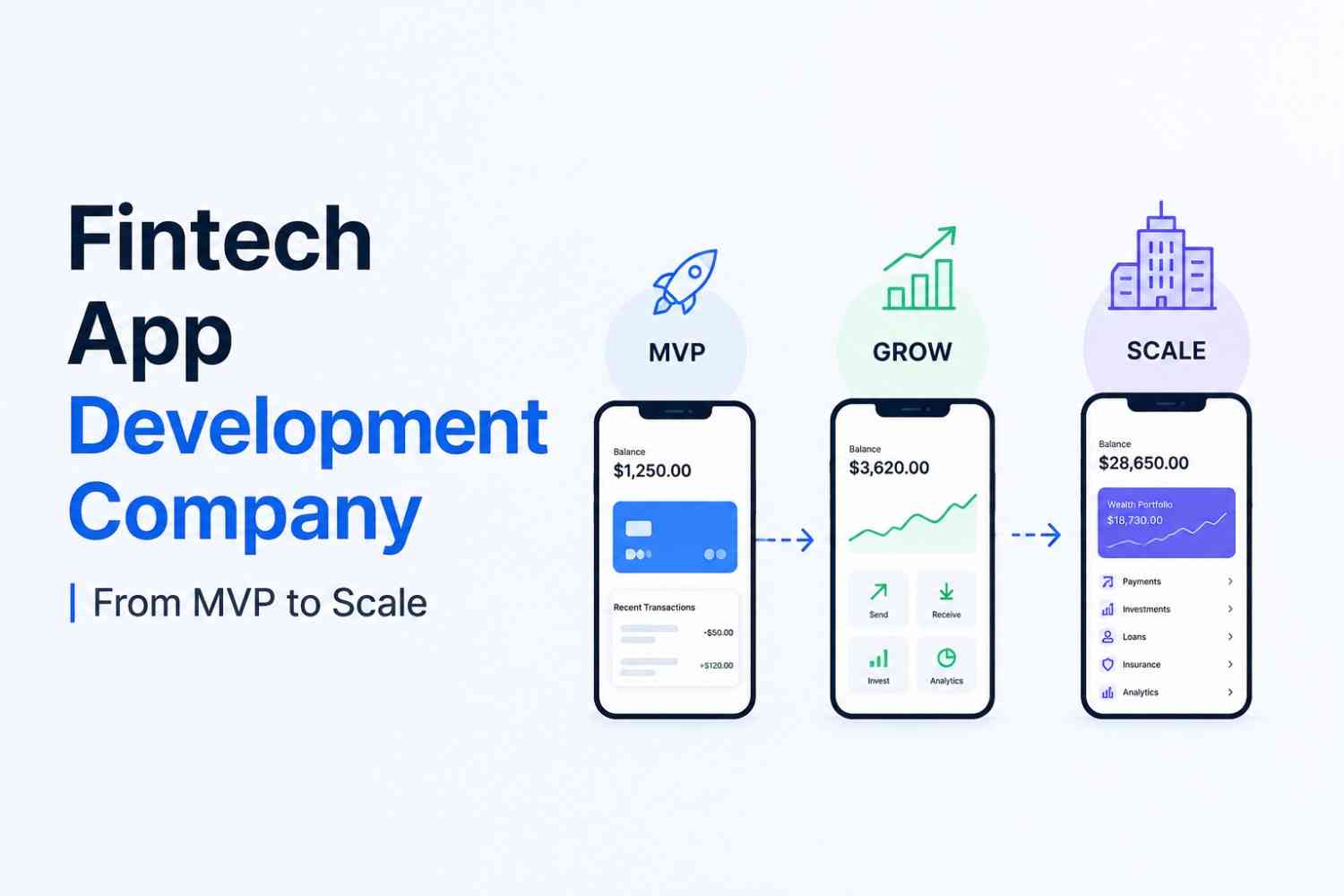
Most startups enter fintech with a bold product idea but quickly discover that building for money is a different game than building for anything else. A reliable fintech app development company does not just write code it shapes your product strategy, security posture and scalability roadmap from day one. The path from a minimum viable product to a fully operating fintech platform is neither linear nor predictable, yet it becomes manageable when the right team walks that road alongside you from the very beginning.
Scaling a fintech product is fundamentally different from scaling a social media or e-commerce platform and most founders discover this difference when it is far too late to course-correct without spending heavily. In fintech, every architectural decision you make at the MVP stage either opens or closes doors for compliance integrations, payment partnerships and user trust down the road.
The MVP-to-scale journey in fintech moves through three distinct phases and each one carries significant weight on the ones that follow it:
Choosing the wrong development partner early on costs far more than the initial contract value, because you end up rebuilding what they built instead of growing confidently on top of it. A strong fintech app development company brings domain-specific knowledge that a generic software agency simply does not carry and that gap becomes painfully visible the moment a compliance audit or payment processor onboarding enters the conversation without warning.
Here is what a capable partner actually delivers to your project from the very first sprint:
A fintech mobile app development company that combines all three of these qualities becomes a long-term growth partner for your business, not just another line-item vendor on a procurement contract.
The MVP phase in fintech is not about building the smallest possible version of your concept it is about validating one specific financial problem with real users while keeping the compliance pathway open for future growth. Many startups treat the MVP as a speed sprint with no guardrails and that decision creates expensive architectural rewrites six months later when a banking partner demands a formal security audit before proceeding with an integration.
A focused fintech app development company will scope your MVP around three core priorities and none of them can be safely deprioritized without direct consequence to your timeline and trust:
The goal is not merely to launch quickly, but to launch in a way that a payment processor or Series A investor can honestly evaluate without raising immediate concerns about your foundation.
After your MVP earns its first real users, the next phase is not adding features it is building the trust infrastructure that every bank, payment processor and enterprise client will examine closely before agreeing to partner with you. This is where many early-stage startups stall, because they treated compliance as optional in Phase 1 and are now paying for that decision with delayed partnerships and blocked account applications from processors.
The compliance foundation your fintech app development company must build in this phase covers the following non-negotiable components:
Skipping this layer does not save you time it borrows time from your future growth and pays it back with compounding interest across every delayed partnership negotiation and compliance remediation sprint.
|
Area |
MVP Phase |
Scale Phase |
|
Architecture |
Monolithic, simple, fast to ship |
Microservices, distributed, fault-tolerant |
|
Compliance |
Decision log, basic KYC, risk mapping |
Full PCI DSS, AML automation, regional certifications |
|
Security |
Role-based access, encrypted storage |
Threat modeling, SIEM, quarterly penetration testing |
|
Analytics |
5–15 tracked activation events |
Real-time dashboards, cohort analysis, churn signals |
|
Support |
Founder-driven, manual escalation |
Ticketing system, SLAs, dedicated support team |
|
Infrastructure |
Single cloud region, fixed capacity |
Multi-region, auto-scaling, 99.9% uptime commitments |
Most fintech products break at scale not because the original idea was flawed, but because the infrastructure was designed for a hundred users when ten thousand arrived at the same time without warning. The scaling phase is where your fintech app development company proves its long-term value, because the decisions made here determine whether you expand confidently into new markets or spend the next twelve months firefighting performance failures that were entirely preventable from the start.
The architecture priorities that separate teams who scale smoothly from teams who do not are worth understanding clearly before you reach this stage:
As your platform grows, the scope of what you need from a development partner expands well beyond feature delivery and the best fintech app development services account for this evolution from the beginning of your engagement rather than presenting it as an expensive upsell later in the relationship. A partner that only ships features without maintaining infrastructure, compliance and performance is a vendor and vendors are simply not enough when your platform handles real people’s money every single day without margin for error.
At scale, your development service engagement should include the following ongoing responsibilities without exception or negotiation:
The fintech app development company you choose should present a documented roadmap covering all three areas before you sign the engagement contract, not after you are fully dependent on them for daily platform operations.
Not every company that claims fintech expertise has actually shipped a regulated financial product through a full compliance cycle and that distinction matters enormously when your users’ money and personal data are directly involved in every transaction. When evaluating fintech app development companies, prioritize teams with documented case studies specifically in payments, lending or digital banking not generic mobile app portfolios that list fintech as one of fifteen equally weighted industries they serve. Ask directly for their compliance process documentation, their security framework references and the payment processors they have satisfied during formal technical audits with verifiable and referenceable outcomes.
The path from MVP to scale in fintech is one of the most demanding journeys in software, because you are building for trust just as much as you are building for functionality and user experience. Every architecture decision, every compliance shortcut and every vendor selection compounds over time either working in your favor as you grow or accumulating against you as technical and legal debt. Partnering with the right fintech app development company from the very beginning is not a luxury reserved for well-funded startups it is the single most cost-effective decision any founder can make, because rebuilding on a broken foundation always costs more than investing in building it correctly the first time around.

© 2025 Crivva - Hosted by Airy Hosting Managed Website Hosting.