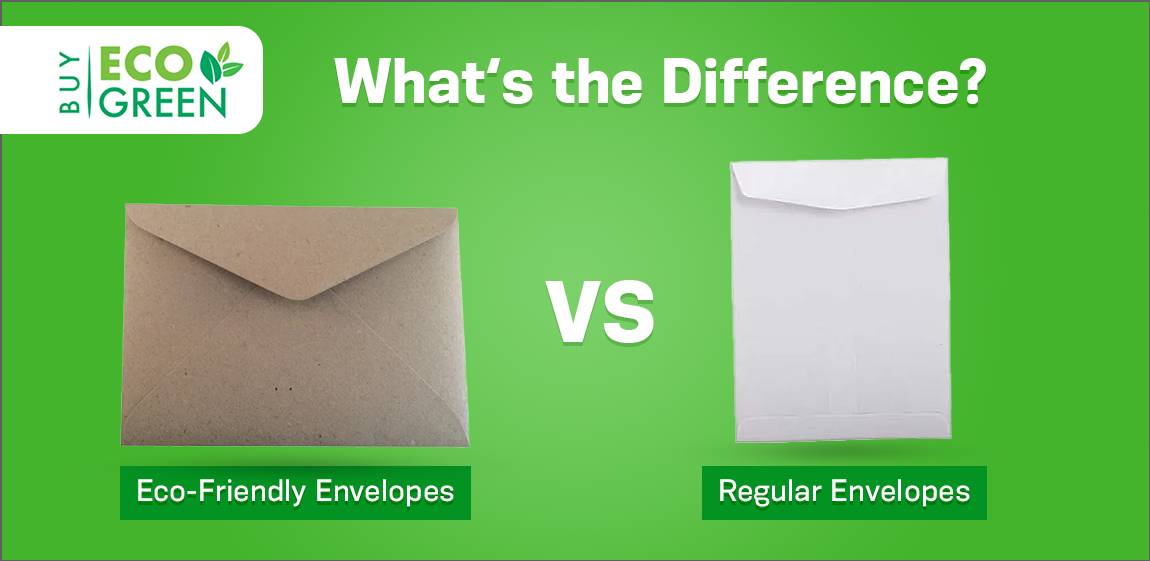
Modern schools and offices rely on envelopes every day: sending invoices, mailing exam results or simply keeping documents tidy. Each of those envelopes has an environmental footprint. Choosing eco‑friendly envelopes instead of conventional ones can significantly reduce waste and resource use. This guide explains how eco‑friendly envelopes differ from regular envelopes, why the difference matters for Australian schools and offices and how to make an informed choice.
Regular envelopes are typically manufactured from virgin wood pulp. Virgin fibre paper uses large amounts of trees, energy and water and produces considerable waste and pollution. A comparison by the Environmental Paper Network shows that producing one tonne of virgin‑fibre paper consumes about 24 trees and 33 million BTUs of energy and releases 5600 pounds of CO₂‐equivalent greenhouse gases, whereas recycled paper avoids all tree cutting and reduces energy use and pollution. MIT’s recycling facts page adds that recycling one tonne of paper instead of using virgin pulp saves 17 trees, 7 000 gallons of water, 4 200 kWh of energy and prevents 60 pounds of air pollutants.
Conventional envelopes often undergo chlorine bleaching to achieve a bright white finish. This process generates chlorinated by‑products that are toxic to ecosystems. The adhesives used to seal regular envelopes are usually solvent‑based; according to adhesive manufacturer H.B. Fuller, solvent‑based adhesives release emissions and require significant energy to remove the solvents.
Eco‑friendly envelopes are designed to minimise environmental impact. Key differences include:
“Kraft” refers to the unbleached brown paper commonly used for mailing. Kraft envelopes are durable and have a natural aesthetic that appeals to environmentally conscious businesses. Twigs Paper explains that recycled brown kraft envelopes are made from 100 % recycled content with 20 % post‑consumer waste. Because they avoid bleaching and include significant post‑consumer fibre, kraft envelopes have a lower carbon footprint and are often biodegradable.
The biggest environmental difference between eco‑friendly and regular envelopes lies in resource consumption.
| Factor | Regular envelopes | Eco‑friendly envelopes |
| Raw materials | Virgin pulp from trees; chlorine bleaching; solvent‑based adhesives | Recycled paper or responsibly sourced paper (e.g. FSC‑certified); chlorine‑free processing; water‑based or solvent‑free adhesives |
| Resource use per tonne | Uses ~24 trees and 33 million BTUs energy; emits 5 600 lb CO₂‑eq | 0 trees; 22 million BTUs energy; reduces greenhouse gas emissions by ~37 % |
| Water & energy savings | Producing new paper consumes large volumes of water and energy | Recycling paper saves 7 000 gallons of water and 4 200 kWh of energy per tonne |
| Air and water pollution | Conventional bleaching and solvents produce chlorinated by‑products and VOCs | Recycled paper production creates 74 % less air pollution and 35 % less water pollution; solvent‑free adhesives release fewer emissions |
| End‑of‑life | Some envelopes have plastic windows or mixed materials that complicate recycling; padded mailers often end up in landfill | Designed for recyclability or compostability; recycled paper decomposes more cleanly and avoids methane emissions |
Consumers often wonder whether envelopes with plastic windows can be recycled. The U.S. EPA states that even envelopes with plastic windows can be recycled. The key is that specialised recycling centres remove the window films and adhesives. An article from All Colour Envelopes explains that council recycling centres use machinery to melt adhesives and separate plastic windows so that the paper fibres can be recycled without contamination.
Recycling paper conserves natural resources and reduces pollution. Shred‑it UK’s study (summarised by All Colour Envelopes) notes that recycling paper uses 70 % less energy and water than producing new paper and that recycling one tonne of paper saves over 17 trees. MIT’s recycling facts further highlight that recycling prevents air pollution and reduces energy use.
When paper decomposes in landfills it produces methane, a greenhouse gas 25 times more potent than CO₂. Using recycled and compostable envelopes reduces waste sent to landfill and therefore helps cut methane emissions. Many kraft and are biodegradable, breaking down naturally without harming the environment.
Adhesives and window materials influence both performance and environmental impact:
There is a perception that green stationery products are more expensive or less durable. While eco‑friendly envelopes sometimes cost a little more due to smaller production runs or certification fees, the price gap is narrowing as demand grows. Recycled kraft envelopes are thick and durable and often have a rustic appearance that enhances brand identity. Twigs Paper emphasises that their recycled brown envelopes are high‑quality, biodegradable and suitable for a wide range of uses. The adhesives used in eco‑friendly envelopes meet the same performance standards as those in regular envelopes, so there is no need to sacrifice reliability.
Here are some tips to help Australian schools and offices select the best envelope:
Read more here: https://www.buyecogreen.com.au/eco-envelopes-vs-regular-envelopes/

© 2025 Crivva - Hosted by Airy Hosting Managed Website Hosting.