Many online stores face the same frustrating problem: traffic comes in, but sales do not follow. Visitors browse products, add items to their carts, and then disappear without completing a purchase. In many cases, the issue is not the products or pricing; it is the store’s foundation. A poorly structured website can cause slow loading speeds, confusing navigation, checkout friction, and weak mobile experiences. These problems reduce trust and cause shoppers to leave before converting. That is why choosing the right CMS and building it strategically is more important than ever.
Modern eCommerce success depends on creating an online store that is fast, user-friendly, scalable, and optimized for customer behavior from the start.
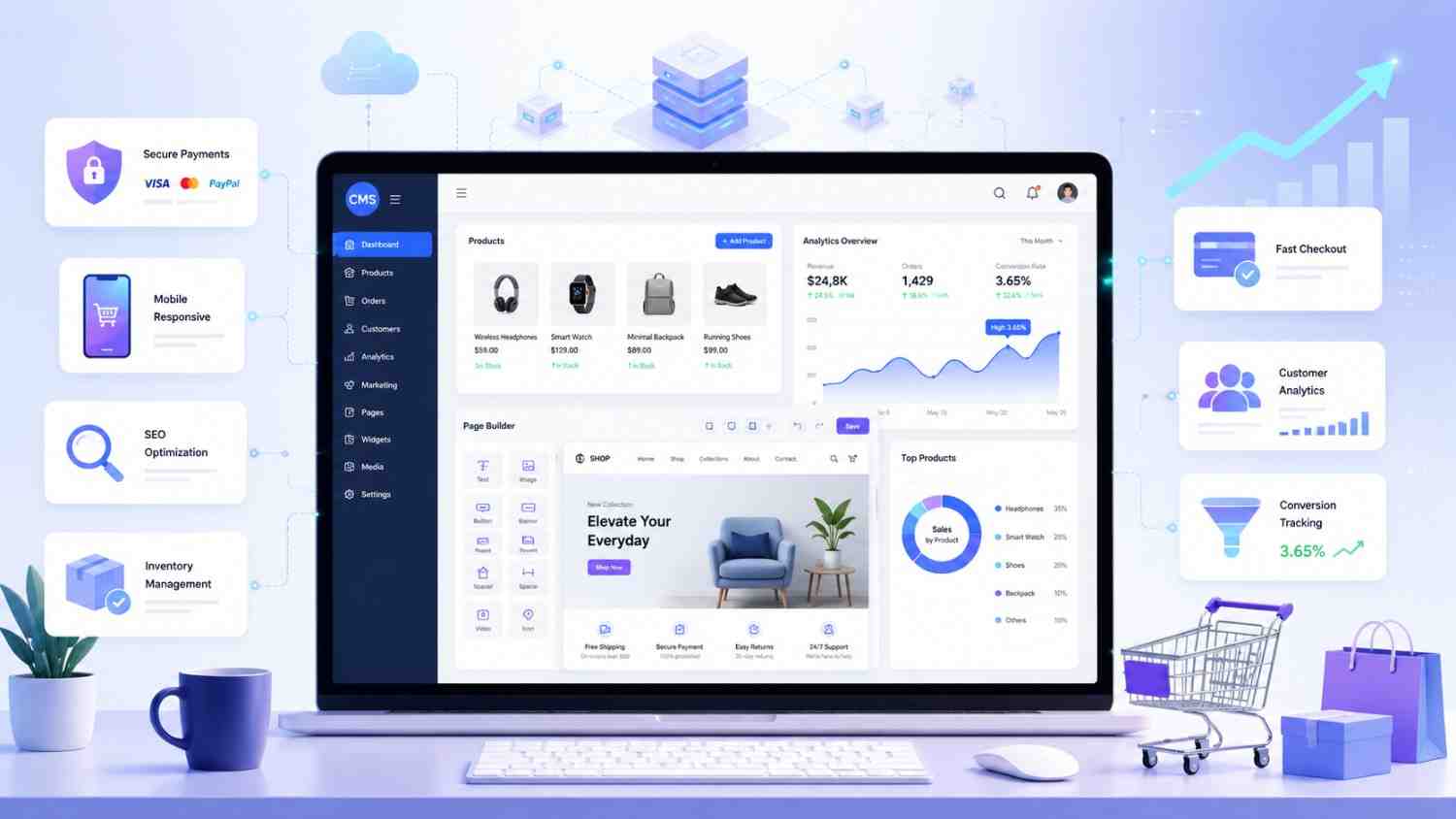
An effective eCommerce CMS serves as the engine for your online store. It handles products, customer data, content, inventory, design, and shopping experiences all in one place.
However, the CMS also influences how users engage with your business. A slow or outdated platform can hurt search visibility, customer retention, and conversion rates.
Businesses often turn to a specialized CMS development company when creating complex online stores. Customization, integrations, and performance improvements need technical planning that goes beyond simple templates.
The right CMS setup helps businesses to
Without these capabilities, growth becomes hard over time.
A high-converting store is not just visually appealing. It removes obstacles from the buying process and builds confidence at every step.
Several key factors influence conversions:
Speed is one of the biggest conversion factors in eCommerce. Users expect pages to load almost instantly, especially on mobile devices.
If pages take too long to load:
A well-developed CMS architecture includes:
Performance improvements directly influence customer satisfaction and purchasing behavior.
Mobile shopping now dominates online commerce. A store that works perfectly on desktop but struggles on smartphones loses significant revenue opportunities.
Mobile-friendly CMS development focuses on:
The goal is to reduce friction for users browsing and buying on smaller screens.
Customers should never feel lost while shopping online. Confusing category structures and cluttered menus create frustration.
A well-organized store structure includes:
Good navigation reduces decision fatigue and helps shoppers quickly find what they need.
Many businesses focus only on products and overlook content strategy. However, content plays a major role in attracting traffic and building trust.
An effective CMS makes it easier to manage:
Helpful content supports users throughout the customer journey. It answers questions, reduces uncertainty, and improves search engine visibility.
For example:
Content and commerce work best when they are integrated into the same ecosystem.
Not every CMS setup is built to support the future growth of ecommerce. High-performing online stores typically include specific capabilities that improve scalability, enhance customer experience, and support long-term business success.
As product catalogs grow, businesses need systems that make updates easy.
This includes:
A flexible backend saves time and reduces operational complexity.
Search traffic remains one of the most valuable acquisition channels for online stores.
A strong CMS should support:
Technical SEO becomes much easier when the CMS is properly structured from the beginning.
Security is critical in eCommerce because customers share sensitive information during transactions.
Modern CMS development prioritizes:
Customers are more likely to complete purchases when the checkout experience feels safe and trustworthy.
Many stores perform well initially but struggle as traffic increases. Scalable development ensures the website can handle:
Planning scalability early prevents expensive rebuilding later.
Businesses often face a common decision: use a prebuilt template or invest in custom development. Templates can work for smaller stores with simple requirements, but they often come with limitations:
Custom development offers greater control over:
The right approach depends on business size, goals, and long-term plans.
Checkout is one of the most sensitive stages of the customer journey. Even small usability issues can lead to abandoned carts.
Effective checkout optimization includes:
Reducing friction during checkout significantly improves completion rates.
Many successful stores continuously analyze user behavior to identify drop-off points and improve the checkout experience over time.
Modern consumers expect more personalized shopping experiences. Generic storefronts no longer create strong engagement.
Advanced CMS systems support:
Personalization helps stores create more relevant experiences, increasing both conversions and customer retention.
This is where the strategic use of an eCommerce CMS becomes especially valuable, as personalization often depends on flexible integrations and customer data management.
A modern online store rarely operates independently. It usually connects with multiple external systems.
Common integrations include:
Strong CMS development ensures these systems communicate smoothly without affecting performance or user experience.
Poor integrations often create operational inefficiencies and customer frustration.
Even visually attractive stores can struggle due to technical and structural issues.
Some common mistakes include:
Avoiding these mistakes improves both usability and long-term performance.
Building a high-converting online store needs more than just an attractive design. The content management system (CMS) behind the store affects performance, scalability, SEO, security, and customer experience.
Successful eCommerce development aims to create smooth shopping journeys that eliminate friction and build trust. From mobile responsiveness and page speed to personalization and checkout improvement, every part plays a role in conversion success.
As online competition increases, businesses that invest in smart CMS development are better equipped to provide smoother experiences, boost retention, and respond to changing customer expectations.
The best CMS depends on business needs, scalability goals, customization needs, and technical know-how. Popular options are WooCommerce, Shopify, Magento, and headless CMS solutions.
CMS development boosts store performance, usability, SEO, security, and scalability. A well-developed CMS creates smoother customer experiences, increasing conversions.
Slow-loading websites lead to higher bounce rates and cart abandonment. Faster websites improve user satisfaction, search rankings, and purchase completion rates.
Key features include mobile responsiveness, SEO tools, secure checkout, product management, integrations, scalability, and performance optimization.
Custom development provides more flexibility, scalability, and performance optimization. Templates are quicker and cheaper for smaller projects with simpler needs.

© 2025 Crivva - Hosted by Airy Hosting Managed Website Hosting.