

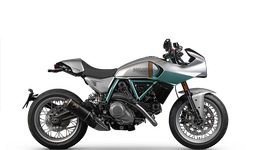
Ducati built the Ducati Formula 73 as a limited-run heritage cafe racer that pulls hard on emotion, but the hardware tells a serious story too. This bike takes the Scrambler 800 mechanical package, wraps it in a race-inspired body, and adds a production cap of 873 units to tie the machine directly to 1973, the year Ducati’s 750 race program stamped its name into endurance racing history.
That headline angle sells the bike. The engineering angle explains why it works.
Looking at the data, the Formula 73 combines an 803 cc air-cooled L-twin, 73 hp, 48 lb-ft, a steel trellis frame, 17-inch spoked wheels, and a claimed wet weight of 403 lb (183 kg). Ducati then layers on premium visual and tactile pieces: a numbered steering plate, bodywork that references the 750 Super Sport lineage, and a color scheme that calls back to the green/silver race aesthetic shown in Ducati’s heritage storytelling.
This is a collector bike, yes. In addition, it is a very usable modern road machine with ABS, traction control, ride modes, quickshifter support, TFT instrumentation, and maintenance intervals that fit real ownership.
The Ducati Formula 73 sits in a niche that keeps getting harder to execute well: the modern cafe racer motorcycle with authentic brand history. Many retro bikes copy shapes. Ducati built this one around a documented racing reference point and tied the limited production number to that origin story.
Specifically, Ducati positions the bike as a tribute to the 1970s Formula racing era and the 750 Super Sport/750 race lineage. The styling leans on period cues, but the chassis and electronics stay modern enough to avoid the common retro-bike trap: great photos, compromised riding.
From an expert perspective, that balance matters more than the paint. Riders can live with a bike that has modest peak power if it delivers strong midrange torque, predictable geometry, and usable electronics. The Formula 73 checks those boxes.
The Formula 73 succeeds because Ducati did not stop at a tank graphic. The bike uses several core cafe racer design cues that change the silhouette and rider impression from every angle.
By comparison, a standard retro-themed motorcycle often relies on one or two cues and keeps the rest of the donor bike visually intact. Ducati changed the visual mass distribution here. The fairing, seat, wheel choice, and frame color work together, so the bike reads as a complete design rather than a trim package.
Consequently, the Formula 73 lands where many “special editions” miss: it looks coherent in profile and in detail shots.
Under the bodywork, Ducati uses the familiar Scrambler-based air-cooled L-twin package. That choice makes sense. A high-output liquid-cooled engine would have pushed the bike away from the mechanical tone Ducati wants and raised thermal, packaging, and cost complexity.
Looking at the data, Ducati tuned this engine for road speed and rider feel, not spec-sheet bragging. Peak torque arrives at 7,000 rpm, and peak power lands at 8,250 rpm, which keeps the useful operating band broad for canyon riding and fast secondary roads.
That matters on a bike like this. The Formula 73 sells an experience built on throttle connection, sound, and corner exits. The air-cooled Desmodue layout supports that brief with direct response and visual character, while the 6-speed transmission and modern clutch package keep the drivetrain civil in traffic.
From an expert perspective, Ducati’s engine choice does three things:
That is smart product logic. Ducati built a heritage Ducati motorcycle that owners can ride often without feeling they bought a museum piece with mirrors.
The Formula 73’s chassis spec tells you how Ducati expects the bike to be ridden. The company did not chase extreme wheel travel or upright ADV ergonomics. It built a road-biased package with stable dimensions and enough hardware quality to support brisk riding.
Specifically, the Pirelli Diablo Rosso IV tire choice gives away Ducati’s intent. This is not a soft-focus retro bike aimed only at city cruising. Ducati paired the heritage design with current high-grip street rubber that supports modern lean angles and stronger braking loads.
In addition, the 330 mm front disc and radial caliper setup deliver the sort of stopping performance buyers now expect at this price point. Ducati also includes Bosch Cornering ABS, which adds a real safety margin when road conditions shift mid-corner.
Ducati did not leave the Formula 73 in a period-correct time capsule. The bike includes a modern electronics and convenience stack that turns it into a practical premium motorcycle, not a garage-only collectible.
Consequently, owners get the visual effect of a classic Ducati cafe racer without giving up features that buyers now expect in the premium segment. That has direct resale value too. Limited editions hold stronger interest when they combine rarity with practical ownership.
Ducati limits the Formula 73 to 873 units, and that number carries marketing weight because it connects directly to 1973. This gives Ducati a clean, memorable story that sales teams can explain in one sentence.
That story matters in the collector market. Buyers paying premium money for a heritage special usually want three things:
The Formula 73 checks all three.
Yanko Design reports a starting U.S. price of $19,995. It also lists a UK figure and timing context, but from a U.S.-buyer SEO angle, the $19,995 number is the useful benchmark because it places the Formula 73 in premium middleweight territory rather than superbike territory.
From an expert perspective, Ducati priced the bike where exclusivity, brand heritage, and usable mechanicals can coexist. Push the price much higher and buyers cross-shop flagship exotica. Price it much lower and the limited-edition positioning loses force.
The Formula 73 competes less on outright horsepower and more on identity, finish, and production scarcity. Still, buyers will compare it against other premium retro roadsters and cafe-leaning machines.
Ask the dealer to document the serial number, included certification items, and any Formula 73-specific accessories at delivery. Limited-edition value depends on complete provenance.
The official spec lists a single seat standard with a two-seat setup possible via accessory kit. If you plan to ride with a passenger, price and parts availability should enter the deal conversation early.
The Pirelli Diablo Rosso IV tires support strong road performance, but sticky street tires can wear faster than touring-oriented rubber. That changes annual running costs for riders who actually use the bike.
On a model like this, paint, trim, and finish condition influence resale almost as much as mileage. Use premium cleaning products and keep a service record with date-stamped photos.
If the Ducati Formula 73 sits on your shortlist, move fast and move methodically. Limited-run Ducati models can vanish from dealer availability long before late-stage shoppers start making calls.
The Ducati Formula 73 works because Ducati backed a strong story with credible hardware. It looks like a collector piece, but the spec sheet says you can ride it hard on real roads. That combination drives demand in this segment, and it gives the bike a stronger long-term position than style-only specials.

© 2025 Crivva - Hosted by Airy Hosting Managed Website Hosting.