


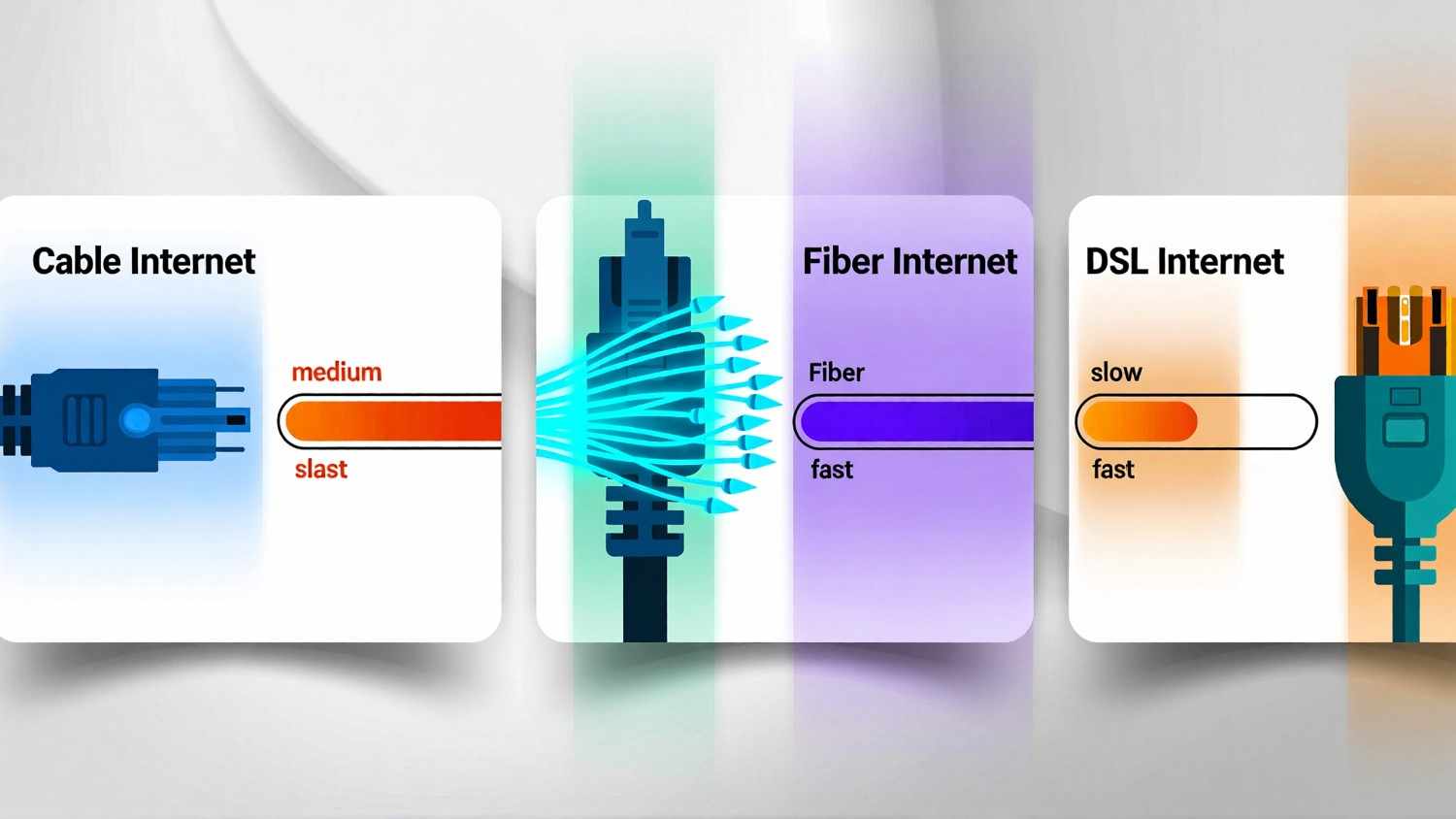
Have you ever wondered why your internet slows down when your family is streaming, gaming, and scrolling at the same time? Or why does your friend across town get faster speeds even though you both pay about the same? This often happens because you’re not on the same type of internet connection.
Today, three main types of home internet dominate: DSL Internet, Cable Internet, and Fiber Internet. Understanding the differences and deciding which one is best for you can be confusing, especially with all the marketing terms out there.
Don’t worry. This guide explains Cable, Fiber, and DSL in a simple, friendly way so you can see how each one works, what makes them different, and which one suits your needs. No tech background needed—just real, useful information.
Let’s dive in.
Most people choose an internet plan without considering what’s behind it. They only pay attention to speed numbers and then get frustrated when those speeds don’t seem fast enough.
Here’s the truth: Your internet type (DSL, Cable, or Fiber) affects how reliable, stable, and fast your connection can be even before you select a speed plan. The technology is just as important as the Mbps on your bill. So if you’ve been dealing with slow Wi-Fi, lagging uploads, or video call dropouts, understanding these technologies is the first step to improving your online experience.
DSL Internet (Digital Subscriber Line) is one of the earliest broadband options, using your home’s telephone lines to provide internet access. But don’t worry you can still use your landline phone while online. DSL sends data over a different frequency, so it doesn’t interfere with your calls.
How DSL Works
DSL uses copper telephone wires to connect to your modem. Because these wires weren’t designed for high-speed data, DSL is often slower than Cable and Fiber.
What You Can Expect With DSL Internet
Who Is DSL Best For?
DSL Internet is best for rural areas, single users, or casual internet browsing. It’s not suited for heavy streaming, fast uploads, or serious gaming so keep your expectations realistic.
Cable Internet uses the same coaxial cables that deliver cable TV, which are better at carrying high-speed data than telephone lines. This makes Cable Internet faster and more reliable than DSL, especially for households where multiple people are online simultaneously.
How Cable Internet Works
Your provider brings the internet to your home with coaxial cables, which are the same as those used for cable TV. These cables can handle a lot of data, so cable internet offers higher bandwidth than older technologies. As a result, cable internet speeds can hit hundreds of Mbps and even go up to 1 Gbps in many places. This makes it a great choice for streaming, gaming, and regular online activities.
What You Can Expect With Cable Internet
The Only Downside?
Cable networks are shared. This means during busy times, like evenings when everyone is streaming, you might notice slower speeds.
Who Is Cable Best For?
If you need fast, reliable internet for a family or multiple devices, Cable Internet is a great, affordable choice.
Fiber Internet is the most modern internet technology available. Instead of using metal wires, it sends data through thin strands of glass using light signals. Yes, your internet literally travels at the speed of light. That’s why Fiber is considered the fastest and most reliable option on the market.
How Fiber Internet Works
A fiber-optic cable transmits data using light pulses. Because light moves extremely fast and doesn’t weaken easily, fiber offers lightning-fast speeds with very low delays (latency).
What You Can Expect With Fiber Internet
The Only Drawback
Fiber isn’t available everywhere. Many rural areas still lack fiber infrastructure since it’s expensive to install.
Who Is Fiber Best For?
If you can get it, Fiber is ideal for remote workers, students, gamers, content creators, or families with many connected devices.
Now that we’ve broken down each type, let’s compare them in plain language.
Fiber is by far the fastest, with speeds reaching multiple gigabits. Cable provides solid mid-to-high speeds, while DSL offers lower, entry-level speeds.
Fiber stands out due to its modern infrastructure. Cable remains consistent but might slow during peak times. DSL is stable yet limited in performance.
This is where Fiber Internet excels offering equal upload and download speeds. Cable uploads are moderate, while DSL uploads are generally slow.
DSL is the most widely available, especially in rural locations. Cable comes next. Fiber is still expanding.
Choosing between Cable vs Fiber vs DSL depends on your needs—and what’s available at your address.
Here’s a simple way to decide:
Understanding the differences between DSL, Cable, and Fiber can save you a lot of frustration and money. Each type has its place, but the right choice depends on how you use the internet and what’s available where you live.
If Fiber Internet is an option, it’s the best choice, fast, reliable, and built for the future. Cable Internet is a strong second choice and works well for most households. DSL remains a solid option for basic needs and rural users.
No matter what you choose, the key is selecting a connection that fits your lifestyle, not just picking the cheapest plan on the list.
DSL uses phone lines, Cable uses TV coaxial cables, and Fiber uses light-based fiber-optic cables. Fiber is fastest, Cable is mid-range, and DSL is entry-level.
Fiber Internet is the fastest, offering speeds in the gigabit range. Cable is fast but not symmetrical. DSL is the slowest.
Yes. Cable Internet provides high speeds and low latency for smooth streaming and gaming in most homes.
Fiber uses light signals instead of electrical ones, meaning it doesn’t weaken over distance and isn’t affected by interference or network congestion.
DSL Internet is still a solid choice for rural areas or light users who mainly browse, email, and stream casually.

© 2025 Crivva - Hosted by Airy Hosting Managed Website Hosting.








