

ift wrapping is rarely the first thing on a procurement list, but it appears in almost every Australian organisation at some point during the year. School fundraiser prizes, corporate end-of-year gifts, council community event hampers, childcare centre celebration packs, not-for-profit donation acknowledgements, and staff recognition gifts all require some form of presentation packaging.
The problem is that most gift wrap purchased without much thought ends up being exactly that: a throwaway choice. Glossy papers coated in plastic laminate, foil finishes loaded with metallics, and glitter-dusted wrapping that contaminates recycling streams are all still widely sold, and many organisations buy them simply out of habit.
For schools, businesses, councils, and community groups working toward sustainability targets, the type of gift wrap your organisation chooses is a small but entirely avoidable source of waste. And with a strong range of genuinely eco-friendly options available, there’s no operational reason to keep reaching for wrapping that heads straight to landfill after a single use.
This guide covers every major type of gift wrap, explains what each one is made from, outlines which organisational contexts each suits best, and helps procurement teams and administrators make choices that align with both practical needs and environmental values.
Before getting into the types themselves, it helps to understand why this decision deserves more attention than it typically receives.
Australians use an estimated 150,000 kilometres of wrapping paper over the Christmas period alone, enough to circle the planet multiple times. A significant proportion of that wrapping cannot be recycled because it contains plastic coatings, metallic laminates, or glitter. It goes directly to the landfill, regardless of whether it ends up in a recycling bin.
For organisations with formal sustainability reporting obligations, packaging waste, including gift wrap, is a trackable and reportable area. Choosing a wrap that is genuinely recyclable, compostable, or reusable contributes to waste diversion figures and supports broader environmental compliance commitments.
Beyond reporting, gift wrap is a visible expression of your organisation’s values. What your school, council, or business chooses to wrap its gifts in communicates something about how seriously it takes sustainability, not just in policy language, but in practice.
Buyecogreen supplies gift wrapping and sustainable packaging to Australian schools, councils, businesses, childcare centres, and not-for-profit organisations. The options below represent the full range of wrapping types your organisation is likely to encounter, with honest guidance on which are genuinely eco-friendly and which are not.
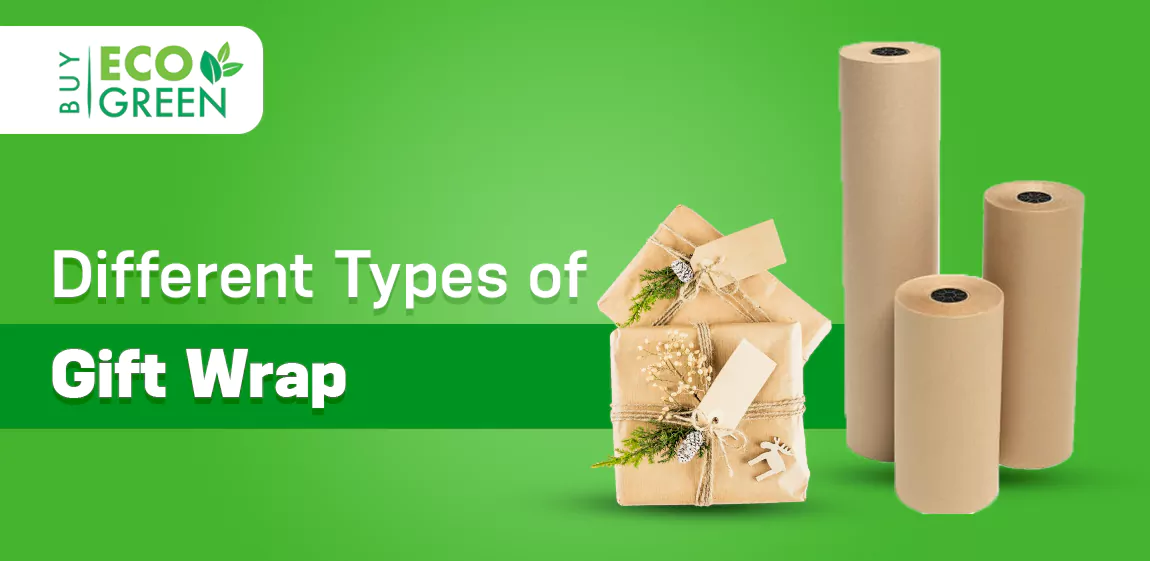
Kraft paper is the standout choice for organisations that need a practical, high-volume, genuinely eco-friendly wrapping solution. It is made from wood pulp using a process that retains more of the wood fibre’s natural lignin, resulting in a strong, durable paper with a characteristic natural brown appearance.
Plain, uncoated kraft paper is fully recyclable through standard kerbside recycling and biodegrades naturally when it reaches the end of its useful life. It contains no plastic laminate, no metallic coating, and no glitter, which means it doesn’t contaminate recycling streams the way many decorative wrapping papers do.
In an institutional context, Kraft paper works across a broad range of applications:
Kraft paper rolls are the most practical format for organisations buying in volume. A single roll covers a large number of items, stores compactly, and gives wrapping staff flexibility in how much they use for each gift, regardless of shape or size.
The natural appearance of kraft paper also responds well to simple, natural decoration. Cotton twine, recycled ribbon, dried botanicals, or a simple handwritten gift tag give kraft-wrapped parcels a considered, premium presentation without adding non-recyclable elements to the package.
Buyecogreen stocks kraft paper rolls made from recycled stock, making this one of the most environmentally responsible wrapping choices available to organisations of any scale.
Tissue paper is a lightweight, fine-grade paper used primarily as a lining inside gift bags, boxes, and hamper baskets rather than as a standalone outer wrap. It adds volume, protects the contents, and gives the recipient something to move through before reaching the gift itself, which improves the overall presentation experience.
In the context of sustainable procurement, tissue paper quality varies significantly. Standard tissue paper is made from short wood fibres and is often too fine and fragile to be recycled through kerbside paper recycling, as the fibres break down too easily in the recycling process. However, recycled tissue paper made from post-consumer waste is widely available and represents a meaningful improvement from a procurement standpoint, even if it shares the same limitations in the recycling stream.
For compostability, plain unbleached tissue paper without dyes or coatings will break down in a composting environment. Coloured tissue paper may contain dyes that affect compostability, depending on the specific product and certification.
Organisations use tissue paper most frequently for:
For schools and childcare centres, tissue paper also has a role in arts and craft activities, paper maché projects, collage work, and sensory play materials, making it a dual-purpose procurement item that supports both packaging and educational program needs.
Buyecogreen supplies recycled tissue paper suited to institutional and business use, available in quantities appropriate for both regular operational needs and seasonal event preparation.
Recycled wrapping paper looks and functions like conventional decorative wrapping paper but is manufactured using post-consumer recycled paper stock rather than virgin materials. It is typically printed with water- or soy-based inks rather than solvent-based inks, which reduces the chemical load associated with production.
The key distinction to understand here is that recycled wrapping paper is not the same as recyclable wrapping paper, though ideally, a product should be both. Paper made from recycled content reduces the demand for newly harvested timber and diverts post-consumer waste from landfill during production. Whether it can be recycled depends on whether it contains coatings, laminates, or finishes that contaminate the recycling stream.
When evaluating recycled wrapping paper for organisational use, look for:
Recycled wrapping paper in roll format is the most practical for bulk institutional use. Sheet formats can be more wasteful for larger items, as staff often need to cut and combine sheets to adequately cover a gift.
This wrapping type suits organisations that want the familiar look and ease of use of conventional roll-format wrapping paper, but with a meaningfully lower environmental footprint. For schools managing large gift-wrapping programs during end-of-year events, or businesses wrapping gifts for staff at scale, recycled roll wrapping paper offers a practical middle ground between standard decorative paper and kraft.
Not every gift can or should be wrapped in paper. Items of an irregular shape, fragile contents, or presentations that need to hold their form during transport are better served by a gift box than by wrapping paper.
Recycled gift boxes are manufactured from post-consumer recycled cardboard, using board stock recovered from households, offices, and industrial sources. They provide structural protection for the contents, stack efficiently for storage and transport, and present well with minimal additional wrapping, often requiring only a ribbon, a gift tag, or a layer of tissue paper inside to complete the presentation.
For Australian organisations with sustainability reporting obligations, recycled cardboard boxes are among the most traceable and verifiable eco-friendly packaging options available. The recycled content of the board is typically quantifiable, recyclability after use is well understood and supported by kerbside collection systems, and the manufacturing footprint is measurable.
Common institutional uses for recycled gift boxes include:
Buyecogreen’s recycled gift boxes are made from 100 per cent recycled cardboard using post-consumer waste paper, supporting a circular material flow that conserves trees, water, and energy compared to virgin board production.

© 2025 Crivva - Hosted by Airy Hosting Managed Website Hosting.