AI pilots perform perfectly in controlled demonstrations. They execute tasks and follow protocols as designed. Once deployed into real workflows, however, these same systems often start to fray. Decisions become inconsistent, and policies are misapplied. The issue is rarely the model’s capability. Instead, it stems from the unmanaged information ecosystem surrounding it.
This gap is what context engineering for LLMs addresses and why enterprises invest in scalable MCP server development to build reliable AI infrastructure. It is the essential discipline for moving from impressive prototypes to robust, production-grade AI infrastructure. It builds the reliable memory and attention systems that enterprise operations require. Without this layer, even the most powerful AI will quietly break under real-world pressure, preventing teams from delivering reliable AI agents at scale.
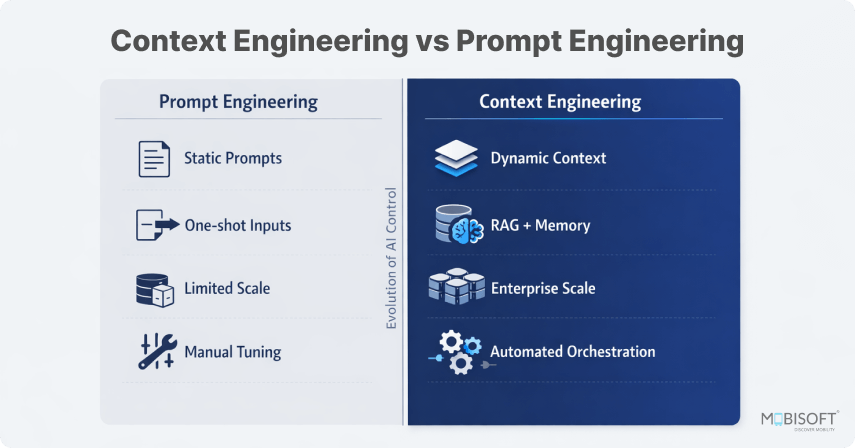
A perfectly crafted prompt can feel like a master key in a demonstration. In a live enterprise environment, that same prompt often stops working. The issue is one of scope. Prompt engineering optimizes a single interaction, but production AI must survive relentless system pressure. This local optimization breaks under the weight of real workflows, which is why context engineering vs prompt engineering becomes a real concern in enterprise systems.
A prompt is static, but business processes are dynamic and expansive. As workflows grow in complexity, the initial instructions are diluted. They must compete with user requests, historical data, and new outputs. The clarity of the original design dissipates, leading to unpredictable behavior and reduced AI agent reliability.
Prompts exist within one continuous stream of text. Enterprise systems, however, are multifaceted. They require separate threads for policy, memory, and operations within a scalable AI agent architecture. Forcing everything into a single string creates a fundamental mismatch. It conflates memory, instruction, and output until the model cannot distinguish its core task.
Key directives get lost in the expanding context. Critical details from earlier in a conversation become inaccessible without proper LLM memory management and dynamic context management. The model then experiences task interference, applying logic from one domain to another. This manifests as inconsistency, not mere hallucination. It is a structural failure.
Consequently, businesses face tangible risks. Inconsistency leads to compliance gaps and erodes trust. Policy drift introduces operational chaos. Relying solely on prompt engineering is building on unstable ground. It cannot support the weight of a full-scale system.
We often discuss context as if it were a vessel, a simple container holding the conversation’s history. This view is incomplete. In practice, context functions as the model’s entire working memory, a dynamic and contested information environment shaped by LLM context engineering. Every new piece of data enters a crowded field where details compete for a finite attention budget.
Modern models face a constant tension. As context grows, the signal of what truly matters can be drowned out by noise inside the model context window optimization process. The model’s ability to focus on critical instructions or recent facts diminishes because all information, urgent or trivial, exists with equal potential. However, existing within the context window is not the same as being accessible. Key details become lost in plain sight, buried beneath layers of dialogue or tangential data.
This unmanaged environment quietly sabotages reasoning. The model may have all the necessary data present, yet fails to retrieve the correct piece at the right moment without proper LLM context optimization. It expends its cognitive bandwidth parsing the entire information instead of acting on curated, relevant knowledge. Therefore, consistent reasoning quality depends not on how much information we provide, but on how effectively we govern that information ecosystem. Without this governance, the context becomes a liability.
In essence, these layers form the new backbone of production AI through enterprise context engineering. They replace fragile, monolithic prompts with a resilient system.
Adopting a context engineering mindset fundamentally alters how we design AI agents. The focus moves from crafting input strings to building integrated information systems through context engineering for AI agents. An agent becomes less a conversational interface and more a coordinator of memory, tools, and state. This change in perspective is what separates a simple chatbot from an autonomous operational unit.
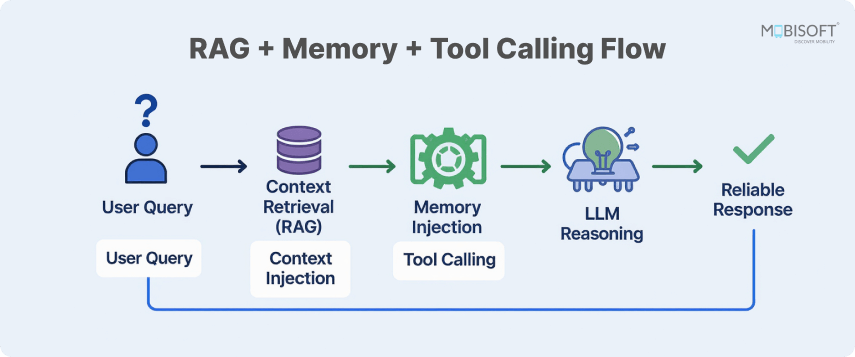
The core upgrade is integrating persistent, searchable memory with proper LLM memory management. This allows the agent to learn from past interactions and apply those lessons to new situations. It transitions the system from having a goldfish-like attention span to developing a form of institutional knowledge. The agent’s actions become informed by history, not just the last few lines of dialogue.
Decision-making is moving from pure generation to retrieval-augmented reasoning using retrieval augmented generation (RAG). The agent actively queries its knowledge bases and memory before formulating a response using structured architectures built with MCP server development. This process grounds its outputs in verified sources and relevant precedents, effectively reducing speculative answers. The loop of retrieval, analysis, and then generation becomes its operational heartbeat.
With a managed context, the agent can reliably orchestrate complex tool sequences across AI agent workflows. It maintains the required state and parameters across multiple steps, such as querying a database, formatting results, and triggering an API. Context engineering provides the thread that ties these discrete actions into a coherent, executable procedure without dropping critical data along the way.
In this architecture, the prompt recedes into the background. It becomes a trigger or a configuration step, not the sole vessel of intelligence. The true substance of the system lies in its memory, retrieval processes, and stateful workflow management. This is why modern, reliable agents are better understood as context systems. Their output is a direct product of their engineered information environment.
Each failure mode escalates technical debt into a tangible business impact. They generate wrong decisions, regulatory exposure, and process failure. Mitigation requires the architectural layers, like isolation, selective retrieval, and clean memory management. Without these, context itself becomes the primary threat to system reliability.
Read more: Context Engineering for LLMs & Enterprise AI Agents

© 2025 Crivva - Hosted by Airy Hosting Managed Website Hosting.