


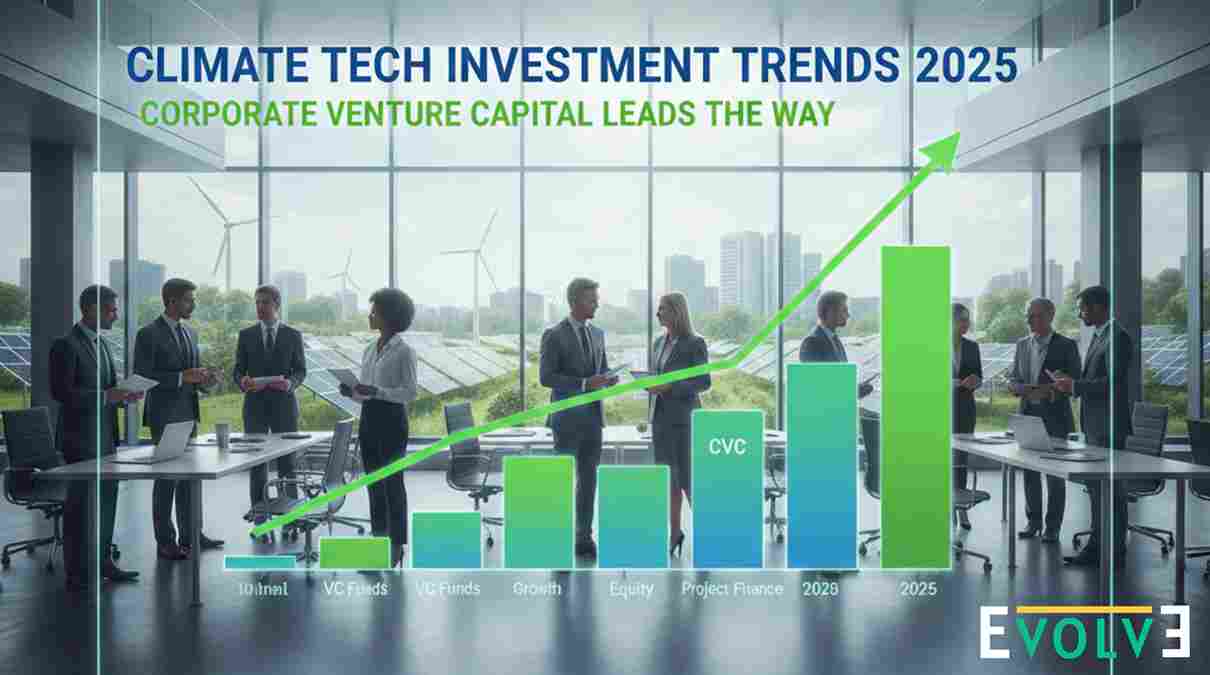
The uncertainty about the policy on the federal level notwithstanding, the pace of climate technology investments is increasing rapidly because corporations and venture capital firms have identified the ethical necessity and the massive business potential in responding to climate challenges. Recent statistics indicate that the investments in clean energy are now greatly exceeding those in fossil fuel across the world, and close to twice the amount of capital is being invested in clean energy compared to fossil fuels in 2025. This trend is perceived to be a great pointer in the future of the energy and industry as a venture capital firm focused on uncovering transformational opportunities, Evolve Venture Capital views this trend as a great opportunity.
The Corporate Climate Pledge.
Although a few firms have reduced their environmental objectives because of regulatory uncertainty, most multinational businesses are continuing to sustain or even increase their environment-related pledges. This is due to a number of factors that have contributed to this persistence:
Customer Demand: Customers are becoming more demanding as they require companies to be environmentally responsible.
Investor Pressure: ESG considerations still have an effect on investments.
Competitive Advantage: Competitive technologies can provide cost-saving and operational advantages.
Regulatory Diversity: International regulations and state regulations generate sustained compliance needs.
Such large stores as Walmart are also setting an example on this direction, as well over fifty percent of their energy resources are obtained through renewable sources today. Their Project Gigaton plan to reduce 1 gigaton of greenhouse gas emissions in their supply chains by 2030 was achieved six years early, in partnership with such suppliers as Nestle, Unilever, Coca Cola, Samsung, and Hanes.
The Investment Numbers
The climate tech market has shown impressive financial performance with an overall returns of close to 200 percent since 2014 to 2024. This performance has resulted in large amounts of venture capital, and climate tech investment is projected to grow until 2025.
Of particular interest is the strategic business participation in this area. The 1,600 plus venture deals made by corporations in climate tech in the first half of 2025 were almost a fifth of the total deals in this field.
Artificial Intelligence and Climate Technology: A Potent Synergy.
The breakthrough of artificial intelligence is one of the most promising changes in the climate tech space. With the rate of AI adoption increasing in the world, its high energy demands are opening novel clean energy innovations.
Solutions that companies are coming up with meet the energy needs of AI by use of clean technology which forms a virtuous circle in which technological advancement helps sustain the environment and not to diminish it.
Climate Innovation Regional Leadership.
Although the federal policy in the U.S. has changed, climate innovation in the state level is still being led by the state initiatives. The new climate laws in California are the extension of the state cap-and-trade program (now referred to as a cap and invest) and the introduction of binding targets to achieve the net-zero greenhouse gas emissions by 2045.
The U.S. Climate Alliance is a bipartisan coalition of 24 governors of more than half of the U.S. population, which still progresses with climate policies in line with the Paris Agreement. Other states are also contemplating the use of polluters pay legislation which would force companies to finance climate adaptation projects.
The International Standards Environment.
In addition to the U.S., global regulations are still influencing the corporate climate strategies. Emission reduction by at least 50 percent by 2030 is the goal of the European Union that is being achieved by binding climate reporting regulations, carbon levies on imported merchandise and clean energy innovation support efforts.The existent dramatic cost cuts in renewable energy, energy storage and electrification technologies have developed attractive business cases not dependent on subsidies or price of carbon. To organizations building their investment strategies, we would suggest that they consider climate tech opportunities in this economic perspective without ignoring the possibility of a large upside to supportive policies in most areas.
In the United Kingdom, New Zealand, Singapore, and California and cities such as Hong Kong, companies also have to contend with emissions reporting. The International Court of Justice has made it clear that nations have legal responsibility to sustain the climate, which may pose an extra burden on the global corporations.
The View of Evolve Venture Capital.
At Evolve Venture Capital, we consider the current expansion of the climate tech investment as the indication of the underlying strength of the sector. The integration of both better technology economies, corporate pledges, and varying regulatory structures build a strong platform to carry on with innovations and implementation.
To founders who are constructing there, we suggest:
Concentrating on solutions that have obvious economic advantages that do not rely on the policy support.
Innovation of technologies to deal with corporate sustainability objectives.
Developing the field of climate tech convergence with other innovation fields such as AI and advanced materials.
Constructing with sensitivity to various regulatory settings to develop solutions that can be implemented anywhere in the world.
Continuous investment in climate technologies despite policy backlash is an indication of the shift of the sector to not just mission-oriented but a financially compelling one. Due to the fact that clean energy has been steadily beating fossil counterparts on both cost and performance, we will see this trend go at a higher rate irrespective of policy changes.
Financial Advisor’s Note
Having been financial advisors at Evolve Venture Capital, we consider the investments in climate technologies to be more motivated by basic economics and less by the support of the policy only. The existent dramatic cost cuts in renewable energy, energy storage and electrification technologies have developed attractive business cases not dependent on subsidies or price of carbon. To organizations building their investment strategies, we would suggest that they consider climate tech opportunities in this economic perspective without ignoring the possibility of a large upside to supportive policies in most areas. Investments that provide well-defined value propositions in the existing market scenarios and also future-proof by providing further benefits as the consideration of climate become more central to the global business will be the most resilient ones.
Contact Information:
Website: www.evolvevcap.com
Email: [email protected]
Phone: +65 8181 4097

© 2025 Crivva - Hosted by Airy Hosting Managed Website Hosting.