

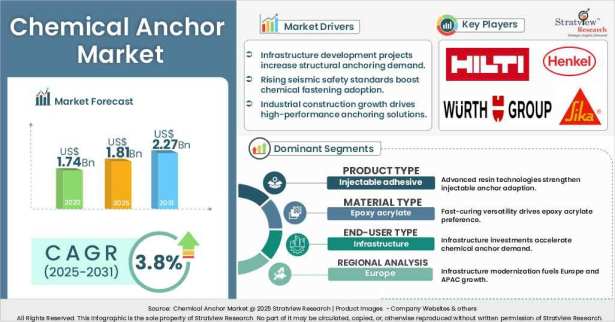
The Chemical Anchor Market was valued at USD 1.74 billion in 2024 and is projected to reach USD 2.27 billion by 2031. The market is expected to expand during the forecast period of 2025-2031, supported by a CAGR of 3.8%.
Chemical Anchor Market Share is influenced by product performance, material chemistry, regional demand, and application depth. Companies competing in this space focus on reliability, curing efficiency, and compatibility with key substrates. As infrastructure and commercial construction activity expands, market share will depend on technical credibility and consistent performance across demanding installation conditions
Chemical anchors are adhesive anchoring systems used to secure structural and non-structural elements to substrates such as concrete, masonry, and natural stone. Their bonding mechanism supports high load-bearing capacity, stress distribution, and resistance to vibration and seismic forces.
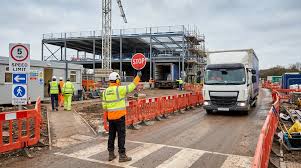
A key demand driver is the rising need for durable anchoring solutions in infrastructure and construction projects. As infrastructure applications involve bridges, tunnels, rail networks, airports, and other critical assets, chemical anchors support secure installation in demanding structural conditions.
Request a free sample report: https://www.stratviewresearch.com/Request-Sample/1979/chemical-anchor-market.html#form
Market Segmentation Analysis
By Product Type
By Material Type
By Substrate Type
By End-User Industry Type
By Region
Injectable Adhesive is likely to remain the largest product type in the years to come. Its position is linked to versatility, ease of application, and suitability for varied construction scenarios. This supports demand across new construction and retrofitting, making product flexibility a strategic requirement for suppliers.
Epoxy Acrylate is expected to be the dominant material of the market during the forecast period. Its balance of performance, cost-effectiveness, adhesion, fast curing, and chemical resistance supports use across structural and non-structural anchoring. The strategic implication is a continued focus on resin performance and application efficiency.
Concrete is estimated to remain the largest substrate for chemical anchors during the forecast period. Since concrete is widely used in foundations, beams, columns, floors, bridges, and infrastructure assets, demand for anchoring systems compatible with concrete remains structurally supported. This reinforces concrete-focused product positioning.
Infrastructure is expected to be the dominant end-user of the market during the forecast period. Large-scale investments in roads, bridges, tunnels, airports, and rail networks increase the need for reliable anchoring systems. For market participants, infrastructure demand remains central to growth analysis and customer prioritization.
Regional Market Insights
Europe is expected to remain the largest market throughout the forecast period. The region’s demand is supported by established infrastructure, regulatory standards, sustainable construction practices, and retrofitting of aging structures. This creates steady demand for high-performance anchoring solutions across critical applications.
Asia-Pacific is likely to grow at the fastest rate. Rapid urbanization, industrialization, and infrastructure development support demand across residential, commercial, and transportation projects. This makes Asia-Pacific an important region in the market forecast for future demand expansion.
Emerging Trends Shaping the Chemical Anchor Market
The Chemical Anchor Market is being shaped by demand for anchoring systems that support high load-bearing performance, stress distribution, and resistance to vibration and seismic activity. These requirements are closely linked to infrastructure and construction applications where safety and reliability are essential.
Another important industry direction is the continued relevance of adhesive formulations that improve curing times and load-bearing capacities. As chemical anchors are used in varied substrates and installation environments, performance consistency remains central to market trends and industry insights.
Key Growth Drivers of the Market
Competitive Landscape
Top Companies in the Market
Conclusion and Strategic Outlook
The Chemical Anchor Market is positioned for steady expansion, growing from USD 1.74 billion in 2024 to USD 2.27 billion by 2031. The forecast period of 2025-2031 reflects a CAGR of 3.8%, with demand linked to infrastructure, construction, and high-performance anchoring requirements.
Injectable Adhesive, Epoxy Acrylate, Concrete, and Infrastructure are key demand areas identified in the market segmentation. Europe remains the largest regional market, while Asia-Pacific is expected to grow at the fastest rate. The industry outlook points to continued demand for reliable, durable, and application-efficient anchoring solutions.
FAQs – Chemical Anchor Market
What is the Chemical Anchor Market size and forecast?
The Chemical Anchor Market size was USD 1.74 billion in 2024. It is expected to reach USD 2.27 billion by 2031, growing at a CAGR of 3.8% during 2025-2031.
What is driving growth in the Chemical Anchor Market?
Growth is supported by demand for durable and high-performance anchoring systems in construction and infrastructure projects. Infrastructure applications such as bridges, tunnels, railways, and airports require reliable fastening solutions.
Which region leads the Chemical Anchor Market?
Europe is expected to remain the largest market throughout the forecast period. Its position is supported by established infrastructure, regulatory standards, sustainable construction practices, and retrofitting activity.
What is the investment outlook for the Chemical Anchor Market?
The market outlook is steady, with annual demand projected to reach USD 2.27 billion in 2031. The cumulative sales opportunity during 2025-2031 is expected to be USD 14.37 billion.

© 2025 Crivva - Hosted by Airy Hosting Managed Website Hosting.