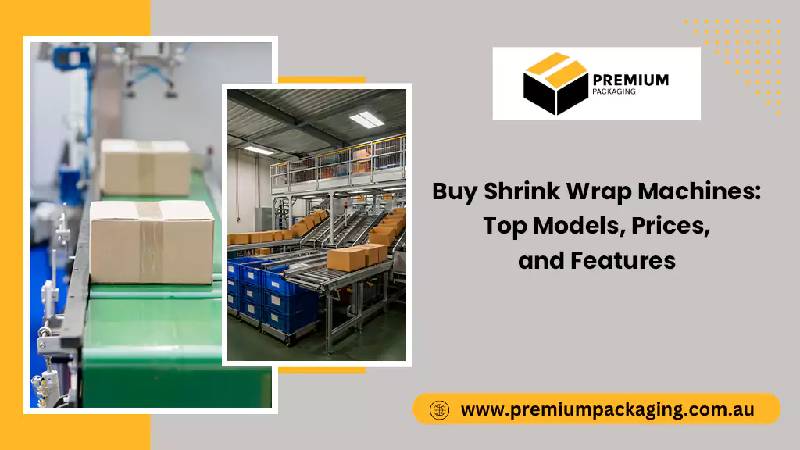
For Australian businesses, buying shrink wrap machines is rarely just about speed. The right system affects pack presentation, transport protection, labour efficiency, line consistency, and how easily your operation scales as volumes rise. Whether you run a food facility, warehouse, manufacturing site, or retail packing line, the best shrink wrap machines are the ones that match your daily throughput, film type, product shape, and floor space.
Shrink wrap packaging equipment is used across Australia to create sealed, tamper-evident, retail-ready, and transit-stable packs. From bundled cartons and multipacks through to tray packs and presentation packaging, the right machine can lift output while reducing waste, rework, and inconsistency. Australian suppliers in this category commonly position shrink systems around production efficiency, reliable sealing, and support for food, beverage, logistics, and industrial applications.
At Premium Packaging, businesses can already source shrink film solutions, including PVC shrink film and POF shrink film, which makes film compatibility a critical part of any machine-buying decision. If your team is evaluating whether to buy shrink wrap machine systems for a new line or an upgrade, the decision should be based on application fit, not just headline shrink wrap machine prices.
Shrink wrapping has a practical place in commercial operations because it delivers more than a neat finish. It can improve load stability for grouped products, create tamper-evident packs, support shelf presentation, and help protect items from dust and handling during storage and transport. In food and beverage operations, it is often used for multipacks, trays, and retail-ready wrapping. In industrial settings, it supports bundling, protection, and dispatch efficiency.
For Australian businesses, machine selection also needs to account for local realities:
That is why a shrink wrap machine cost comparison only tells part of the story. The real cost sits in throughput, downtime, changeovers, film waste, operator training, and maintenance demands.
A shrink wrap machine is packaging equipment that encloses a product in shrink film and then applies heat to cause the film to contract tightly around it. In practice, it provides businesses with a secure, professional pack that enhances presentation, helps deter tampering, and protects goods during handling, storage, and dispatch. For Australian operations, shrink wrap machines are commonly chosen for multipacks, trays, cartons, retail packs, and a range of industrial bundling tasks.
That basic definition matters because many buyers confuse shrink wrap with stretch wrap. Stretch film is pulled tight around a load without heat, while shrink film requires controlled heat to conform around the product. If you are planning to buy shrink wrap machine systems, this difference affects equipment type, film selection, energy use, and pack finish from day one.
The core components of a shrink wrap machine usually include a sealing unit, a heating stage, and a product transfer system. The sealer closes the film around the product, the heat source shrinks the film for a tight finish, and conveyors or product guides move packs through the process. Depending on the model, you may also see film cradles, perforation features, digital temperature controls, adjustable conveyors, and safety guarding.
For buyers comparing shrink wrap packaging solutions, these components matter because they shape speed, consistency, and operator involvement. A simple manual setup may use a sealer and a heat gun, while larger shrink-wrap packaging equipment often combines L-bar sealing, shrink tunnels, and powered conveyors. As production volumes rise, the quality of these components becomes a major factor in output and pack uniformity.
The differences between machines come down to output, automation level, product type, and line integration. Manual and entry-level units suit lower volumes and simpler pack formats, semi-automatic systems improve speed and consistency for growing operations, and automatic shrink wrap machines are built for high-throughput environments where labour efficiency and repeatable pack quality matter most. The right choice depends on how many products you wrap each day, how often sizes change, and how much downtime your operation can tolerate.
This is where many machine buyers go wrong. They focus on sticker price rather than workflow fit. A lower-cost unit may look attractive, but if it slows dispatch, requires extra labour, or wastes film, it can become the more expensive option over time. For Australian businesses, the best shrink wrap machines are those that align with production targets, provide servicing support, and offer a compatible shrink film supply.
These are often used by smaller operations, seasonal packers, start-up manufacturers, and businesses testing a shrink-wrapping process before moving to higher output. Typical setups include an I-bar sealer or compact L-bar sealer paired with a heat gun or a basic shrinking stage. Competitor pricing in the market shows entry systems sitting at the lower end of the category, but they are generally best for hundreds, not thousands, of packs per day.
Best suited to:
These are a common step up when a business needs cleaner seals, better presentation, and more consistent output. Chamber machines seal and shrink in a single enclosed cycle, while L-bar systems typically pair with a tunnel for faster output. They are often chosen by businesses packing gift lines, printed cartons, food sleeves, promotional packs, and display-ready bundles.
Best suited to:
These systems pair a sealer with a dedicated tunnel and conveyor, making them better suited to steady daily production. If you are comparing top shrink wrap machines for packaging, this category often represents the practical midpoint between affordability and performance. Competitors in this segment are positioned to handle thousands of packs per day, which is why they appeal to growing manufacturers and distribution operations.
Best suited to:
Automatic systems are designed for higher-speed production where products feed into the machine and pass through sealing and shrinking with minimal operator intervention. In the broader market, these are used where output targets are high, pack dimensions are relatively consistent, and line automation is part of a wider efficiency strategy. Australian manufacturers often pair them with conveyors, collators, and other packaging equipment.
Best suited to:
When buyers search for shrink wrap machine prices, they usually want a clean figure. In reality, machine cost varies by automation level, sealing format, tunnel size, conveyor length, film compatibility, safety features, output speed, and whether installation or after-sales support is included. Public competitor pricing shows a broad gap between entry-level units and automatic production machines, with basic systems in the hundreds of dollars and advanced automated systems reaching well into the tens of thousands in overseas listings. Those figures are useful as directional benchmarks, but Australian landed cost, support, freight, and compliance can materially change the final number.
In practical terms, your shrink wrap machine cost comparison should include:
For many Australian businesses, the cheapest system is not the best commercial decision. A machine that runs reliably with the right shrink film, produces clean seals, and keeps your line moving will usually deliver a better long-term return.
If you are planning to buy a shrink wrap machine for an Australian operation, start with the application rather than the machine name. The right questions are operational:
Are you wrapping retail cartons, trays, bottles, printed boxes, food packs, industrial kits, or grouped eCommerce units? Product shape and fragility will affect sealing style and tunnel settings.
Film choice matters. Premium Packaging supplies PVC and POF shrink film, each with different handling and performance characteristics. Compatibility between your machine and shrink film should be checked before purchase, especially if appearance, clarity, food presentation, or production speed matter.
A machine suitable for a few hundred packs per day will not suit a line that needs several thousand. Underbuying often creates bottlenecks within months.
If your SKUs vary regularly, changeover time becomes a serious commercial issue. Easy adjustment features can save substantial labour over the year.
Servicing, spare parts, commissioning, and technical guidance should all be considered before purchase. Local support is often just as important as machine specification. Australian competitors strongly emphasise service and after-sales capability for this reason.
Learn more: https://premiumpackaging.com.au/blog/buy-shrink-wrap-machines/

© 2025 Crivva - Hosted by Airy Hosting Managed Website Hosting.