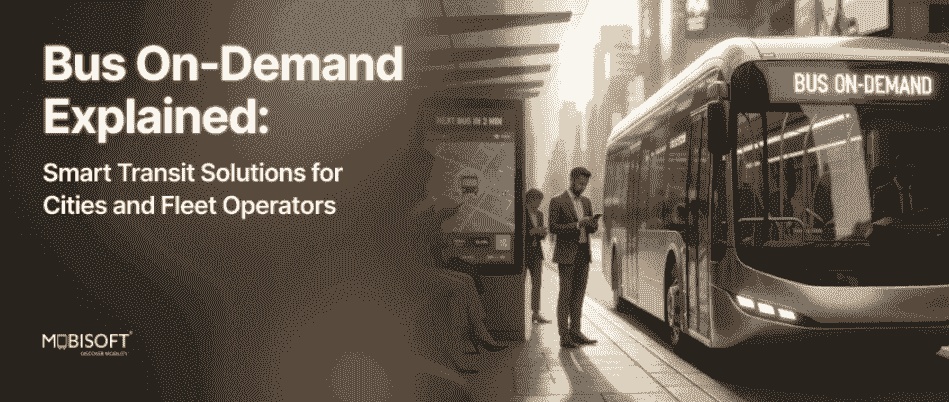
With a rising population, urbanization, and an increasing number of vehicles on the road, transport systems are facing several challenges. The population is growing, and city infrastructure is becoming increasingly complex. Bus transport alone cannot fulfill the personalised needs of commuters today. Dynamic solutions such as Bus on-demand services offer customised services using technology. Tech-aligned services are efficient, making travel easier.
On-demand buses enable transportation through on-demand bus apps, adapting routes in real-time based on demand. A 2025 survey report indicates that the global bus market, encompassing both public and on-demand buses, is expected to grow significantly from USD 51.27 billion in 2024 to USD 116.99 billion by 2035. This growth is due to rising urbanization, increased population, and the shift to sustainable transport systems.
The worldwide experience with using bus on-demand systems is a valuable step toward sustainable urban transport solutions. Cities facing burgeoning populations and acute environmental conditions find this new-age strategy a chance to improve public commute services.
Building on this momentum, on-demand bus systems are increasingly being viewed as a bridge between traditional fixed-route public transport and fully private mobility options. Unlike conventional buses that operate on rigid schedules and predefined routes, on-demand buses leverage advanced algorithms, real-time data, and mobile applications to dynamically adjust routes, stops, and frequencies based on actual passenger demand. This flexibility significantly reduces empty miles, optimizes fuel consumption, and enhances overall operational efficiency for transit authorities and private operators alike.
From a commuter’s perspective, on-demand bus services offer a more personalized and convenient travel experience. Passengers can book rides through mobile apps, receive real-time vehicle tracking updates, and enjoy shorter walking distances to pick-up and drop-off points. This level of responsiveness improves reliability and reduces waiting times, making public transportation more attractive to users who might otherwise rely on private vehicles or ride-hailing services. As a result, cities can reduce traffic congestion while increasing public transport ridership.
Technology plays a central role in the success of on-demand bus ecosystems. Artificial intelligence, machine learning, and predictive analytics are used to forecast demand patterns, optimize fleet allocation, and balance supply with fluctuating commuter needs throughout the day. Integration with GPS, IoT devices, and cloud-based fleet management platforms enables operators to monitor vehicle performance, driver behavior, and service quality in real time. These insights help transit agencies make data-driven decisions that improve safety, punctuality, and cost control.
On-demand buses also align closely with sustainability and environmental goals. By consolidating multiple individual trips into shared bus rides, cities can significantly cut down on carbon emissions and fuel usage. When combined with electric or hybrid bus fleets, the environmental impact is further reduced, supporting broader climate action plans and low-emission urban mobility initiatives. Many municipalities now see on-demand buses as a critical component of their smart city and green mobility strategies.
In addition, on-demand bus systems support social inclusion and equitable access to transportation. They can be deployed in underserved or low-density areas where fixed-route buses are not economically viable. This ensures reliable mobility for elderly populations, students, and working professionals living on city outskirts or in suburban zones. By filling these transit gaps, on-demand buses help create a more inclusive urban transport network.
The operational benefits for transit agencies are equally compelling. Dynamic routing and demand-responsive scheduling lower operational costs by minimizing unnecessary trips and improving fleet utilization. Fare collection and ticketing are often digitized, reducing cash handling and administrative overhead. Furthermore, integration with multimodal transport networks allows on-demand buses to complement metro, rail, and fixed-route bus services, creating a seamless end-to-end travel experience for passengers.
Globally, pilot programs and large-scale deployments of on-demand bus services have demonstrated promising results. Cities across North America, Europe, and Asia-Pacific are experimenting with demand-responsive transit models to address peak-hour congestion, first-mile and last-mile connectivity challenges, and evolving commuter expectations. These initiatives highlight how adaptable transport systems can respond more effectively to rapid urban growth and changing mobility behaviors.
In conclusion, on-demand bus transportation represents a transformative shift in urban mobility. By combining flexibility, technology, and sustainability, it addresses many of the limitations of traditional public transport while meeting modern commuter expectations. As cities continue to grow and prioritize sustainable development, on-demand buses are poised to play a vital role in building resilient, efficient, and environmentally responsible urban transportation networks.
Bus-on-demand services combine technology and operational planning to provide efficient urban transportation. The smooth working of these services involves:
Learn how our bus fleet tracking solutions help operators monitor performance, ensure route accuracy, and enhance real-time visibility for passengers.

© 2025 Crivva - Hosted by Airy Hosting Managed Website Hosting.