

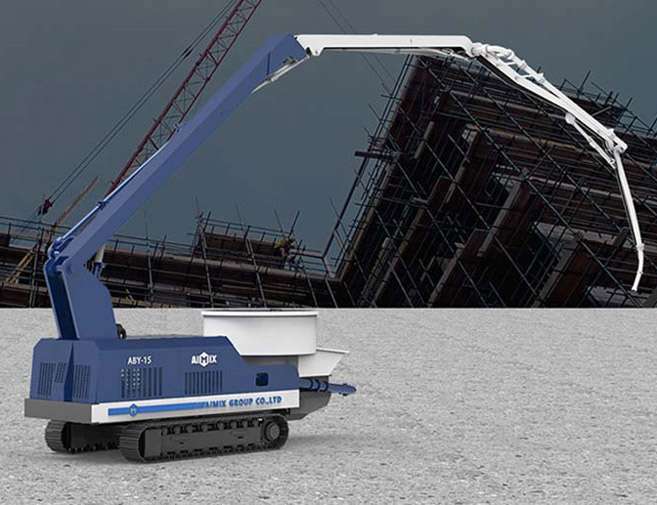
Residential foundation work has long occupied an awkward space in the construction equipment landscape—too constrained for the full-sized concrete pumps that dominate commercial projects, yet too demanding for the wheelbarrows and crane-and-bucket methods that have persisted for generations. The result has been a sector characterized by inefficiency, physical strain on labor forces, and a quality ceiling imposed by the limitations of manual placement. The emergence of boom-equipped mini concrete pumps is quietly dismantling these constraints, introducing a level of precision and productivity to residential foundations that was previously reserved for high-rise and infrastructure applications. These compact machines, typically mounting articulating booms on chassis narrow enough to navigate residential streets and tight lots, represent a convergence of hydraulic engineering and spatial intelligence that addresses the specific challenges of housing construction. Where traditional methods introduced variability—uneven pours, cold joints from delayed placement, aggregate segregation from excessive handling—the boom pump delivers concrete with surgical accuracy, reaching over obstacles, around corners, and into the deepest corners of complex formwork. This precision revolution is reshaping not only how foundations are poured but how residential projects are scheduled, staffed, and ultimately, how they perform over decades of service.
The defining challenge of residential foundation work is not the volume of concrete but the geometry of the site. A typical housing development presents a maze of constraints: narrow lot lines, existing structures, overhead power lines, landscaping that must be preserved, and access roads not designed for heavy equipment. Conventional concrete delivery relies upon ready-mix trucks backing to the edge of the pour, often requiring the chute to be extended to its maximum reach, a position that compromises operator visibility and control. When the pour extends beyond chute range, contractors resort to wheelbarrows or buggies—methods that introduce delays between mixing and placement, risk segregation, and demand a small army of laborers moving rapidly across unstable ground. Boom-equipped mini pumps address these spatial challenges by decoupling the concrete source from the placement point. The truck remains on accessible roadway or designated access points, while the boom—typically ranging from 20 to 40 meters of reach—articulates over fences, across excavated trenches, and into the furthest corners of the foundation footprint. This reach capability transforms site logistics. Contractors no longer require multiple access points around the foundation perimeter; a single setup position serves the entire pour. The elimination of wheelbarrow traffic across the site reduces soil compaction around the excavation and minimizes the risk of trench collapse from heavy foot traffic. For infill projects in established neighborhoods, where site access is particularly constrained, the boom pump’s ability to reach over existing structures becomes a decisive advantage, enabling foundation pours that would otherwise require disruptive demolition or extended manual handling.
Beyond spatial access, the precision enabled by boom articulation yields significant material efficiency gains that accumulate meaningfully over a contractor’s portfolio. Traditional chute placement operates with inherent imprecision; the operator’s ability to direct flow is limited by the chute’s fixed geometry, and stop-start control is crude at best. The result is over-pour into excavation areas beyond the formwork, spillage that must be excavated and removed, and a constant tension between placing concrete quickly and placing it accurately. A boom-equipped mini pump offers proportional control at the discharge point, with the operator directing flow through a remote control that can be positioned at the point of placement. This proximity enables the operator to fill forms systematically, directing concrete precisely to where it is needed without the overshoot that characterizes chute placement. The implications for material efficiency are substantial. Over-pour and spillage that might account for 2 to 5 percent of ordered volume in traditional placement can be reduced to fractions of a percent. For a contractor pouring multiple foundations annually, the cumulative material savings alone can offset a significant portion of the equipment investment. Moreover, the precision enables more aggressive formwork designs. Contractors can specify formwork with tighter tolerances, confident that the placement method will fill complex geometries without exerting the lateral forces that manual placement methods risk. This confidence translates to foundations that require less remedial work, fewer adjustments during framing, and a final product that meets specifications with a consistency that manual methods cannot guarantee.
The integration of boom pumps into residential foundation work has effects that ripple through project schedules in ways that extend far beyond the pour itself. A foundation that would require a full day using chute-and-wheelbarrow methods can be completed in two to three hours with a properly positioned boom pump. This compression of placement time generates downstream efficiencies that fundamentally alter project sequencing. With the pour completed earlier in the day, finishing crews can begin their work during daylight hours, when conditions for proper curing are most favorable. The earlier completion also allows for earlier removal of formwork, which in turn advances the framing schedule. For contractors managing multiple projects simultaneously, the ability to complete a foundation pour before midday enables the same crew to mobilize to a second site in the afternoon, effectively doubling the throughput of labor and equipment resources. This acceleration is particularly valuable in markets where weather windows are limited; a crew that can complete a pour between morning rain showers is a crew that keeps projects on schedule where competitors are forced into delay. The pump’s capacity to place concrete at rates of 30 to 60 cubic meters per hour—far exceeding manual methods—also changes the calculus of ordering concrete itself. Contractors can order full truckloads without concern that placement speed will lag behind delivery, eliminating the material waste and truck demurrage charges that arise when trucks wait in queue behind a slow placement operation.
Perhaps the most significant long-term impact of boom-equipped mini pumps lies in their effect on the residential construction workforce. The traditional method of placing concrete foundations is physically punishing: laborers moving wheelbarrows across uneven terrain, climbing in and out of excavations, and working under time pressure to place material before it loses workability. This physical toll contributes to high turnover rates, chronic labor shortages, and a workforce aging out of the industry without sufficient younger workers entering to replace them. The boom pump transforms the physical demands of foundation work from brute force to skilled operation. A single operator manages the remote control, directing the boom with precision while communicating with a small crew managing formwork and finishing. The number of laborers required for a typical foundation pour can be reduced by 50 to 70 percent, with those remaining focused on quality control rather than material movement. This reduction in labor dependency is not merely an efficiency gain; it is a resilience strategy in an industry facing persistent labor shortages. Contractors who adopt boom pump technology can maintain production schedules with smaller, more skilled crews, reducing their vulnerability to fluctuations in labor availability. Moreover, the technology changes the nature of the work, making foundation placement a role that attracts workers with technical aptitude rather than exclusively those capable of sustained physical exertion. As the residential construction industry confronts demographic shifts and evolving workforce expectations, the precision revolution represented by boom-equipped mini pumps offers a pathway to sustainable productivity that does not rely upon the diminishing supply of traditional manual labor.

© 2025 Crivva - Hosted by Airy Hosting Managed Website Hosting.